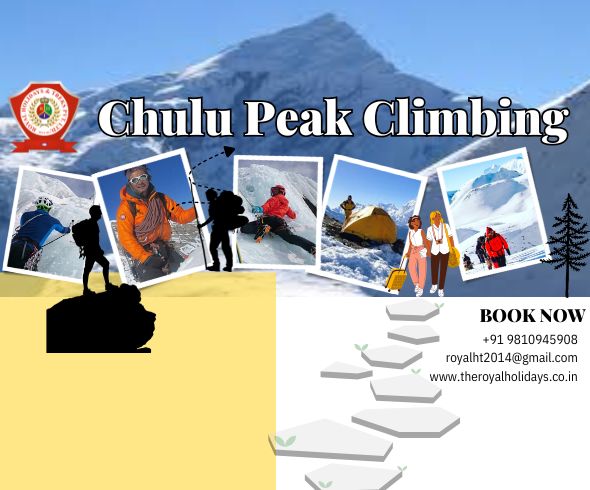
Chulu Peak Climbing

10 Days

Chulu Far East Peak Climbing is one of the most popular and delightful Himalayan expeditions in the Annapurna Region. The magnificent peak in thenorth-central part of the Himalayas, Chulu Far East Peak, is at an elevation of 6,059 meters (19,878 feet) and its expedition offers some of the most exhilarating adventures in the Himalayan region.

The iconic Himalayan expedition explores the trekking route across the diverse landscapes of the region traverses across the Annapurna Conservation Area, offers the most incredible and spectacular views of the Himalayan vistas, adds cultural and traditional prospects of the Himalayas settlements, and finally tests the mountaineering enthusiasts on 6,000-meter class mountain peak.

Chulu Far East Peak Climbing is an overall complete package that suits the palate of every kind of    mountaineering adventurer. As it is also one of the easiest climbing peaks in the Himalayan range, it is perfect for mountaineering beginners who want to test their skillset on the alpine setting before scaling
the highest peaks in the world. At the same time, it also offers a wonderful opportunity for seasoned and veteran mountaineers to widen their Himalayan prospects in the Annapurna region. If you are looking forward to this delightful and gratifying Himalayan adventure, Exciting Nepal Treks offers the best value 21-Day Chulu Far East Peak Climbing expedition.

Best Season for Chulu Far East Peak Climbing

Nepal is a popular destination for high-altitude trekking the mountain expeditions, this amazing Himalayan country offers such a diverse range of adventures that hardly anyone will feel left out. Although the Himalayan adventures can be done throughout the year, the ideal for these Himalayan expeditions is during the peak season like autumn (September- November) and spring (March-May).

Similarly, the Chulu Far East Peak Climbing expedition is also at its best during these peak seasons. Although both of these seasons have stable climatic conditions, dry trekking trails, and warm temperatures, autumn is considered the best season for Himalayan expeditions.

The temperature of the autumn season which is moderate makes it the perfect time for outdoor adventures, similarly, as the weather is pretty stable nothing beats views of the picturesque Himalayan vistas of this season. The lush trails and nourished rivers thanks to the monsoon rain and the festive season in the country that sees some of the grandest festivals like Dashain, Tihar, and Chhath have made autumn the most popular season for the adventure in the Himalayas.

You can expect the temperature of the Chulu region to hover around 14°C to 18 °C during the autumn season and higher regions may see light snowfall as the winter closes in. Similarly, the spring season in the Himalayas is known as the natural paradise, where the natural allurements of the region are at their
peak from lower forested areas to the high pasture lands.

Famous among nature lovers the trekking trails of the Himalayan region welcomes guests with colorful rhododendron and wildflowers. It is also the best time to witness the endangered Himalayan flora and fauna of the region and capture the perfect shots of the Himalayan vistas amidst the natural allurements.

The temperature of the Chulu region is around 15°C to 21 °C during the daytime and you can expect them to drop to 6°C or lower in the early mornings and nights. It is pretty much safe to assume that the temperature above 4,000 meters is generally minus degrees during the morning and nighttime as you get close to the alpine environment of the Himalayas.

Overview

Travel is the movement of people between relatively distant geographical locations, and can involve travel by foot, bicycle, automobile, train, boat, bus, airplane, or other means, with or without luggage, and can be one way or round trip. Travel can also include relatively short stays between successive movements.

The origin of the word “travel” is most likely lost to history. The term “travel” may originate from the Old French word travail, which means ‘work’. According to the Merriam Webster dictionary, the first known use of the word travel was in the 14th century.

It also states that the word comes from Middle English travailen, travelen (which means to torment, labor, strive, journey) and earlier from Old French travailler (which means to work strenuously, toil). In English we still occasionally use the words “travail”, which means struggle. According to Simon Winchester in his book The Best Travelers’ Tales (2004), the words “travel” and “travail” both share an even more ancient root: a Roman instrument of torture called the tripalium (in Latin it means “three stakes”, as in to impale).

 

Arrive at Tribhuwan International Airport, Kathmandu, you are welcomed by the team and then you will be transferred to your hotel. This trail goes through Ghorepani Poon Hill. Normally, the trek starts like Phokhara to Nayapul and ends like Phedi to Pokhara.

While early travel tended to be slower, more dangerous, and more dominated by trade and migration, cultural and technological advances over many years have tended to mean that travel has become easier and more accessible. The evolution of technology in such diverse fields as horse tack and bullet trains has contributed to this trend.

The Palace of Fifty five Windows: This magnificent palace was built during the reign of King Yakshya Malla in A.D. 1427 and was subsequently remodeled by King Bhupatindra Malla in the seventeenth century. Among the brick walls with their gracious setting and sculptural design, is a balcony with Fifty five Windows, considered to be a unique masterpiece of woodcarving.

Far far away, behind the word mountains, far from the countries Vokalia and Consonantia, there live the blind texts.

Separated they live in Bookmarksgrove right at the coast of the Semantics, a large language ocean. A small river named Duden flows by their place and supplies it with the necessary regelialia.

Even the all-powerful Pointing has no control about the blind texts it is an almost unorthographic life One day however a small line of blind text by the name of Lorem Ipsum decided to leave for the far World of Grammar.

The Big Oxmox advised her not to do so, because there were thousands of bad Commas, wild Question Marks and devious Semikoli, but the Little Blind Text didn’t listen.

When she reached the first hills of the Italic Mountains, she had a last view back on the skyline of her hometown Bookmarksgrove, the headline of Alphabet Village and the subline of her own road, the Line Lane. Pityful a rethoric question ran over her cheek.

The Trip Cost Includes

  • Pick-up or Drop-off service from and to Airport(in our own vehicle)
  • Transportation to and from!!
  • Food all along the trip(Breakfast, Lunch, Dinner and a cup of coffee or tea) and accommodations during the trip in hotels with family environment
  • Transportation, food, accommodation and insurance of Guide during the trip
  • Down jacket, all-season sleeping bag, duffel bag and trekking map(in case if you don’t have your own. Down jacket, sleeping bag and duffel bag must be returned after completion of the trip)
  • First Aid Medical Kit(Your guide will carry the Medical Kit but we also advise to bring yourself for your own use, as far as possible)
  • All the required permits and paperwork

The Trip Cost Excludes

  • International Airfare
  • Visa Charges
  • Hotel Expenses(In Kathmandu, some packages do include hotel expenses)
  • Your travel and medical insurance
  • Personal Expenses such as shopping, bar bills, hot shower, telephone, laundry, titbits etc
  • Food and accommodations in Kathmandu
  • Services not mentioned or not promised by the agent/agency
  • Emergency expenses such as expenses on chartered helicopter.
How fit do I need to be to do this trek?

Annapurna Base Camp is a Grade B or a moderately difficult trekking route. So any fit person can do this trek, even if you do not have any previous experience. You should be aware of what to expect and mentally prepare for it. Then, as long as you will to, you can.

How long do we walk every day when doing Annapurna Base Camp trekking?

On average, you walk about 4 to 6 hours per day. One or two days can be as less as 3hrs and one or two days can be as long as 7hrs.

What is the highest altitude reached in this trek?

The highest altitude reached is 4190m. This is the elevation of Annapurna Base Camp. ABC is the highest we will climb in this trek.

What about battery charging and hot shower facilities?

Yes, you can charge batteries en route. Charger should be brought. There are hot shower facilities as well. You may have to pay certain amount for both ($1-$2). Negotiate. Also, hot water facility could be free at lower elevation.

Are there ATMs on the way to Annapurna Base Camp?

No. There are no ATMs on this trek route. You will have to draw enough cash in Pokhara or Kathmandu. There are a number of ATMs in these cities. Everything is paid in Nepali rupees. So money should be exchanged before the start of the trek.

What about internet access?

Yes. Internet can be accessed in most places. Sometimes, there might be some technical problems. Internet in Nepal is not as fast as you are used to and at times you can just lose connection.

Is it necessary to hire Guides/trekking agency for Annapurna Base Camp trekking?

Not really. It depends on you. If you want, ABC trekking can be done independently. You could hire a guide and a porter by yourself instead of going through an agency or not hire a guide at all. Although, not having a guide can be a little problematic during off season.

It really depends on you. Is it your first time in Nepal? How confident are you of being able to find your way around? How pressed on time are you? If you go through an agency, it will be costlier but everything will be planned. You will only have to come, trek and return.

How much do guides and porters cost?

For Annapurna region, pay for guides range from $20 to $30 per day and porters take $15 to $25 per day.

You can send your enquiry via the form below.

Chulu Peak Climbing