


Varanasi—also known as Kashi or Banaras—is widely regarded as India’s spiritual capital and stands as one of the world’s oldest continuously inhabited cities. Nestled along the crescent-shaped banks of the sacred River Ganges, the city is a labyrinth of narrow galis (lanes), ancient temples, and vibrant markets that collectively embody the essence of Hindu mythology and Indian culture. It is famously referred to as the “City of Light,” a destination where devotees arrive in search of Moksha (liberation from the cycle of birth and death). The city’s lifeline consists of its 84 ghats (riverfront steps), where rituals ranging from the festive evening Ganga Aarti to the solemn, ceaselessly burning funeral pyres at Manikarnika Ghat are performed. Beyond its spiritual significance, Varanasi is also a hub of education and craftsmanship, home to the prestigious Banaras Hindu University and the world-renowned tradition of Banarasi silk weaving.
A journey to Varanasi is a sensory experience that seamlessly blends antiquity with everyday life; here, one encounters wandering sadhus (ascetics), majestic palaces lining the riverbanks, and a magnificent street-food scene featuring delectable local delicacies such as Malaiyo and Kachori-Sabzi. Whether you are watching the sunrise from a wooden boat gliding across the river, or exploring the nearby ruins of Sarnath—where the Buddha delivered his first sermon—this city offers a profound, and often life-altering, perspective on time, faith, and humanity.
Varanasi’s economy represents a unique blend of ancient traditions and modern industrial development, resting primarily upon its spiritual significance and skilled craftsmanship. Its most vital pillar is the tourism and hospitality sector, which has witnessed a massive surge following the completion of the Kashi Vishwanath Corridor; millions of pilgrims and international tourists visit the city annually, thereby providing employment to a vast network of hotels, restaurants, boatmen, and tour guides. Another major driver of the economy is the handloom and textile industry, particularly the weaving of world-renowned Banarasi silk.
Varanasi is generally considered a safe city for tourists—including solo travelers, families, and the elderly—provided that you exercise general “street-smart awareness and caution” while navigating the streets.
Most Famous And Attractive Tourist Places In Varanasi :
1. Banaras Hindu University – The Biggest Residential University
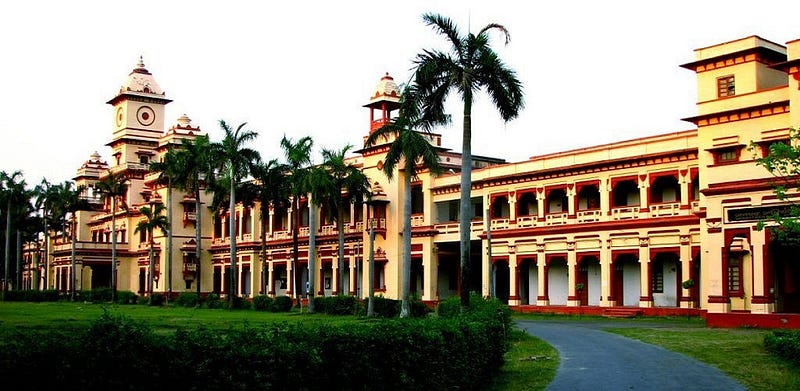
Banaras Hindu University (BHU), established in 1916 by the great nationalist leader Pandit Madan Mohan Malaviya, is recognized as the largest residential university in Asia and one of the largest in the world. Spanning a sprawling 1,300-acre main campus on the southern edge of Varanasi, it is often described as a “city within a city” due to its self-contained infrastructure that includes over 60 residential hostels housing nearly 30,000 students. The campus follows a unique semi-circular “sunburst” layout, with roads radiating from the centre, and features magnificent Indo-Gothic architecture. Beyond its residential capacity, BHU is a premier “Capital of Knowledge” (Sarvavidya ki Rajdhani), encompassing six institutes, 14 faculties, and approximately 140 departments across diverse fields such as arts, science, medicine (IMS-BHU), and technology (IIT-BHU). Significant landmarks within the walled campus include the Shri Vishwanath Mandir, which boasts one of the tallest temple towers in the world, and the Bharat Kala Bhavan museum, which holds over 100,000 rare artifacts. The university also maintains a massive 2,700-acre South Campus in Barkachha, focusing on agricultural and rural development, further cementing its status as a massive global educational hub.
2. Assi Ghat – For Those Seeking Spirituality
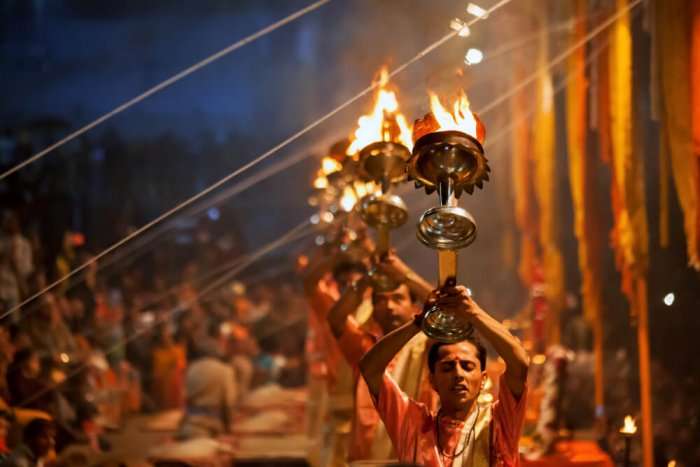
Assi Ghat is the southernmost of Varanasi’s major riverfronts and serves as the quintessential sanctuary for those seeking a deeper, more meditative spiritual experience. Situated at the confluence of the Ganges and the Assi River, it is historically revered as the place where the poet-saint Tulsidas wrote parts of the Ramcharitmanas. Unlike the more chaotic central ghats, Assi is famous for Subah-e-Banaras, a daily pre-dawn ritual that begins with Vedic chanting and a traditional fire ceremony (Aarti) as the sun rises, followed by live Indian classical music and a mass yoga session. This atmosphere attracts a unique mix of pilgrims, long-term travelers, and scholars who gather under the ancient peepal trees to meditate or discuss philosophy. The ghat is also a gateway to the southern part of the city, offering a spacious stone plaza where visitors can sit for hours soaking in the rhythmic life of the river, making it the primary hub for those who want to experience the soul of Kashi without the overwhelming crowds of the main market areas.
3. Dashashwamedh Ghat – The Most Vibrant Ghat In Town
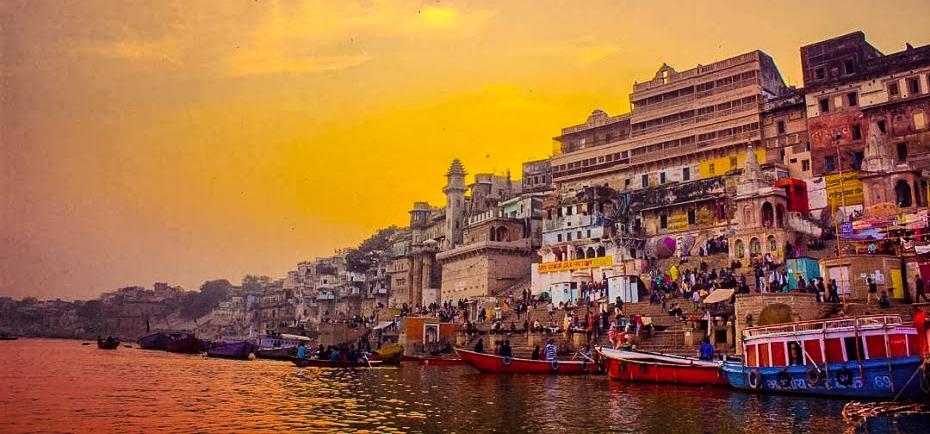
Dashashwamedh Ghat is the beating heart of Varanasi and undoubtedly its most spectacular and energetic riverfront. Its name, meaning “the ghat of ten sacrificed horses,” stems from a legend involving Lord Brahma, marking it as one of the most auspicious spots for Hindu pilgrims. By day, the ghat is a kaleidoscope of activity, crowded with saffron-clad priests under bamboo umbrellas, flower sellers, and devotees taking a holy dip in the Ganges. However, it truly comes alive at dusk during the world-famous Ganga Aarti. As darkness falls, a group of young priests performs a synchronized ritual of fire, incense, and bells on elevated platforms, drawing thousands of spectators who watch from the stone steps and crowded boats on the river. This sensory explosion of rhythmic chanting and glowing lamps makes it the epicentre of the city’s spiritual tourism and the most vibrant representation of Kashi’s ancient living traditions.
4. Manikarnika Ghat – The Prime Cremation Ghat
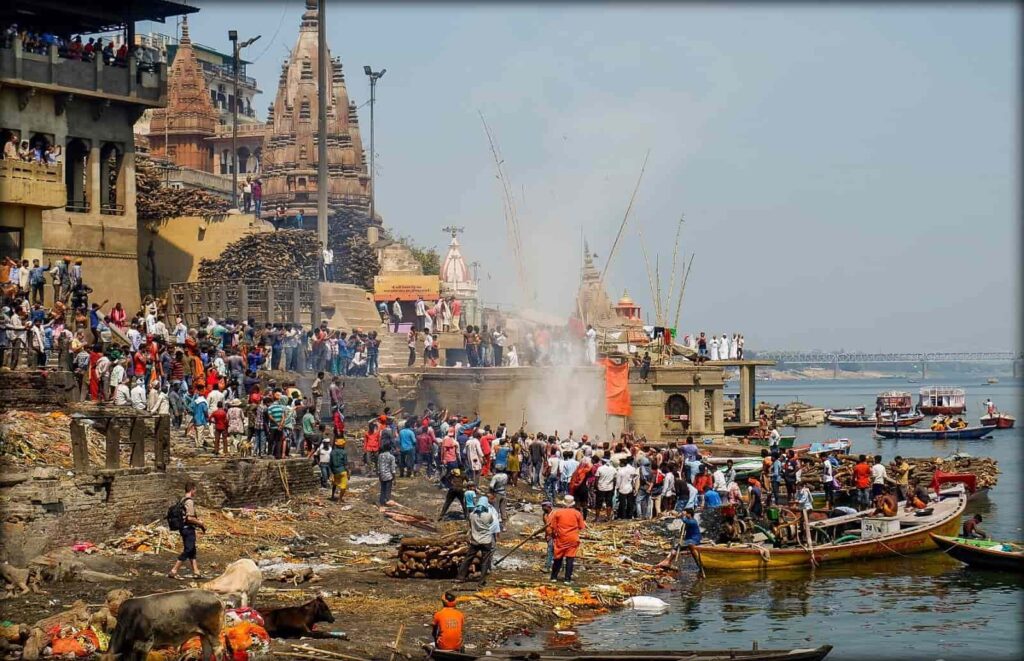
Manikarnika Ghat is the primary and most sacred cremation site in Varanasi, often referred to as the “Gateway to Heaven.” According to Hindu belief, receiving last rites here grants moksha (liberation from the cycle of rebirth), as it is believed that Lord Shiva himself whispers a sacred mantra into the ears of the departed. The ghat is a place of profound and stark reality where funeral pyres have burned continuously for centuries. It is characterized by stacks of firewood lined along the narrow alleys and the eternal flame, which is said to have been burning for generations. While it can be an intense experience for visitors, it is not viewed by locals as a place of gloom, but rather as a sacred space for the ultimate transition of the soul. Observing from a respectful distance, one witnesses the ancient, ritualistic process of life meeting its end against the backdrop of the timeless Ganges.
5. Shivala Ghat – The Reflection Of The Past
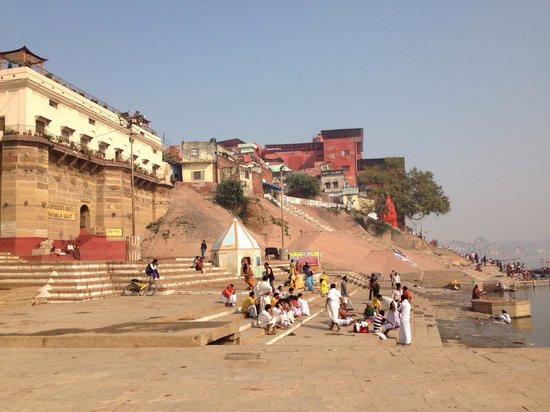
Shivala Ghat stands as a majestic architectural window into the 19th century, embodying the regal and historical grandeur of Varanasi’s past. Named after the numerous small shrines dedicated to Lord Shiva that dot its landscape, the ghat is most famous for the massive Shivala Fortress (Chet Singh Fort), built by the former Maharaja Chet Singh. The fort’s intricate stone carvings and imposing walls reflect a blend of Mughal and Rajput styles, serving as a reminder of the city’s political history and the rebellion against British rule that took place here. While it was once a hub of royal activity, the ghat is now much quieter and more secluded than its neighbors, making it a favorite spot for those who want to admire the river’s beauty amidst ancient, weathered ruins. Its tranquil stone steps and the reflection of the fort’s bastions in the Ganges create a nostalgic atmosphere that feels virtually unchanged by modern times.
6. Ahilyabai Ghat – Famed For Its Name
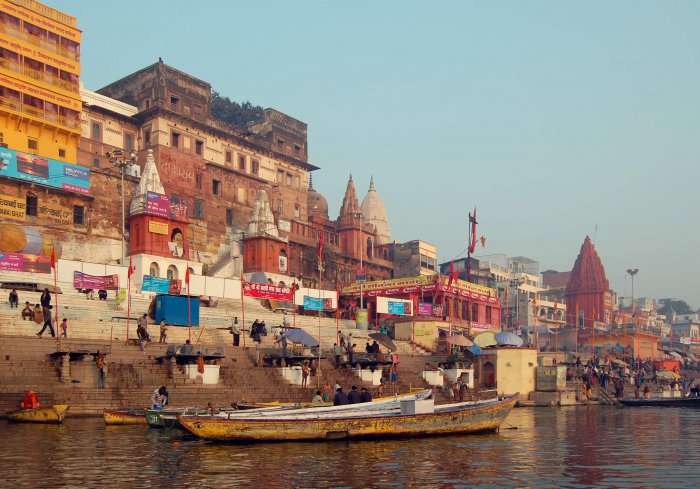
Ahilyabai Ghat holds a special place in Varanasi’s history as the first ghat to be named after a person, specifically the legendary Queen Ahilyabai Holkar of Indore. In the late 18th century, at a time when much of the city’s riverfront was in disrepair, this visionary Maratha queen took it upon herself to renovate the ghats and rebuild the famous Kashi Vishwanath Temple, effectively reviving the city’s spiritual glory. The ghat itself is an architectural marvel of its time, featuring a large palace-like structure and sturdy stone steps designed to withstand the river’s flow. It is celebrated not just for its physical beauty, but as a symbol of female leadership and religious devotion. Today, it remains a clean and relatively peaceful spot where the legacy of the “Philosopher Queen” is honored by the pilgrims and locals who visit to pay their respects to the woman who shaped the modern face of Varanasi.
7. Rana Mahal Ghat – For The True Explorers
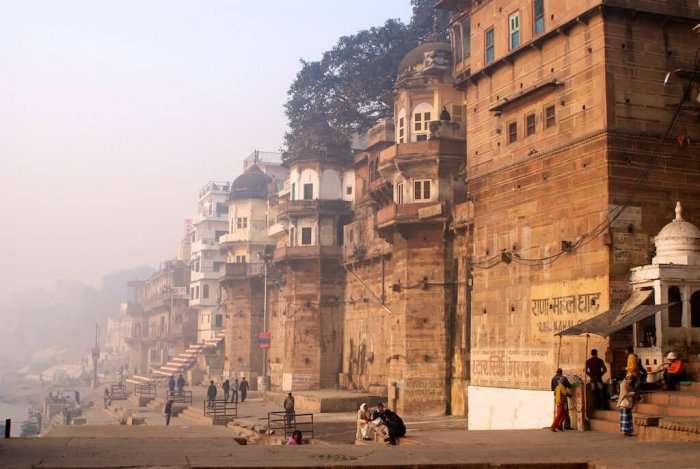
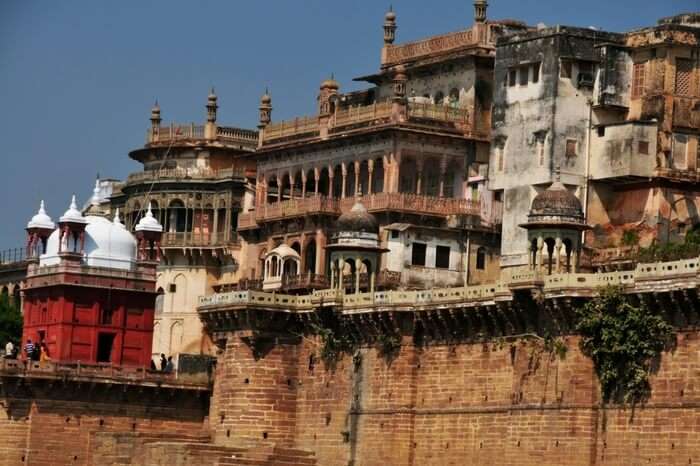
Rana Mahal Ghat is a hidden gem for explorers who appreciate history and architecture away from the main tourist crowds. Built in the late 17th century by Rana Jagat Singh of Udaipur, this ghat is a stunning example of Rajasthani architecture transplanted to the banks of the Ganges. The most striking feature is the magnificent palace (Mahal) that towers above the river, showcasing traditional Rajput elements like ornate balconies, arched windows, and intricate stone carvings. While the palace itself is now largely private and weathered by time, the ghat remains a quiet, atmospheric spot that feels like a step back into the era of the Maharajas. Its relatively secluded location makes it a favorite for photographers and those who enjoy wandering through the labyrinthine alleys that connect the palace to the rest of the old city, offering a glimpse of Varanasi’s royal past that many casual visitors miss.
8. Panchganga Ghat – Where The Five Rivers Met
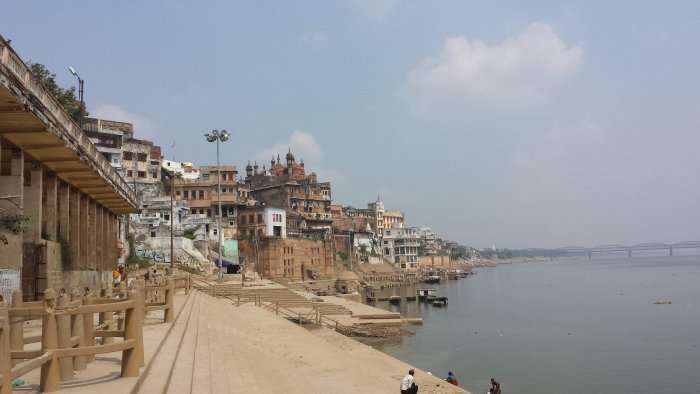
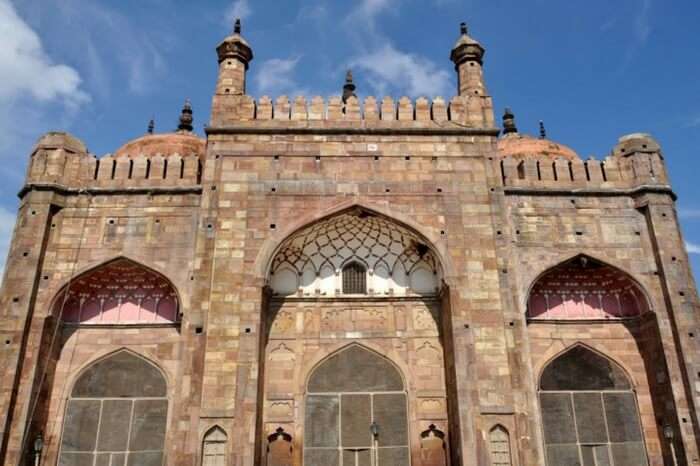
Panchganga Ghat is one of the most spiritually significant sites in Varanasi, revered as the sacred point where five holy rivers are believed to meet: the Ganges, Yamuna, Saraswati, Kirana, and Dhutpapa. While only the Ganges is visible to the physical eye, the others are said to join underground, making this “confluence” a site of immense religious power. Architecturally, the ghat is dominated by the Alamgir Mosque, built by Emperor Aurangzeb atop the ruins of an ancient Vishnu temple; the mosque’s massive structure creates a striking silhouette against the skyline. Below, the stone steps are dotted with small cells and shrines where ascetics and scholars have meditated for centuries. The ghat is also famous for the Ganga Jhelam festival during the Hindu month of Kartik, when hundreds of bamboo poles with flickering lanterns are hoisted into the air to light the path for ancestors, creating a breathtaking visual of floating lights against the night sky.
9. Chousatti Ghat – Famous Sanskrit Scholar’s Shelter
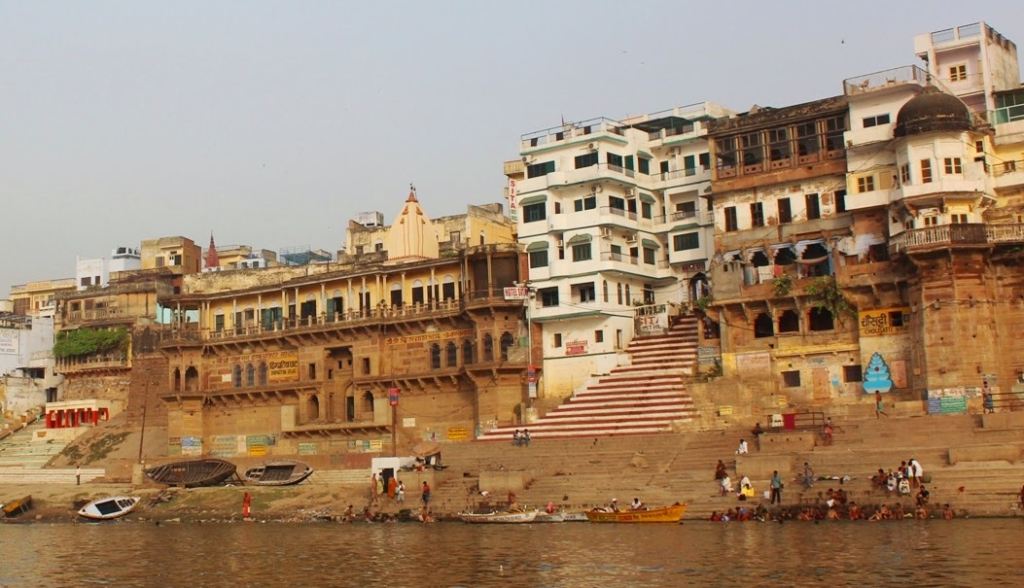
Chousatti Ghat is a site of deep intellectual and spiritual heritage, most famously known as the shelter and residence of the renowned 16th-century Sanskrit scholar and saint, Pandit Madhusudan Saraswati. The ghat takes its name from the Chousatti (64) Yogini Temple situated atop the steps, which is dedicated to the 64 auxiliary deities of Goddess Durga. It served as a vital hub for Vedic learning, where the scholar famously defended the city’s traditions and engaged in philosophical discourses that shaped the religious landscape of the time. Architecturally, the ghat is distinct for its steep, weathered stone stairs and the ancient, fortress-like building that once housed the scholar. Even today, the atmosphere remains thick with a sense of quiet scholarly devotion, attracting those who wish to pay homage to the city’s long-standing tradition of Sanskrit excellence and monastic wisdom.
10. Kedar Ghat – Sacred Bathing Place
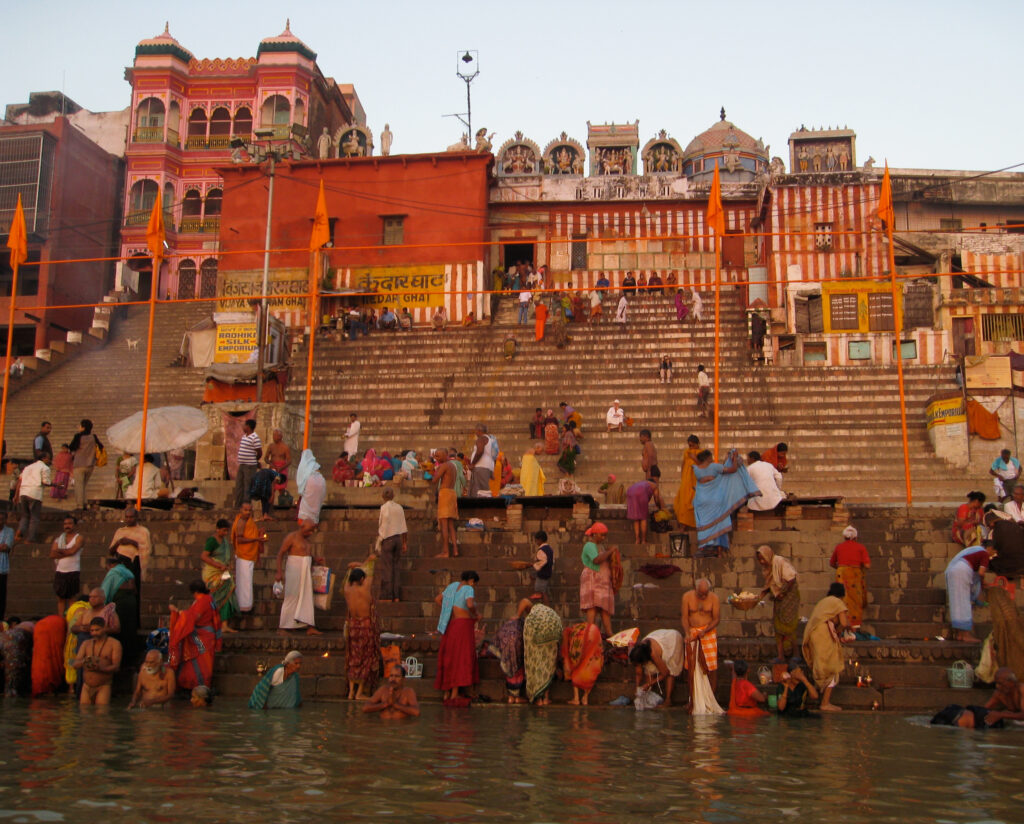
Kedar Ghat is one of the most significant and ancient bathing spots in Varanasi, particularly revered by devotees from South India. Named after Lord Kedarnath, it is believed that a ritual bath here yields the same spiritual merit as visiting the famous Kedarnath Temple in the Himalayas. The ghat is visually striking, characterized by its vibrant red and white striped walls and the majestic Kedarshwar Temple that towers above the riverbank. This temple is dedicated to Lord Shiva and is unique for its Dravidian-style influences, reflecting the diverse cultural fabric of the city. Throughout the day, the ghat is bustling with pilgrims performing religious rites, offering prayers, and taking holy dips in the Ganges. Because of its deep sanctity and the belief that the waters here possess healing properties, it remains a focal point for those seeking purification and a direct connection to the divine.
11. Manmandir Ghat – Marvel At Views Of River Ganga
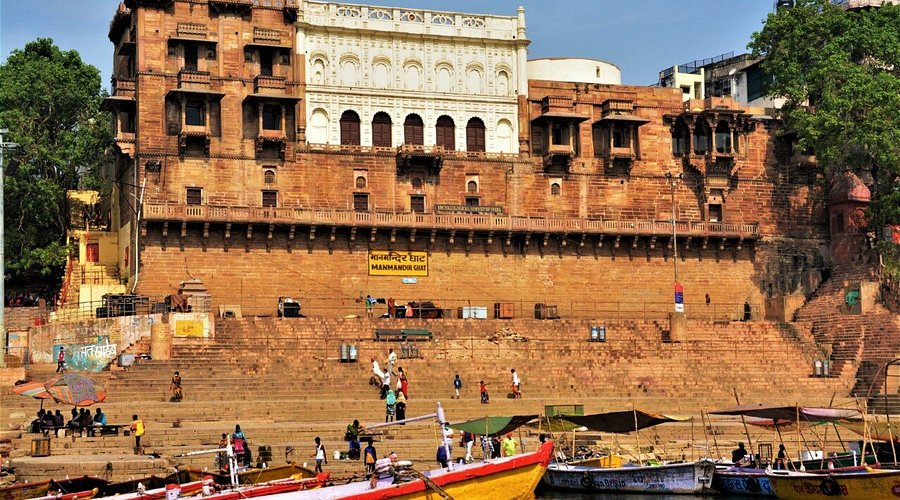
Man Mandir Ghat is a stunning architectural masterpiece that offers some of the most elevated and panoramic views of the River Ganga. Built in the late 16th century by Raja Man Singh of Amber, the ghat is most famous for the majestic Man Singh Palace and its exquisite stone-carved balconies. However, its true marvel is the 18th-century Jantar Mantar, an astronomical observatory built on the palace roof by Sawai Jai Singh II. This unique combination of royal Rajput architecture and scientific ingenuity provides a vantage point like no other; from its height, you can see the crescent sweep of the Ganges stretching from the northern to the southern horizon. The stone instruments (yantras) used for tracking stars still stand today, making the ghat a fascinating intersection where ancient Indian science meets the timeless spiritual beauty of the river.
12. Kashi Vishwanath Temple – The Only Jyotirlinga In Uttar Pradesh
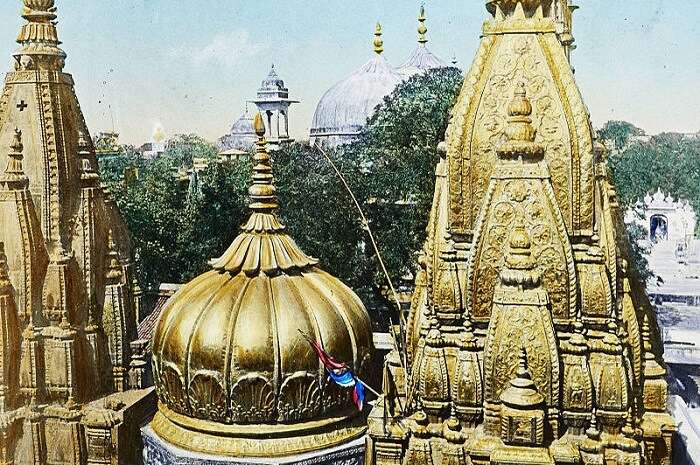
The Shri Kashi Vishwanath Temple is the spiritual soul of Varanasi and holds immense significance as the only Jyotirlinga in Uttar Pradesh among the twelve holiest Shiva shrines in India. Located on the western bank of the Ganges, the temple has been destroyed and rebuilt several times throughout history, with the current structure commissioned by the Maratha monarch Ahilyabai Holkar in 1780. It is famously known as the “Golden Temple” due to its magnificent spires plated with over 800 kilograms of pure gold, a contribution made by Maharaja Ranjit Singh of Punjab. The temple complex was recently transformed by the Kashi Vishwanath Corridor, which now connects the shrine directly to the river ghats, providing a spacious and grand walkway for pilgrims. Devotees believe that a visit to this temple and a dip in the Ganges lead to Moksha (salvation), making it one of the most visited and revered pilgrimage sites in the Hindu world.
13. Tulsi Manas Temple – Where Ramcharitmanas Was Written
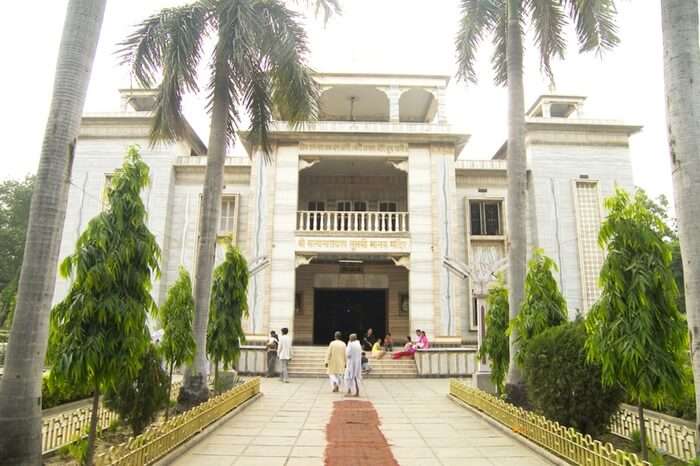
The Tulsi Manas Temple is a unique and historically significant shrine built on the very site where the legendary poet-saint Goswami Tulsidas is believed to have composed the Ramcharitmanas, the Awadhi adaptation of the epic Ramayana. Constructed in 1964 by the Sureka family, the temple is made entirely of white marble and is surrounded by beautifully manicured gardens. What makes this temple truly remarkable is that its walls are intricately engraved with the entire text of the Ramcharitmanas, allowing visitors to read the verses as they circumambulate the sanctum. The upper floor houses automated moving statues and dioramas that depict key scenes from the life of Lord Rama and Tulsidas, making the epic accessible and engaging for all ages. Unlike many of the ancient stone temples in Varanasi, Tulsi Manas offers a serene, museum-like atmosphere that celebrates the literary and spiritual revolution Tulsidas sparked by bringing the story of Rama to the common people in their own language.
14. Durga Temple – The Fabled Old World Legend
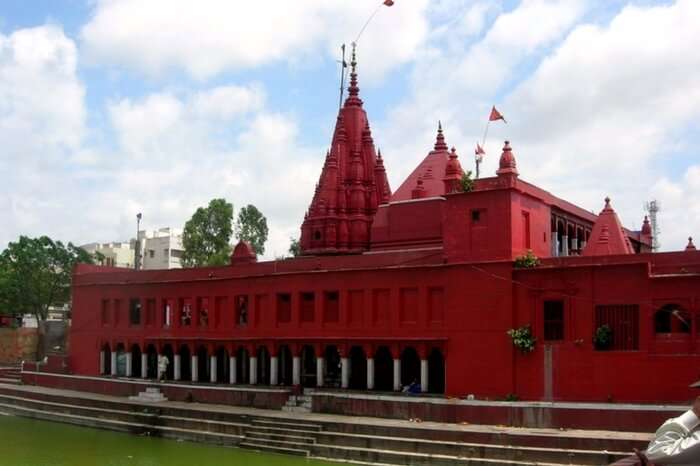
The Durga Temple, popularly known as the “Monkey Temple” due to the large population of macaques that reside there, is one of Varanasi’s most iconic and ancient shrines. Built in the 18th century by a Bengali Maharani, the temple is a striking example of Nagara-style architecture, characterized by its multi-tiered spires and vibrant ochre-red walls, which symbolize the power and energy of the Goddess Durga. According to local legend, the deity’s idol was not man-made but appeared on its own (Swayambhu) within the sanctum. The temple is situated next to a large rectangular water tank called the Durga Kund, which was historically connected to the Ganges. Its heavy stone carvings and fortress-like presence evoke a sense of the “old world” charm of Kashi, especially during the festival of Navratri, when thousands of devotees gather to witness the goddess adorned in traditional finery. Despite being a major pilgrimage site, the temple maintains a mystical and slightly wild atmosphere, standing as a testament to the fierce and protective feminine divinity that has guarded the city for centuries.
15. Sankat Mochan Hanuman Temple – Famous Since The 1900s
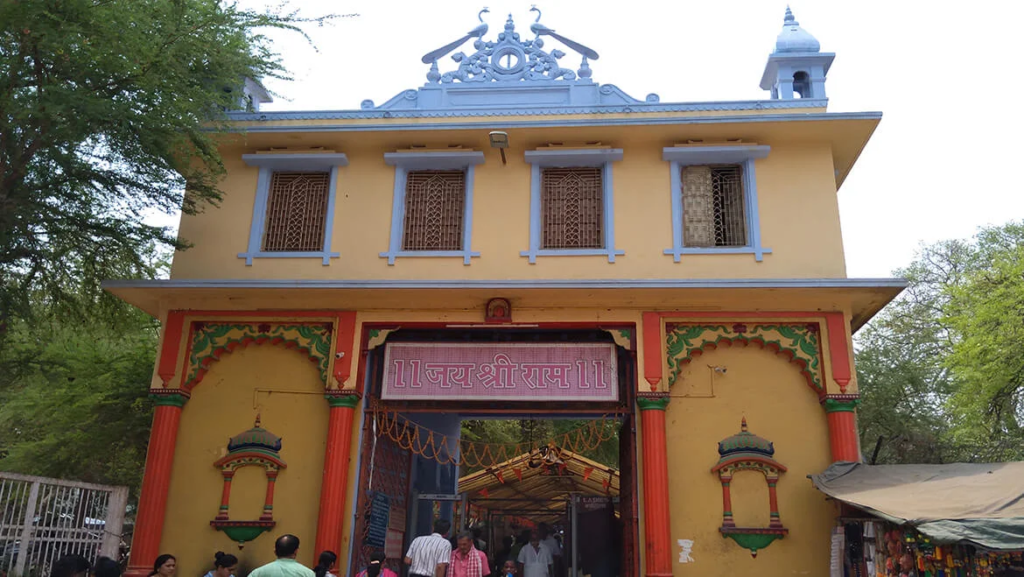
The Sankat Mochan Hanuman Temple is one of the most sacred sites in Varanasi, established by the saint-poet Goswami Tulsidas in the early 16th century, though the current structure gained widespread prominence and expansion in the early 1900s through the efforts of Pandit Madan Mohan Malaviya. The temple is dedicated to Lord Hanuman, the “Reliever of Troubles” (Sankat Mochan), and is unique because the deity’s idol faces his lord, Rama, whom he worshipped with eternal devotion. A distinct feature of this temple is that the Prasad (offering) served here is the famous “Besan Ke Ladoo,” which is highly sought after by devotees. Every Tuesday and Saturday, thousands of people flock to the temple to chant the Hanuman Chalisa and seek protection from the astrological influences of Shani (Saturn). Beyond its religious fervor, the temple is a cultural hub, famously hosting the annual Sankat Mochan Sangeet Samaroh, a world-renowned classical music and dance festival that attracts top artists from across the globe to perform as a tribute to the deity.
16. Nepali Temple – Feel The Essence Of Lord Shiva
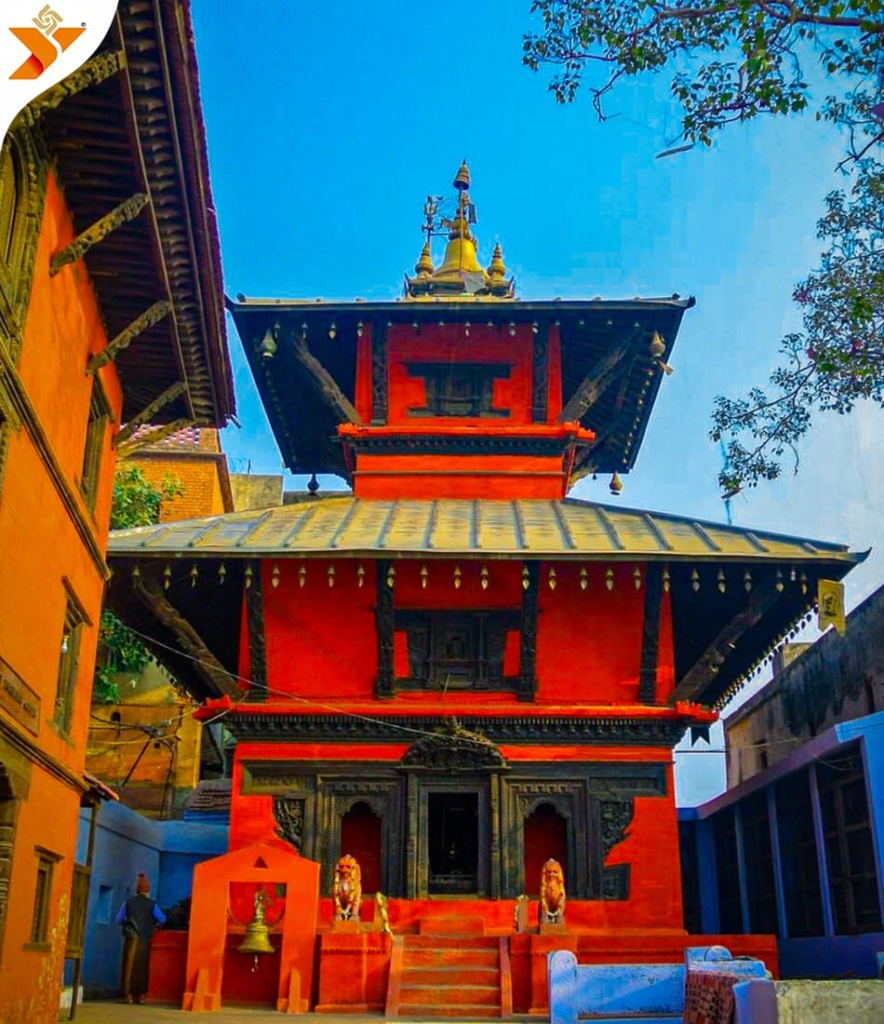
The Nepali Temple, also known as the Kanthwala Temple, is an architectural and spiritual marvel that brings the essence of the Himalayas to the banks of the Ganges. Built in the 19th century by the King of Nepal, Rana Bahadur Shah, the temple is a replica of the famous Pashupatinath Temple in Kathmandu. What makes this temple truly unique in Varanasi is its construction; it is made entirely of terracotta, stone, and Nepalese wood, which is said to be termite-resistant. The structure features the classic Pagoda-style architecture with intricate wood carvings that are often compared to those found in Khajuraho due to their detailed depictions of various deities and mystical scenes. Dedicated to Lord Shiva, the temple radiates a distinct sense of peace and Himalayan mysticism, offering a quiet sanctuary where the fragrance of aged wood and the cool river breeze allow visitors to experience the “Pashupati” (Lord of all beings) form of Shiva in a setting that feels worlds away from the city’s usual bustle.
17. Chinese Temple – Dedicated To Lord Buddha
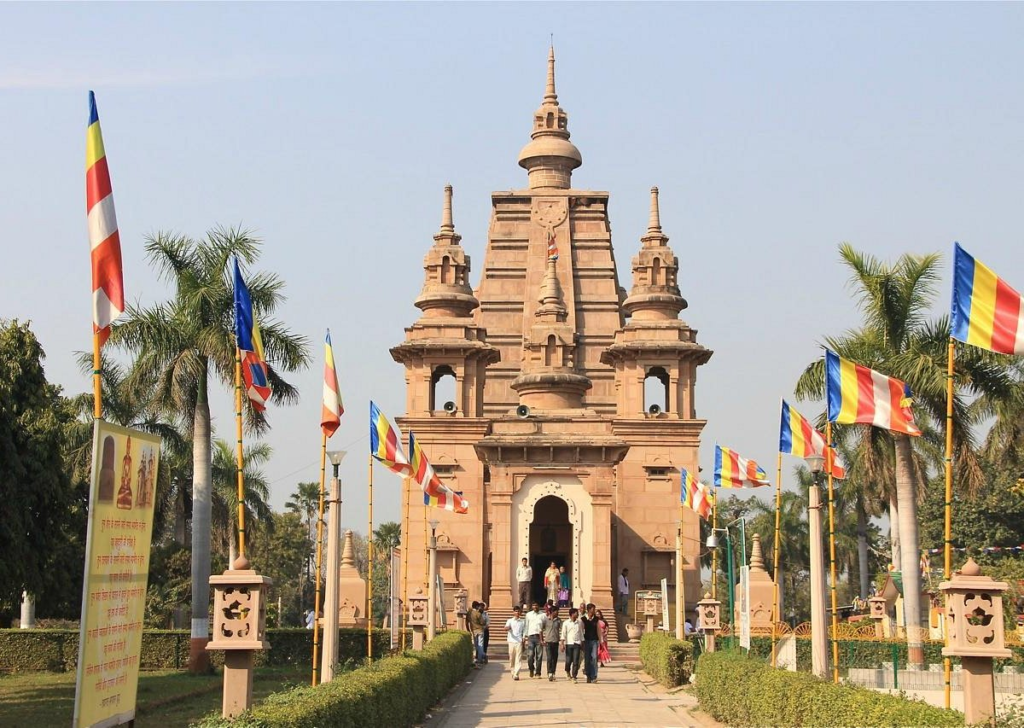
The Chinese Buddhist Temple in Sarnath, Varanasi, is a vibrant and peaceful shrine established in 1939 by the abbot of Beijing, Tao-Kai, and the president of the Eastern Asian Buddhist Association, Fa-Yuan-Tsu. Located near the Mulagandha Kuti Vihar, the temple is instantly recognisable by its traditional Chinese architecture, featuring a striking red and yellow exterior and intricate decorative motifs. Inside, the tranquil sanctuary houses a central statue of Lord Buddha along with various smaller idols, all illuminated by traditional Chinese lanterns. A standout educational feature of the temple is a large information board that illustrates the entire life of Buddha through photos and descriptions in Hindi, English, and Chinese. Additionally, the temple pays homage to history with a detailed map on its outer wall depicting the travel route of the 7th-century Chinese scholar Hiuen Tsang during his pilgrimage to India. Surrounded by calm gardens, it offers a meditative environment for visitors looking to explore the intersection of Chinese and Indian Buddhist traditions.
18. Sita Samahit Sthal – Must Visit In Varanasi
Sita Samahit Sthal, also known as Sitamarhi, is a highly revered pilgrimage site located in the Bhadohi district, approximately 45–80 km from Varanasi. This sacred spot is believed to be the exact location where Goddess Sita descended into the earth after being asked to prove her purity a final time. The temple complex is situated on the picturesque banks of the Ganges and features a unique architectural layout with a white marble shrine dedicated to Sita. A major highlight of the site is the 108-foot tall statue of Lord Hanuman, which is among the tallest in the world and stands atop a 20-foot rock featuring a cave temple underneath. Visitors can also explore the nearby Valmiki Ashram, where Maharishi Valmiki is said to have composed the Ramayana and raised Sita’s sons, Luv and Kush. Surrounded by serene gardens and a quaint pond, the temple offers a tranquil atmosphere for meditation and spiritual reflection, making it a key destination for those following the Ramayana trail.
19. Tibetan Temple – Marvel At The Tibetan Architecture
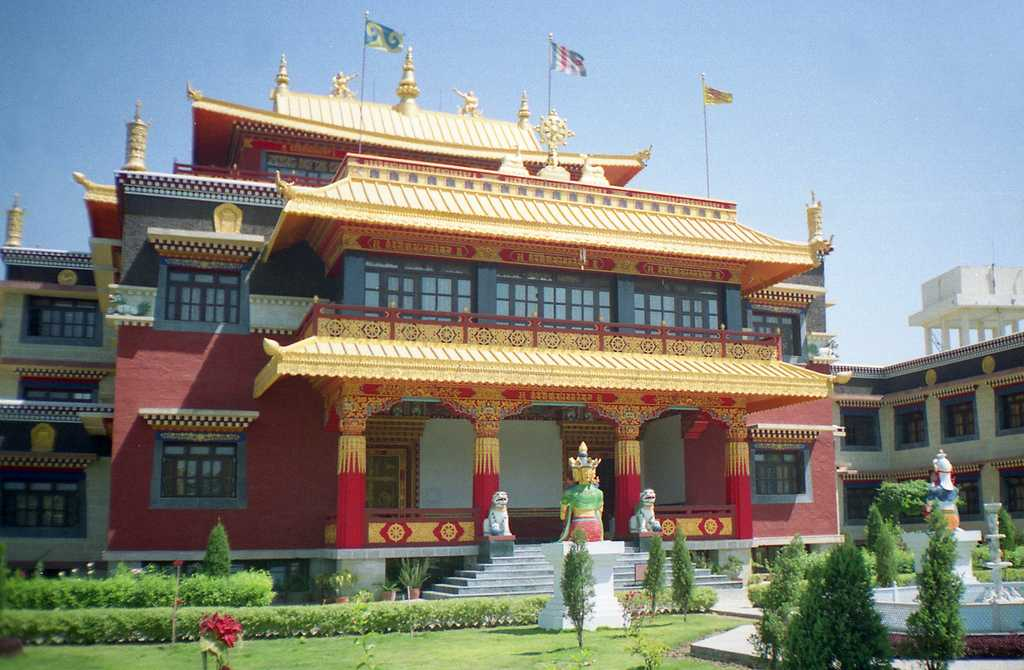
The Tibetan Temple, also known as the Lhaden Chenmo Tibetan Monastery, is a masterpiece of traditional Tibetan architecture located in Sarnath, about 10 km from Varanasi. Built in 1955, it was one of the first Tibetan monasteries established in India following the Dalai Lama’s exile, serving as a symbol of gratitude to the Indian government for providing refuge. The structure is instantly recognisable by its vibrant bright red and yellow exterior, guarded at the entrance by two majestic stone lions that represent strength and protection. Its most iconic architectural features include a series of prayer wheels along the outer walls—which devotees spin clockwise to release mantras like “Om Mani Padme Hum” into the universe—and a light pink stupa in the courtyard dedicated to those who fought for Tibetan independence. Inside, the sanctuary is adorned with intricate Thangka paintings and colorful frescoes on the walls and ceilings that depict the life of Lord Buddha. At the heart of the temple sits a colossal, gold-plated statue of Shakyamuni Buddha in a meditative pose, creating a deeply serene environment perfect for reflection and quiet meditation.
20. Batuk Bhairav Mandir – Temple With Healing Powers
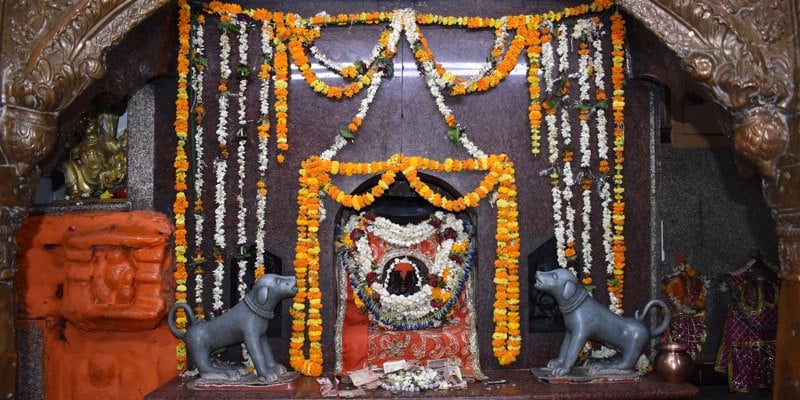
The Batuk Bhairav Mandir in the Kamaccha area of Varanasi is a highly significant pilgrimage site dedicated to the child form of Lord Shiva, known as Batuk Bhairav. The temple is famously associated with healing powers, primarily centered around the Akhand Deep (eternal lamp) that has been burning continuously for centuries. Devotees believe the oil from this sacred lamp is miraculous, often applying it to cure skin diseases, heal physical wounds, and even serve as a remedy for dog bites. As Batuk Bhairav is worshipped in his youthful, compassionate form, the temple is known for its uniquely approachable atmosphere compared to the more fierce Kaal Bhairav temple. It is a vital hub for Aghoris and Tantrik followers who seek spiritual protection and the removal of obstacles.
21. Bharat Mata Mandir – Worship Mother India
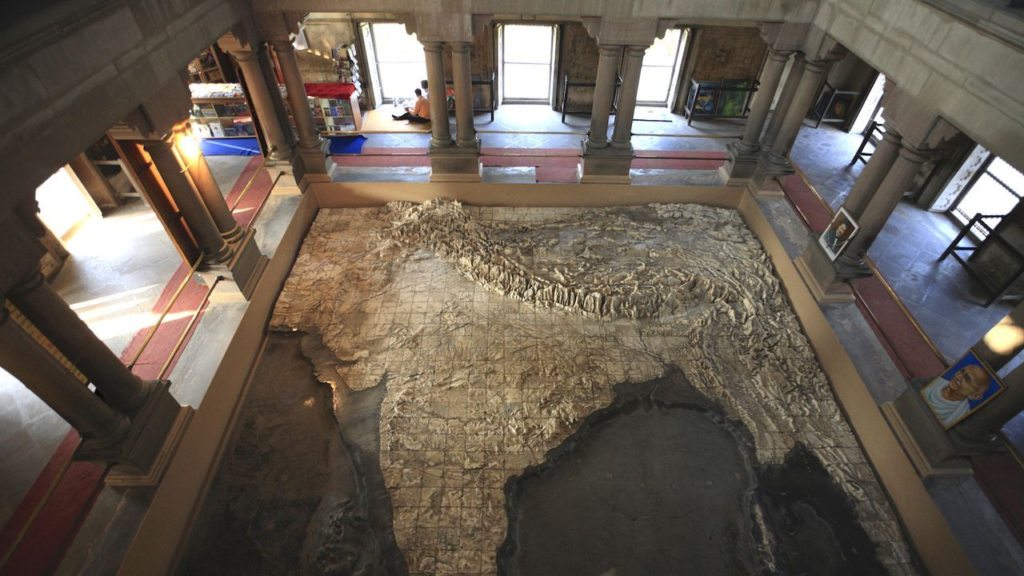
The Bharat Mata Mandir, located on the Mahatma Gandhi Kashi Vidyapith campus in Varanasi, is a unique shrine that celebrates the spirit of Indian nationalism rather than a traditional deity. Established in 1936 by philanthropist and freedom fighter Babu Shiv Prasad Gupta and inaugurated by Mahatma Gandhi, the temple was designed to be a secular platform promoting religious unity and peace. Instead of idols, the center of the temple features a massive, three-dimensional relief map of undivided India (Akhand Bharat) carved from white Makrana marble. This topographical masterpiece is meticulously crafted to scale, detailing approximately 450 mountain ranges, 800 rivers, vast plains, and even the smallest islands with incredible precision. On special national holidays like Republic Day and Independence Day, the map is symbolically decorated, and the water bodies represented on the marble are filled with water.
22. Gyan Vapi Well – The Well Of Knowledge
The Gyan Vapi Well, or the “Well of Knowledge,” is a site of immense spiritual and historical significance located between the Kashi Vishwanath Temple and the Gyanvapi Mosque. According to Hindu mythology, the well is believed to be older than the Ganges itself; it is said that Lord Shiva dug the well with his trident to create a source of water for the city, and the water is considered to be the liquid form of wisdom. A prevailing legend states that when the original temple was under threat of destruction in the 17th century, the head priest jumped into the well with the sacred Jyotirlinga of Lord Shiva to protect it from desecration. Today, the well is sheltered by a beautiful stone colonnade and a canopy built in 1828 by Rani Baiza Bai of Gwalior. While access to the immediate area is strictly regulated due to its sensitive location, it remains a focal point for pilgrims who believe that drinking its water or even catching a glimpse of the site leads to high spiritual enlightenment and the attainment of “Jnana” (knowledge).
23. Ramnagar Fort & Museum – The Mughal Era Fort
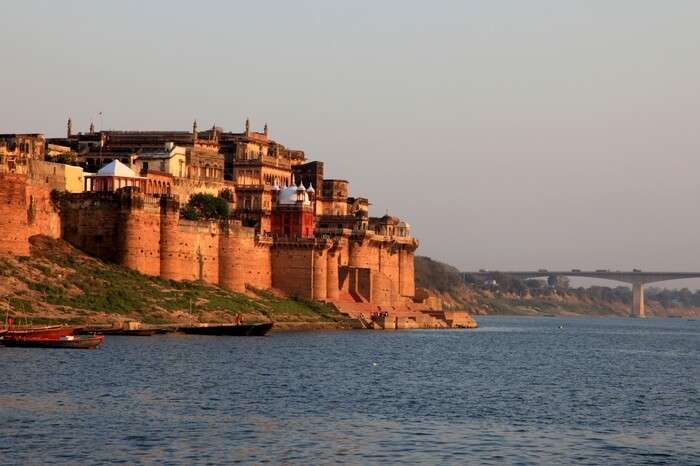
The Ramnagar Fort, standing majestically on the eastern bank of the Ganges opposite Varanasi’s main ghats, is an 18th-century sandstone fortress built by Maharaja Balwant Singh in 1750. Serving as the ancestral home and official residence of the Kashi Naresh (the King of Varanasi), the fort is a quintessential example of Mughal-style architecture, featuring cream-coloured Chunar sandstone, fortified walls, ornate balconies, and sprawling open courtyards. While the royal family still resides in a private wing of the palace, the public areas house several significant shrines, including the Veda Vyasa Temple—dedicated to the sage who is believed to have resided here—as well as the Durga and Dakshin Mukhi Hanuman temples. A major highlight is the Saraswati Bhawan Museum, which showcases the royal family’s eclectic treasures, including a remarkable collection of vintage cars, gold-and-silver brocaded palanquins, an extensive armoury of international weaponry, and a rare 19th-century astronomical clock that displays not only time but also the cycles of the moon and positions of the planets.
24. Chunar Fort – A Spooky Little Rampart
Chunar Fort, located about 30–40 km from Varanasi in the Mirzapur district, is an ancient sandstone stronghold perched on a rocky bluff of the Vindhya Range. Often referred to as “spooky” or eerie due to its raw, unpolished state and local legends, the fort is famously associated with the supernatural events depicted in the classic Hindi novel Chandrakanta. A prominent legend claims that the saint Bharthari still resides invisibly within his samadhi (shrine) inside the fort, and locals caution visitors not to respond to mysterious voices or linger in dark corners after dusk. Beyond the folklore, the fort is an architectural marvel featuring the Sonwa Mandap, a 28-pillar pavilion built for a Nepali princess, and a massive 200-foot deep bawdi (stepwell) connected to the Ganges. Its history is a timeline of Indian power, having been held by King Vikramaditya, the Mughal Emperor Akbar, the Afghan ruler Sher Shah Suri, and later the British, who used its dark underground dungeons and secret tunnels to house high-profile prisoners.
25. Sarnath – The Famed Historical Ruins
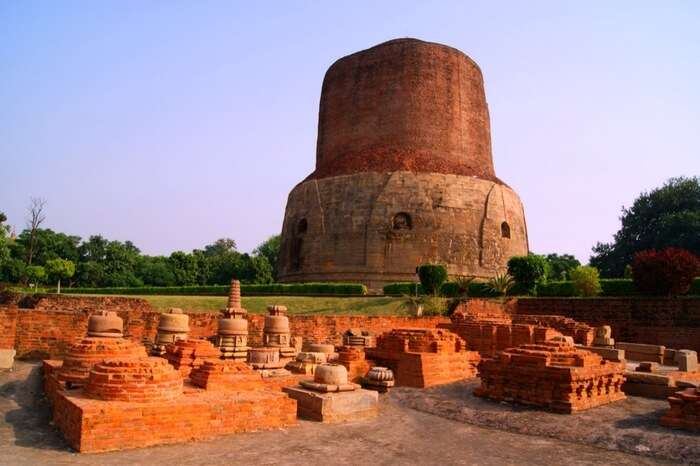
Sarnath, located just 10 km from Varanasi, is one of the four most sacred Buddhist pilgrimage sites in the world, marking the spot where Lord Buddha delivered his first sermon, known as Dharma Chakra Pravartana, after attaining enlightenment. The site is a sprawling complex of famed historical ruins that offer a glimpse into ancient Indian history and Buddhist heritage. The most dominant structure is the massive Dhamek Stupa, a 43-metre-tall cylindrical tower built of stone and brick, intricately carved with floral and geometric patterns from the Gupta period. Nearby lies the Chaukhandi Stupa, which marks the spot where Buddha first met his five disciples. Visitors can also explore the remains of several ancient monasteries, the foundations of the Dharmarajika Stupa, and the celebrated Ashoka Pillar. Though the original pillar was broken, its famous “Lion Capital”—the official National Emblem of India—is preserved in the adjacent Sarnath Archaeological Museum. The entire area is draped in a profound sense of peace, drawing monks and travellers alike to meditate amidst the ancient red-brick foundations.
26. Bharat Kala Bhavan Museum – Art And Culture Hub
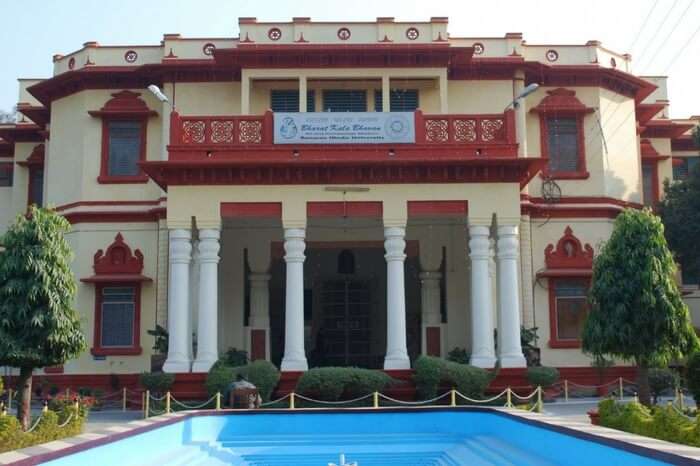
The Bharat Kala Bhavan Museum, located within the lush campus of Banaras Hindu University (BHU), is one of India’s most prestigious university museums and a premier hub for art and culture. Established in 1920 with the support of stalwarts like Rabindranath Tagore and Madan Mohan Malaviya, it houses a staggering collection of over 100,000 artifacts that span thousands of years of Indian history. The museum is globally renowned for its exquisite collection of miniature paintings, particularly from the Mughal, Rajasthani, and Pahari schools, which showcase incredible detail and vibrant natural pigments. Beyond paintings, the museum features a “Galleria of Ancient Indian Sculptures” with masterpieces from the Gandhara and Mathura schools, an extensive collection of ancient coins from the Kushan and Gupta empires, and rare textiles including world-famous Banarasi silk brocades. A unique section of the museum is dedicated to the literary and personal memorabilia of famous personalities, alongside a dedicated Alice Boner Gallery which explores the deep connection between sacred art and spiritual geometry.
27. Man Mandir Observatory – The Varanasi Heritage
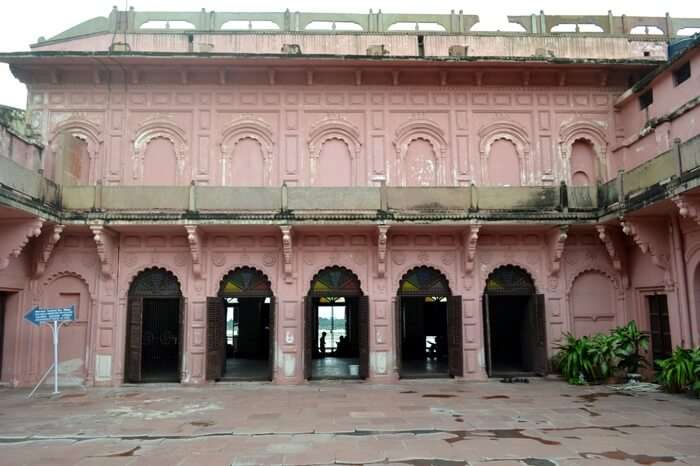
The Man Mandir Observatory, also known as Jantar Mantar, is a historic scientific marvel perched on the roof of the 16th-century Man Mahal Palace near Dashashwamedh Ghat. While the palace itself was built by Raja Man Singh, the rooftop observatory was added in 1737 by Maharaja Sawai Jai Singh II of Jaipur, a brilliant astronomer who built similar structures in Delhi and Jaipur. This “Stone Age” observatory houses massive masonry instruments like the Samrat Yantra (a giant sundial) and the Chakra Yantra, which were used centuries ago to accurately measure time, track the movement of stars, and predict eclipses without any modern technology. Today, the site has been transformed into a Virtual Experiential Museum where visitors can enjoy 3D shows and interactive displays about the city’s heritage, all while taking in some of the most breathtaking panoramic views of the Ganges River from its balconies.
28. Ramnagar Ramlila – Witness The Oldest Ramlila
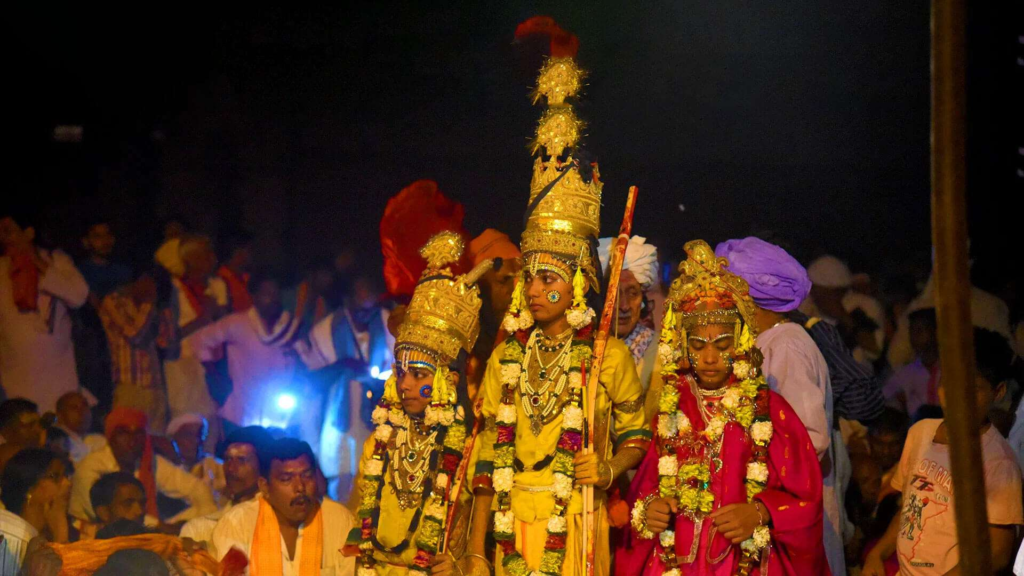
The Ramnagar Ramlila is widely considered the oldest and most authentic performance of the Ramayana in the world, having been staged annually for over 近200 years under the patronage of the Royal Family of Varanasi. Unlike modern plays performed on a single stage, this Ramlila is unique because it transforms the entire town of Ramnagar into a giant moving theatre; different episodes take place at specific permanent locations representing Ayodhya, Janakpur, or Lanka. The performance lasts for 31 days during the Sharad Navratri period and is famous for its strict adherence to tradition. There are no microphones or electric lights; actors (known as Swaroops) deliver their dialogues in a rhythmic chant illuminated only by flaming torches (mashals), creating a deeply mystical atmosphere. Thousands of pilgrims, known as Nemis, follow the procession every night with handheld copies of the Ramcharitmanas, making it a profound spiritual journey rather than just a dramatic show.
29. Aqua World – A Summer Paradise

Aqua World, located on the Varanasi-Sultanpur Highway (near the Mohansarai area), is Varanasi’s premier water park and a popular summer paradise for locals and tourists alike. Designed as a refreshing escape from the city’s intense heat, the park features a wide array of thrilling water slides, a massive wave pool that mimics the ocean, and dedicated splash zones for younger children. One of its main draws is the Rain Dance floor, where visitors can groove to popular music under artificial rain showers, creating a vibrant party atmosphere. The park is well-maintained with green landscaped areas, providing a resort-like feel that makes it an ideal spot for family outings, school trips, and group picnics.
30. Varanasi Fun City – For Thrilling Roller Coaster Rides
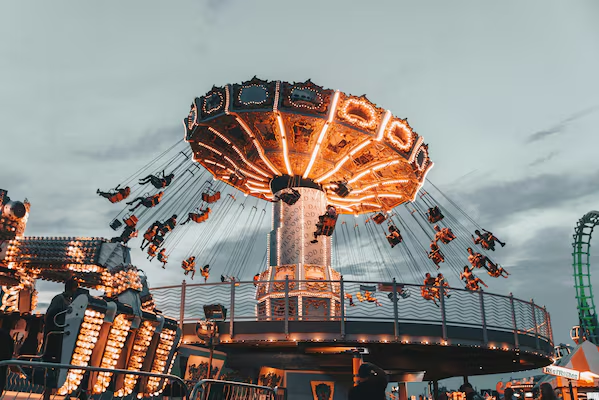
Varanasi Fun City, located on the Pandeypur-Panchkroshi Road, is the city’s largest and most popular amusement and water park, making it the go-to destination for thrilling roller coaster rides and family entertainment. The park is divided into two main sections: a dry park and a water park. The dry park features a variety of adrenaline-pumping attractions, including its signature roller coaster, a towering Giant Wheel that offers views of the surrounding area, and high-energy rides like the Columbus (swinging pirate ship) and Breakdance. For those seeking a break from the heat, the water park section offers a massive wave pool, multi-lane racing slides, and a vibrant Rain Dance arena with a live DJ, creating a high-energy atmosphere perfect for groups and families.