

Nestled at the foothills of the sacred Girnar Hills in Gujarat, Junagadh is a city of profound historical and spiritual depth. It presents a unique confluence of ancient Hindu, Jain, and Indo-Islamic heritage. Its name, meaning “Old Fort,” refers to the city’s renowned Uparkot Fort. Dating back 2,300 years, this fort has withstood numerous sieges throughout history. Situated within its complex are rock-cut Buddhist caves and ancient stepwells. During the reign of the Babi Nawabs, the city served as the capital of the Junagadh Princely State. The Nawabs left behind an architectural legacy that remains visible today in the ‘Mahabat Maqbara’—a mausoleum that brings the imagery of a fairytale to life, known for its winding, spiral minarets. Beyond its stone ramparts, Junagadh also serves as the main gateway to the ‘Gir National Park,’ the last remaining sanctuary for the Asiatic lion. Furthermore, Junagadh is a major pilgrimage site, attracting millions of devotees annually for the ‘Mahashivratri Mela’ and the ‘Lili Parikrama.’ From the 10,000 steps leading up to the volcanic peaks of Mount Girnar to the royal treasures housed in the ‘Durbar Hall Museum,’ Junagadh offers glimpses of an era spanning from the edicts of Emperor Ashoka to the opulent age of the Nawabs. For these reasons, Junagadh stands as one of India’s most culturally diverse and captivating cities.
Junagadh’s economy is multifaceted, relying primarily on agriculture, industrial production, and a rapidly expanding tourism sector. Agriculture—considered the backbone of the region—provides employment to approximately 70% of the local population. Benefiting from the district’s fertile black soil and the numerous rivers flowing through it, this district stands at the forefront of the entire state in the production of groundnuts and garlic (contributing 26% and 34%, respectively, to Gujarat’s total output).
Junagadh is generally regarded as a very safe and hospitable destination for tourists, where the locals are typically helpful and welcoming. During the day, the streets here buzz with activity and are teeming with crowds; climbing Girnar Hill even at night is a common practice, as thousands of pilgrims and tourists ascend the steps amidst bright lights and a collective, convivial atmosphere.
Most Famous And Attractive Tourist Places In Junagadh :
1.Gir National Park
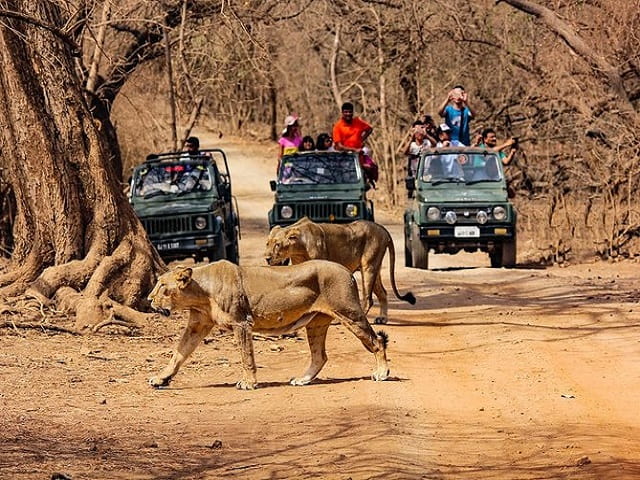
Gir National Park, also known as Sasan Gir, is a world-renowned wildlife sanctuary in Gujarat, India, and holds the unique distinction of being the only natural habitat in the world where the Asiatic lion survives in the wild. Spanning a total area of approximately 1,412 square kilometres, it was established as a sanctuary in 1965 and designated as a national park in 1975 to rescue the Asiatic lion from the brink of extinction—a population that had plummeted to just 20 individuals in 1913 due to indiscriminate hunting but has since successfully recovered to nearly 900 as of 2025. The park’s ecosystem is dominated by the largest dry deciduous forest in Western India, featuring undulating hills, plateaus, and seven perennial rivers that nourish a biodiversity hotspot home to 40 species of mammals, 425 species of birds, and 37 species of reptiles. Beyond its famous lions, visitors can spot leopards, striped hyenas, and rare herbivores like the Chowsingha (the world’s only four-horned antelope), while the Kamleshwar Dam serves as a vital water source and a habitat for a large population of marsh crocodiles. For travelers, the park offers regulated jeep safaris through 13 different routes, though the main sanctuary remains closed during the monsoon season from mid-June to mid-October; however, the Devalia Safari Park (Gir Interpretation Zone) remains open year-round to offer guaranteed lion sightings in a smaller, fenced enclosure.
2. Girnar Hills
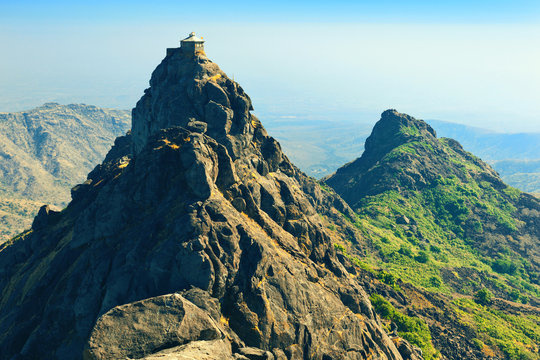
Girnar Hills, also known as Girinagar or Revatak Parvata, is a majestic and sacred mountain range in Junagadh that is believed to be even older than the Himalayas. Rising to an elevation of approximately 1,145 metres (3,757 feet), it is the highest point in Gujarat and serves as a major pilgrimage hub for both Hindus and Jains. The mountain is famous for its grueling but spiritually rewarding trek of nearly 10,000 stone steps that wind past 866 ancient temples spread across five distinct peaks. For Jains, it is a Mahatirth where the 22nd Tirthankara, Lord Neminath, achieved Nirvana. For Hindus, the peaks are steeped in Vedic history, featuring the revered Amba Mata Temple, the Gorakhnath Peak, and the final summit of Guru Dattatreya, which houses the footprints of the deity. Beyond its religious significance, Girnar is an extinct volcano composed of unique volcanic rock, and its surrounding lush forests are part of a wildlife sanctuary home to leopards and diverse bird species. While many pilgrims begin the 7.5 km trek from Girnar Taleti before dawn to avoid the heat, the recently inaugurated Girnar Ropeway—one of the longest in Asia—now provides a 10-minute alternative to reach the Ambaji temple, making the sacred heights accessible to everyone.
3. Junagadh Fort
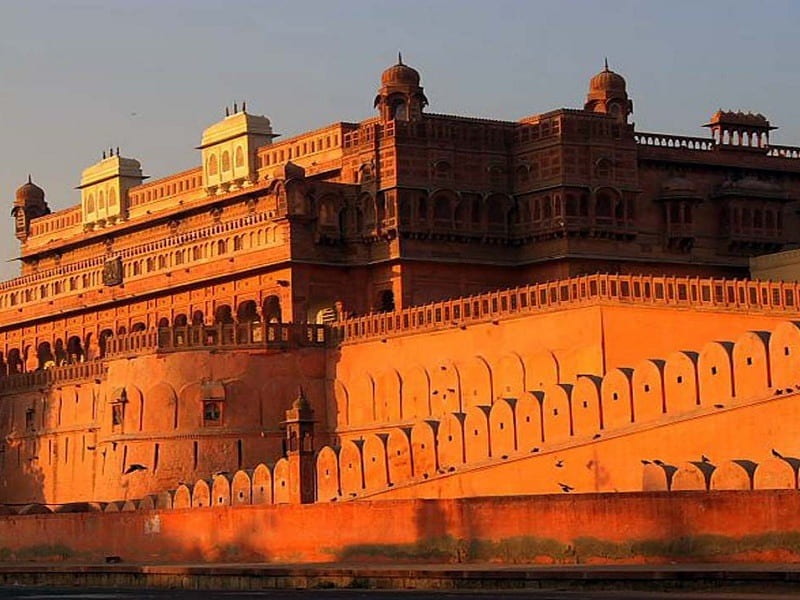
Junagarh Fort is a magnificent 16th-century fortress in Bikaner, Rajasthan, celebrated as one of the few major Indian forts not built on a hilltop but on flat ground. Originally named Chintamani, it was renamed Junagarh (“Old Fort”) in the early 20th century. Built between 1589 and 1594 by Raja Rai Singh, a prominent general under Mughal Emperor Akbar, the fort features a 986-meter-long wall with 37 bastions and is surrounded by a protective moat. Its architecture is a unique blend of Rajput, Mughal, and Gujarati styles, showcasing intricate red sandstone carvings, marble work, and lavish interiors. Within its walls lie 37 stunning palaces, including the gold-adorned Anup Mahal, the cloud-frescoed Badal Mahal, and the mirror-decorated Phool Mahal. Today, it serves as a well-preserved museum housing royal artifacts like medieval weaponry, silver carriages, and a World War I DH9 De Havilland warplane
4.Uperkot Fort
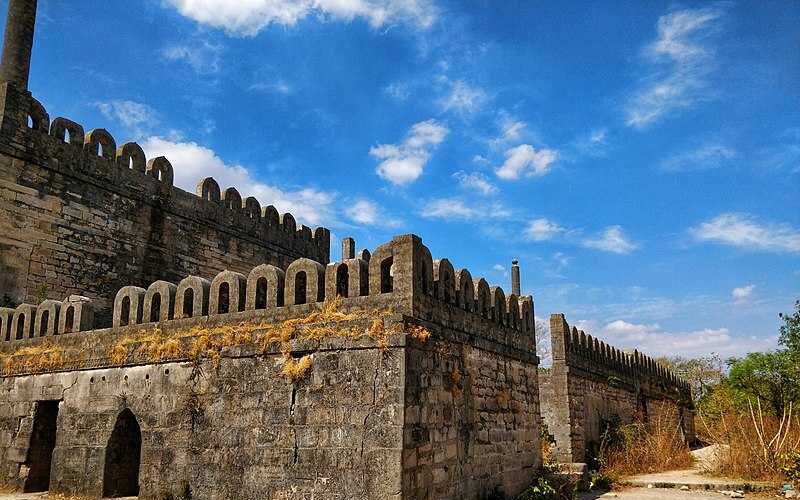
Uperkot Fort (also known as Uparkot) is an ancient citadel in Junagadh, Gujarat, believed to have been originally built by Chandragupta Maurya around 319 BC. Perched on an elevated plateau at the foothills of the Girnar range, this 2,300-year-old fortress is famous for its incredible resilience, having survived at least 16 sieges, one of which reportedly lasted for 12 years. The fort is enclosed by massive stone walls that reach up to 20 metres in height and was historically protected by a 300-foot-deep moat once filled with crocodiles. Inside the complex, visitors can find a unique blend of historical layers, including Buddhist caves dating back to the 2nd century AD, the grand Jama Masjid, and two remarkable rock-cut stepwells—Adi Kadi Vav and Navghan Kuvo—which were vital for water supply during long battles. Guarding the ramparts are the famous medieval bronze cannons, Neelam and Manek, which were cast in Cairo and brought to India by Turkish admirals in the 16th century.
5.Mahabat Maqbara

Mahabat Maqbara, also known as the Mausoleum of Bahaduddinbhai Hasainbhai, is a stunning architectural masterpiece in Junagadh that blends Indo-Islamic, Gothic, and European styles into a singular, fairy-tale structure. Built in the late 19th century (completed in 1892), this monument serves as the tomb of the Vizier to Nawab Mahabat Khan II and is often referred to as the “Mini Taj Mahal” of Gujarat. Its most striking and iconic features are the four surrounding minarets, which are encircled by unique external spiral staircases that wind upward to the top, a design element rarely seen in Islamic architecture. The main structure is adorned with intricate stone carvings, silver-plated doors, towering French-style windows, and elaborate Gothic arches that give it a hauntingly beautiful, “Hogwarts-like” appearance. Despite its slightly weathered condition, it remains one of Gujarat’s most photographed landmarks due to its dramatic silhouette and the sheer complexity of its stone masonry.
6. Damodar Kund
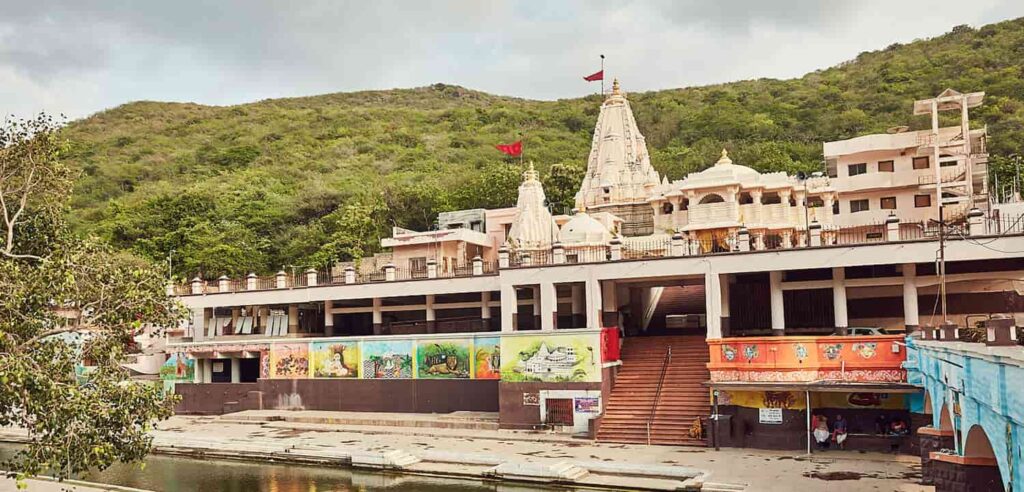
Damodar Kund is one of the most sacred lakes in Gujarat, located at the serene foothills of the Girnar Hills in Junagadh. Spanning approximately 257 feet in length and 50 feet in breadth, this holy reservoir is a vital spiritual stop for pilgrims before they begin their ascent of the Girnar mountain. According to Hindu mythology, the waters of the kund are believed to possess divine properties capable of purifying sins and helping departed souls achieve moksha (salvation); as a result, it is a primary site for performing asthi-visarjana (immersion of ashes) and other ancestral rites, similar in significance to the Ganges at Haridwar. The site is deeply connected to the 15th-century saint-poet Narsinh Mehta, a dedicated devotee of Lord Krishna who reportedly bathed here daily and composed many of his famous prabhatiyas (morning hymns) on its banks.
7. Darbar Hall Museum
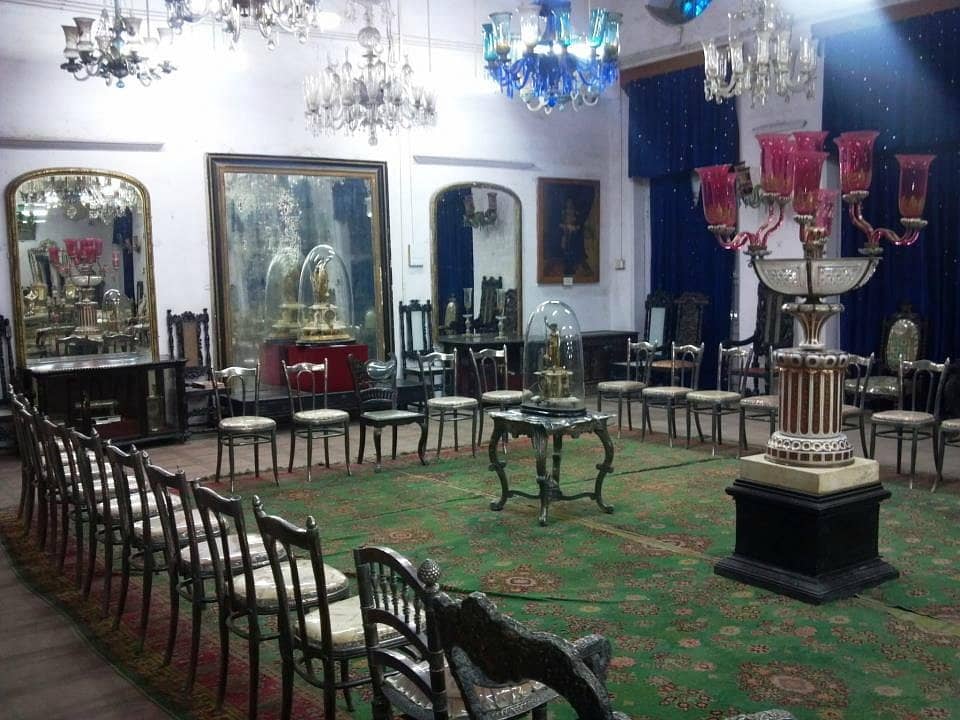
The Darbar Hall Museum, located within the historic premises of the 19th-century City Palace, is Junagadh’s premier cultural institution and a treasure trove of the city’s royal history. Once the official assembly hall where the Nawabs of Junagadh held their court (Darbar), the museum now preserves the opulent lifestyle and heritage of the Babi dynasty. The most spectacular feature of the museum is the Darbar Hall itself, which remains frozen in time with its massive shimmering chandeliers, majestic silver thrones, and velvet-covered chairs. The walls are adorned with life-sized oil paintings of the former rulers, while the floors are covered with hand-woven carpets, reflecting the Indo-Gothic architectural grandeur of the era.
8. Somnath Temples
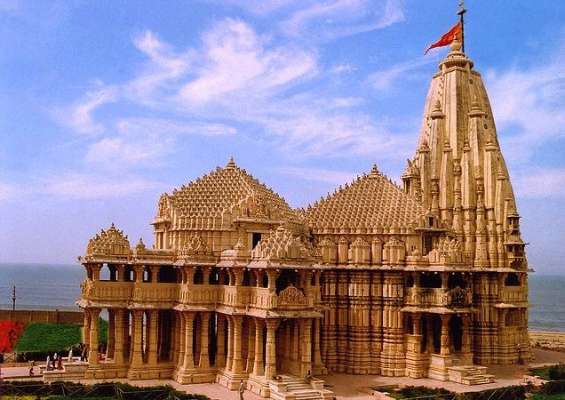
Somnath Temple, located on the western coast of Gujarat in Prabhas Patan near Veraval, is revered as the first among the twelve Jyotirlinga shrines of Lord Shiva and is one of the most sacred pilgrimage sites in Hinduism. Known as “The Shrine Eternal,” the temple has a tumultuous yet resilient history; it was destroyed and rebuilt several times by various invaders and rulers, with the current structure being reconstructed in the Chaulukya (Solanki) style of Hindu temple architecture and completed in 1951 under the efforts of Sardar Vallabhbhai Patel. The temple’s imposing architecture features a 150-foot-tall Shikhara (spire), intricate stone carvings, and a grand Sabha Mandap. It is situated at a unique geographical point called the Triveni Sangam, where three holy rivers—Kapila, Hiran, and Saraswati—meet the Arabian Sea. A fascinating feature of the temple complex is the Baan Stambh (Arrow Pillar), which claims that there is no land in a straight line from that point to the South Pole, highlighting the ancient Indians’ advanced geographical knowledge.
9.Sakkarbaug Zoo
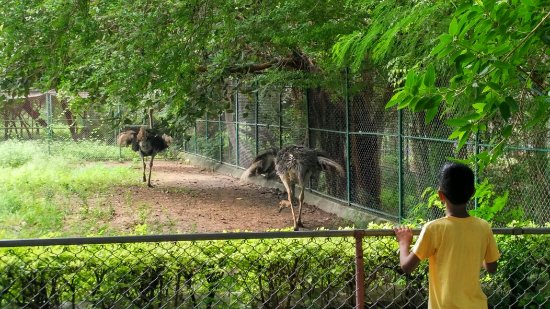
Sakkarbaug Zoological Park, commonly known as the Junagadh Zoo, is a 200-hectare wildlife reserve located at the foothills of Mount Girnar. Established in 1863 by Nawab Mohabatkhanji Babi-II, it is the oldest zoo in Gujarat and one of the largest in India. The zoo is globally renowned as a premier conservation and breeding centre for the Asiatic lion, providing purebred individuals to international zoos to help save the species from extinction. Beyond its lions, the park houses over 1,300 animals across nearly 100 species, including Royal Bengal tigers, leopards, white-backed vultures, and Indian gray wolves. The facility is divided into distinct sections for birds, mammals, and reptiles, and even includes a Natural History Museum that showcases rare skeletons and educational exhibits.
10.Chorwad Beach
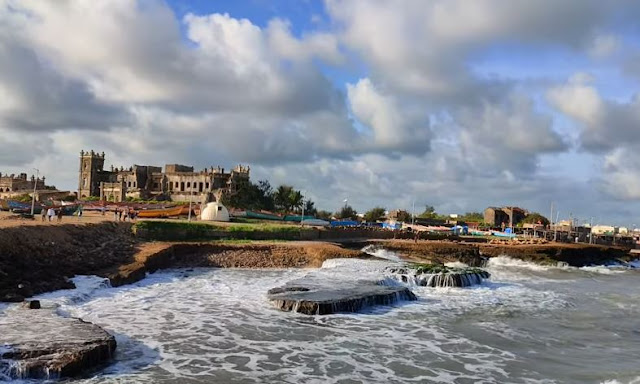
Chorwad Beach, located about 66 km from Junagadh, was once the glamorous summer retreat of the Nawab of Junagadh and remains one of Gujarat’s most historically significant coastal destinations. The beach is famous for its rugged, rocky shoreline and the majestic Daria Mahal Palace, a stunning 1930s architectural gem that formerly served as a royal residence and later a luxury hotel. While the waters here have strong currents and are generally not recommended for swimming, the beach is a popular spot for long walks, camel rides, and enjoying the dramatic views of the Arabian Sea crashing against the rocks. The area is also significant as the birthplace of the legendary industrialist Dhirubhai Ambani, and visitors often combine a trip to the beach with a visit to his ancestral home, which has been converted into a memorial.