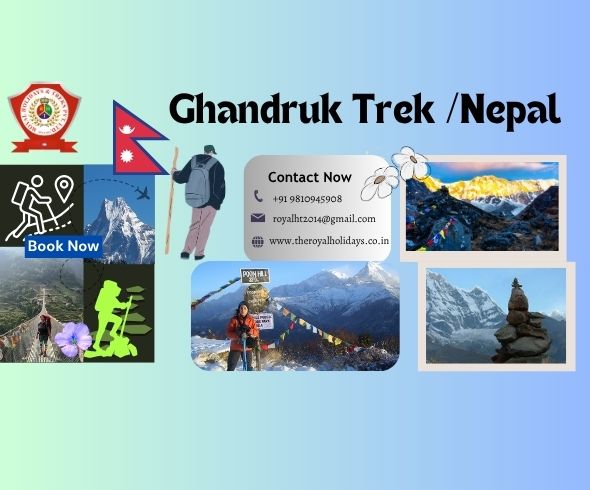
The Ghandruk Trek, also known as the Ghandruk Cultural Trek, is one of the most accessible and visually rewarding short treks in Nepal’s Annapurna region, reaching a maximum altitude of roughly 2,010 metres. Starting with a scenic drive from Pokhara to Nayapul or Kimche, the trail leads you through a lush landscape of terraced rice paddies, mossy oak forests, and crossing suspension bridges over the rushing Modi Khola river. The crown jewel of the journey is the village of Ghandruk itself—a sprawling “stone village” inhabited by the Gurung community, famous for its slate-roofed houses and its deep history with the legendary Gorkha soldiers.
As you walk, the massive peaks of Annapurna South, Hiunchuli, and the iconic Machhapuchhre (Fishtail) remain constant companions, appearing so close from the village center that they seem to loom directly over the houses. This trek is uniquely focused on cultural immersion, allowing travelers to visit the Old Gurung Museum, try on traditional ethnic costumes, and experience authentic mountain hospitality in well-established teahouses. Because the trails are well-maintained and the altitude remains relatively low, it is considered an easy-to-moderate trek, making it the perfect choice for families, first-time trekkers, or those with limited time who still wish to witness the raw majesty of the Himalayas.
Most Famous And Attractive Tourist Places In Ghandruk Trek :
1. Old Gurung Museum

The Old Gurung Museum in Ghandruk is a captivating cultural landmark that serves as a living tribute to the heritage and daily life of the Gurung people, who are renowned globally for their service as Gorkha soldiers. Housed within a traditional stone building, this privately-run museum offers an intimate look at a vanishing way of life through its extensive collection of centuries-old artifacts, including ancient weaponry, handcrafted farming tools, wooden kitchenware, and intricate woven baskets. Visitors are encouraged to engage with the culture directly, as the museum provides the popular opportunity to dress in traditional Gurung attire—complete with heavy gold jewelry and velvet fabrics—for photographs against the backdrop of the Himalayas. By documenting the history of the “Tamu” (Gurung) community, the museum provides essential context to the trek, transforming Ghandruk from just a scenic stop into a deep educational experience regarding the resilience and traditions of Nepal’s mountain ethnic groups.
2. Jhinu Danda Hot Springs
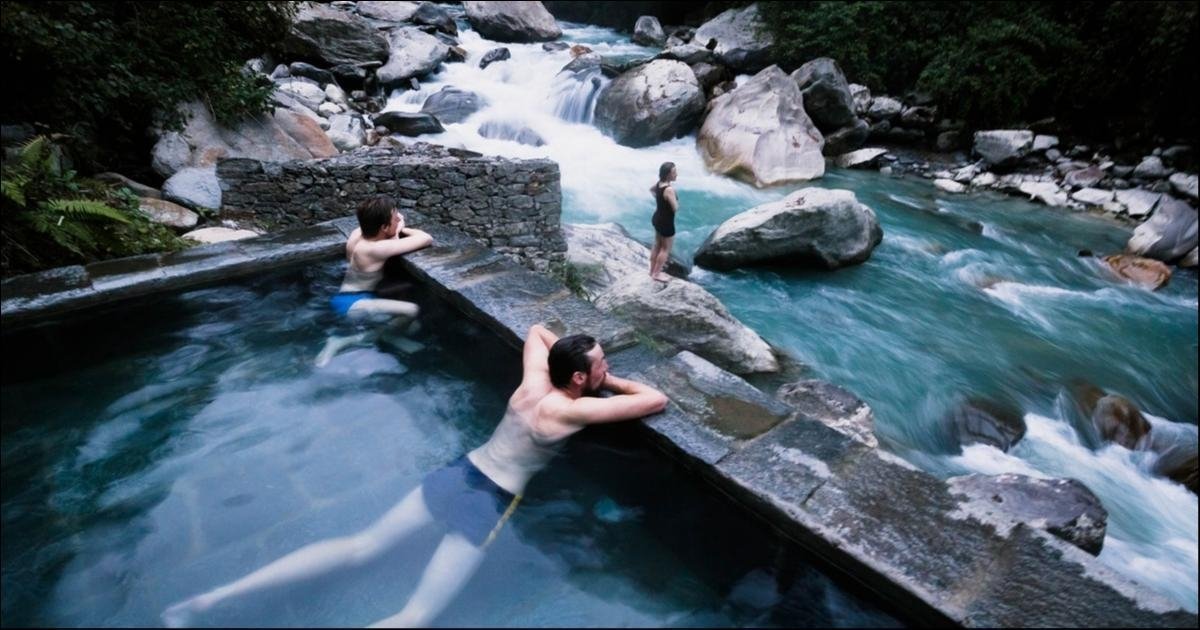
Jhinu Danda Hot Springs is a natural sanctuary located on the banks of the glacial Modi Khola river, sitting at an altitude of approximately 1,780m. To reach the springs, trekkers must descend a steep, winding trail from the main village of Jhinu Danda for about 20 to 25 minutes, eventually reaching three well-maintained stone pools filled with mineral-rich, warm water. These springs are legendary among trekkers as the ultimate “natural spa,” providing a perfect way to soothe sore muscles and joints after days of climbing the steep Himalayan stairs. The experience is made even more dramatic by the location; as you soak in the steaming water, you can hear the thundering roar of the icy river just a few feet away and look up at the lush, green jungle canopy that clings to the surrounding cliffs. It is a place of total relaxation and rejuvenation, offering a unique contrast between the tropical warmth of the pools and the crisp, cool air of the Annapurna canyon.
3. Tadapani Village

Tadapani Village, perched at an altitude of approximately 2,630m, is a breathtaking settlement that serves as a vital junction for trekkers navigating between Ghorepani, Ghandruk, and the Annapurna Base Camp. The village is most famous for its “eye-level” mountain views; because it sits on a prominent ridge, peaks like Machhapuchhre (Fishtail) and Annapurna South appear startlingly close, dominating the horizon with a clarity that few other villages can match. Tadapani is entirely surrounded by a vast, ancient rhododendron forest, the largest of its kind in the world, which transforms into a vibrant sea of red and pink blooms during the spring months. Even outside of the blooming season, the moss-covered trees and frequent sightings of Langur monkeys leaping through the canopy give the village a mystical, wild atmosphere. For many, a night in Tadapani is a highlight of the trek, offering crisp mountain air, a cozy teahouse culture, and some of the most intimate sunrise photography opportunities in the entire Annapurna region.
4. Poon Hill (Sunrise Point)

Poon Hill, standing at an elevation of 3,210 metres, is world-renowned as the ultimate sunrise viewpoint in the Annapurna region and serves as the physical and emotional climax of the trek. To witness the spectacle, trekkers typically begin a steep, one-hour ascent from Ghorepani in the pre-dawn darkness, guided by headlamps through frosty trails. Once at the summit, as the sun crests the horizon, a breathtaking 360-degree panorama unfolds, illuminating over 20 Himalayan peaks—including the two “eight-thousanders,” Dhaulagiri and Annapurna I—in a transition of deep purples to brilliant molten gold. The viewpoint is equipped with a multi-story metal tower and a small tea shack, where hundreds of travellers from around the globe gather in a shared moment of awe. It is more than just a geographic high point; it is a place of profound beauty where the sheer scale of the Dhaulagiri and Annapurna massifs provides a life-changing perspective on the majesty of the Himalayas.
5. Landruk Village

Landruk Village is a charming and authentic Gurung settlement situated at an elevation of about 1,565m, directly facing Ghandruk from the opposite side of the Modi Khola valley. While Ghandruk is famous for its stone houses, Landruk is renowned for its incredible emerald-green terraced fields that drape across the steep mountainside like giant staircases, creating one of the most iconic agricultural landscapes in Nepal. The village offers a much quieter and more rustic atmosphere than its more famous neighbour, making it a favorite for trekkers seeking a peaceful experience away from the main crowds. From the doorsteps of its traditional lodges, you get a stunning perspective of Annapurna South and Hiunchuli, as well as a clear view of the winding river far below in the canyon. Walking through Landruk allows you to see the daily rhythm of Himalayan farming life, where the hospitality is warm, the trails are lined with colorful flowers, and the view of the valley stretching toward the horizon is simply unforgettable.
Overview
Travel is the movement of people between relatively distant geographical locations, and can involve travel by foot, bicycle, automobile, train, boat, bus, airplane, or other means, with or without luggage, and can be one way or round trip. Travel can also include relatively short stays between successive movements.
The origin of the word “travel” is most likely lost to history. The term “travel” may originate from the Old French word travail, which means ‘work’. According to the Merriam Webster dictionary, the first known use of the word travel was in the 14th century.
It also states that the word comes from Middle English travailen, travelen (which means to torment, labor, strive, journey) and earlier from Old French travailler (which means to work strenuously, toil). In English we still occasionally use the words “travail”, which means struggle. According to Simon Winchester in his book The Best Travelers’ Tales (2004), the words “travel” and “travail” both share an even more ancient root: a Roman instrument of torture called the tripalium (in Latin it means “three stakes”, as in to impale).