


Uttarakhand’s Char Dham Yatra, often referred to as the ‘Chhota Char Dham’ (Lesser Char Dham), stands as one of the most sacred and spiritually transformative pilgrimage routes in Hinduism. It encompasses four high-altitude shrines: Yamunotri, Gangotri, Kedarnath, and Badrinath. Traditionally, this pilgrimage follows a clockwise direction (Parikrama) from west to east—commencing at Yamunotri, the source of the Yamuna River, which symbolizes purification; proceeding to Gangotri, the source of the Ganges River; moving on to Kedarnath to seek the blessings of Lord Shiva; and finally concluding at Badrinath, the abode of Lord Vishnu. It is believed that completing this arduous journey through the Garhwal Himalayas washes away the sins of a lifetime and leads to the attainment of Moksha (spiritual liberation). Due to heavy winter snowfall, these temples remain open for only six months—typically from April/May to November.
The Char Dham Yatra serves as the backbone of Uttarakhand’s economy, providing a vital source of livelihood for thousands of local families during the six-month pilgrimage season. It fuels a vast hospitality and service ecosystem, wherein hotels, homestays, and local Dharamshalas rely entirely on the arrival of millions of pilgrims for their annual income. The transportation sector also experiences a significant boom, generating employment opportunities for thousands of drivers, guides, and helicopter service providers. Furthermore, the pilgrimage sustains a unique informal economy in these high-altitude regions, where local porters (coolies), mule owners, and palanquin bearers (kahars) provide essential transport services along trekking routes such as those leading to Kedarnath and Yamunotri. Beyond travel and accommodation, this pilgrimage also boosts local agricultural and handicraft markets, as devotees purchase locally grown organic produce, woolen textiles, and religious souvenirs. The revenue generated from this pilgrimage is often utilized by the state government to enhance infrastructure—such as roads and medical facilities—in remote hilly regions, thereby benefiting the local population throughout the year.
The Char Dham Yatra is a safe destination for travelers. This is largely attributed to a highly “regulated, digitally tracked, and medically equipped” system established by the Uttarakhand government to mitigate the risks associated with high-altitude terrain. Safety measures have been significantly bolstered through the Char Dham All-Weather Road Project. Under this initiative, approximately 900 kilometers of highway have been widened; road curves have been made safer, and slopes have been reinforced to minimize the risk of road accidents. For real-time safety monitoring, the ‘Tourist Care Uttarakhand’ system employs GPS tracking and mandatory QR-code registration. This enables the authorities to monitor the movement of pilgrims and promptly issue essential weather-related alerts.
Tourist Places To Visit In Char Dham :
1.Hemkund Sahib
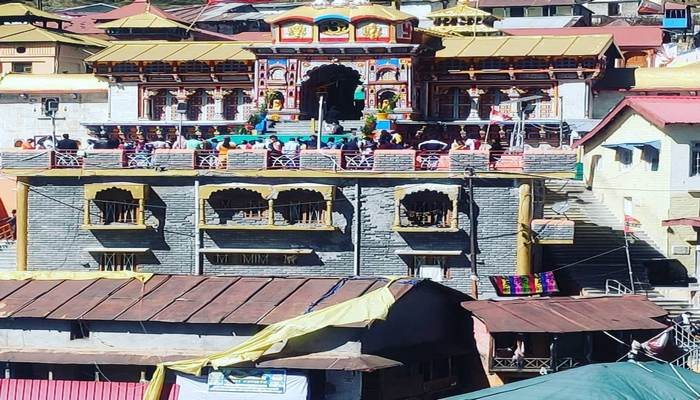
Hemkund Sahib is a world-renowned Sikh pilgrimage site and the highest Gurudwara in the world, perched at an altitude of approximately 4,329 meters (14,200 feet) in the Chamoli district of Uttarakhand. Situated on the banks of the pristine, glacial Hemkund Lake (also known as Lokpal Lake), the shrine is surrounded by seven snow-capped peaks, collectively known as Saptashringa, each marked with a triangular Sikh flag called a Nishan Sahib. The site holds immense spiritual significance as it is believed to be where Guru Gobind Singh Ji, the tenth Sikh Guru, performed deep meditation in a previous life, a detail mentioned in the Bachitra Natak within the Dasam Granth. Beyond its Sikh roots, the location is also sacred to Hindus, who believe Lord Lakshmana meditated here to recover from his injuries; a small temple dedicated to him stands near the Gurudwara. Due to heavy winter snowfall, the shrine is inaccessible from October to April, reopening each May for the annual Hemkund Sahib Yatra. The journey to this “Lake of Snow” involves a challenging 19 km trek starting from Govindghat, with a major stop at Ghangaria village, where pilgrims must return for overnight stays as the high altitude and freezing conditions at the shrine prevent sleeping arrangements at the top.
2.Badrinath Dham
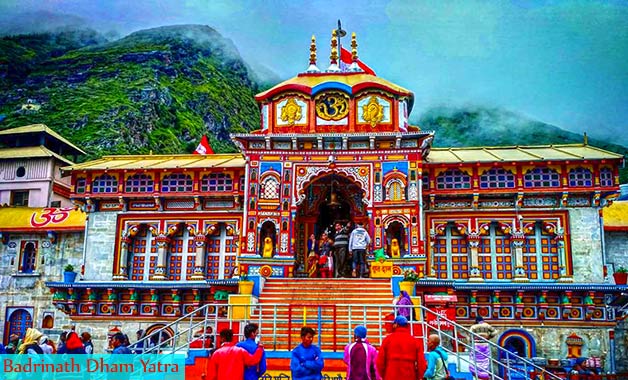
Badrinath Dham is one of the most sacred pilgrimage sites in Hinduism, serving as the northern anchor of the Char Dham circuit and one of the 108 Divya Desams dedicated to Lord Vishnu. Located in the Garhwal Himalayas at an altitude of approximately 3,133 metres (10,279 feet), the temple sits majestically between the Nar and Narayana mountain ranges on the banks of the Alaknanda River. For the 2026 season, the temple portals (kapat) officially opened on April 23, 2026, at 6:15 AM, and are tentatively scheduled to close in mid-November. The presiding deity is a 1-foot tall self-manifested (Swayam Vyakta) statue of Lord Vishnu carved from black Shaligram stone, depicting him in a meditative Padmasana posture. According to legend, Lord Vishnu performed intense penance here for the welfare of humanity, during which his consort, Goddess Lakshmi, took the form of a Badri (berry) tree to shield him from the harsh elements—giving the site its name. Re-established in the 8th century by Adi Shankaracharya, the temple complex includes the natural Tapt Kund hot springs, where devotees traditionally bathe before entering the shrine to purify themselves. Accessible by road from Rishikesh and Joshimath, the shrine remains a powerful symbol of spiritual liberation (Moksha) and draws millions of devotees during its six-month opening window each year.
3.Kedarnath Dham
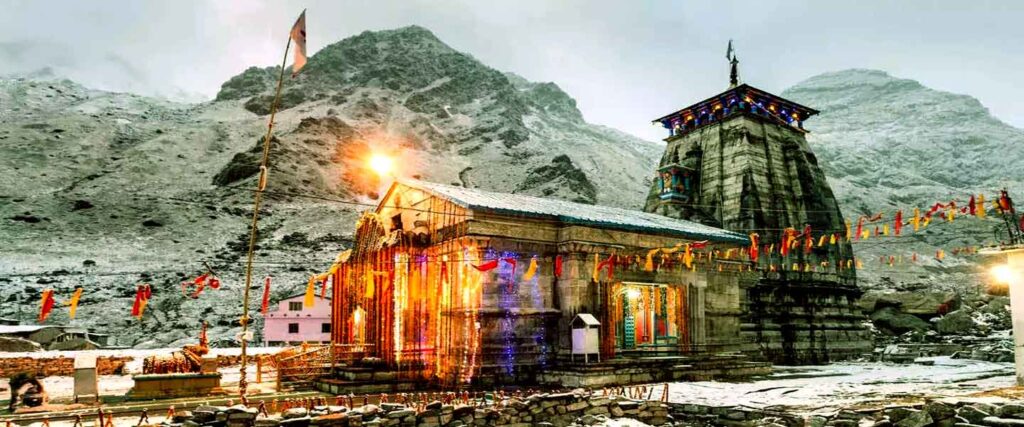
Kedarnath Dham is one of the most revered and spiritually significant shrines in Hinduism, dedicated to Lord Shiva and serving as the highest of the 12 Jyotirlingas in India. Perched at an altitude of approximately 3,583 metres (11,755 feet) in the Rudraprayag district of Uttarakhand, the temple stands majestically against the backdrop of the snow-clad Kedarnath peak and Kedar Dome. For the 2026 season, the temple portals officially opened on April 22, 2026, and are tentatively scheduled to close on November 11, 2026, for the winter. According to legend, the original temple was built by the Pandavas as an act of penance to seek forgiveness from Lord Shiva after the Kurukshetra war; when Shiva took the form of a bull to evade them and dived into the earth, his hump manifested at this sacred spot. The current stone structure, a masterpiece of ancient Nagara style architecture built from massive interlocking grey slabs, was revitalised in the 8th century by Adi Shankaracharya, whose samadhi lies just behind the shrine. Reaching the temple requires a challenging 16 km trek from the base at Gaurikund, though many pilgrims also opt for helicopter, pony, or palki services. The shrine famously survived the devastating 2013 floods, an event often attributed to a massive boulder—now worshipped as Bhim Shila—that rolled down and diverted the floodwaters away from the temple structure.
4.Gangotri Dham

Gangotri Dham is a sacred Himalayan shrine dedicated to Goddess Ganga, serving as one of the four essential pillars of the Chota Char Dham Yatra in Uttarakhand. Located at an altitude of approximately 3,100 metres (10,170 feet) in the Uttarkashi district, the 18th-century white granite temple was originally built by the Gorkha General Amar Singh Thapa near the site where the holy river is said to have first touched the earth. For the 2026 season, the temple portals officially opened on April 19, 2026, coinciding with the auspicious day of Akshaya Tritiya, and are scheduled to close on November 10 or 11, 2026, during the festival of Bhai Dooj. According to Hindu mythology, the river descended from the heavens to cleanse the sins of King Bhagirath’s ancestors; to prevent the earth from being swept away by her force, Lord Shiva caught the waters in his matted locks. While the temple is the center of worship, the physical source of the river—the Gaumukh Glacier—is located a further 19 km trek away from the town. Unlike Kedarnath, the main Gangotri temple is accessible by motorable road from Rishikesh (approx. 250 km), and during the winter months when the shrine becomes snowbound, the goddess’s idol is moved to its winter home in Mukhba village for continued worship.
5.Yamunotri Dham

Yamunotri Dham is the westernmost shrine of the Char Dham circuit and the sacred source of the Yamuna River, located at an altitude of 3,293 metres (10,804 feet) in the Uttarkashi district of Uttarakhand. Dedicated to Goddess Yamuna, the daughter of the Sun God (Surya) and sister of the God of Death (Yama), the temple marks the traditional starting point of the pilgrimage, which traditionally moves from west to east. For the 2026 season, the temple portals officially opened on April 19, 2026 (Akshaya Tritiya) and are expected to close on November 11, 2026 (Bhai Dooj). The main attraction is the black marble idol of the goddess, but the spiritual experience is centered around the Surya Kund natural hot springs, where pilgrims boil rice and potatoes in the scalding water to offer as prasad. Before entering the shrine, devotees offer prayers at Divya Shila, a massive rock pillar nearby. Reaching the temple requires a 6 km trek from the base camp at Janki Chatti, a path that winds through lush forests and waterfalls. During the harsh winter months when the shrine is buried in snow, the deity is moved to the village of Kharsali (also known as Khushimath), which houses the oldest Shani Dev temple in India, where she is worshipped until the following spring.
6. Har ki Pauri
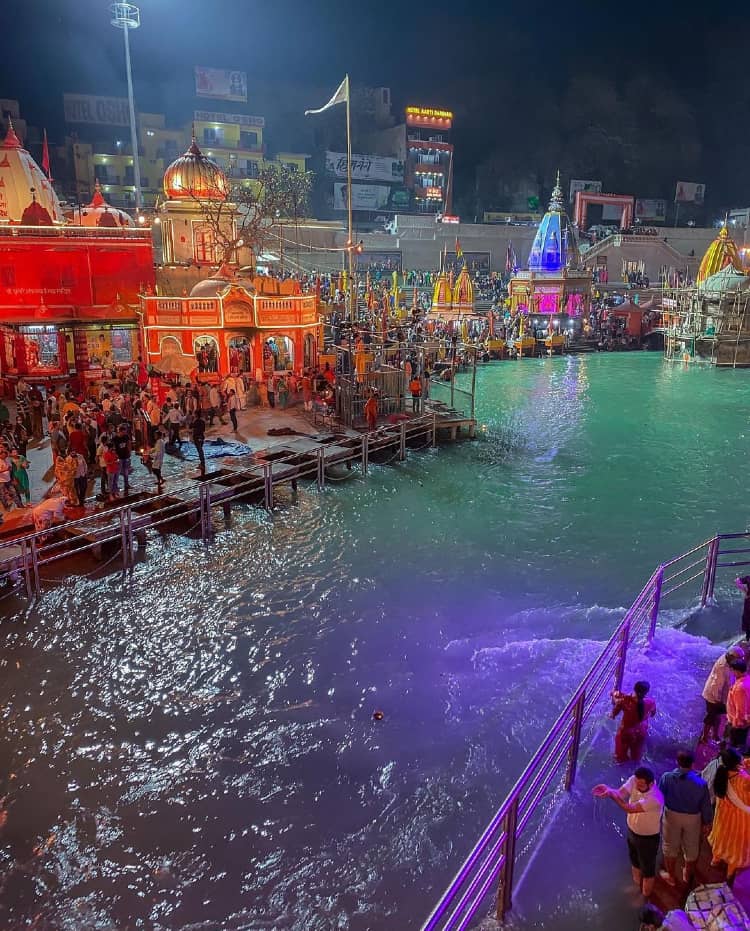
Har Ki Pauri is the spiritual heart of Haridwar and one of the most sacred bathing ghats in India, located at the precise spot where the holy river Ganges leaves the mountains and enters the plains. The name translates to “the feet of Lord Vishnu” (Hari), as it is believed that the deity visited this spot during Vedic times and left a footprint that is still revered today on a stone wall within the waters. According to Hindu mythology, this ghat contains the Brahmakund, the exact location where drops of Amrit (the elixir of immortality) fell from the sky while being carried by Garuda after the churning of the ocean (Samudra Manthan). Established in its original form in the 1st century BC by King Vikramaditya in memory of his brother Bharthari, the ghat has grown into a major pilgrimage hub that hosts the world-famous Kumbh Mela and Ardh Kumbh Mela every 12 and 6 years respectively. Today, thousands of devotees gather here daily to take a ritual dip, believed to wash away sins and grant Moksha (salvation), and to witness the mesmerizing evening Ganga Aarti. During this ceremony, priests perform rhythmic prayers with massive brass lamps while thousands of small leaf-floating lamps (diyas) are released into the river, creating a glowing, ethereal atmosphere that defines the spiritual essence of Haridwar.
7. Rishikesh
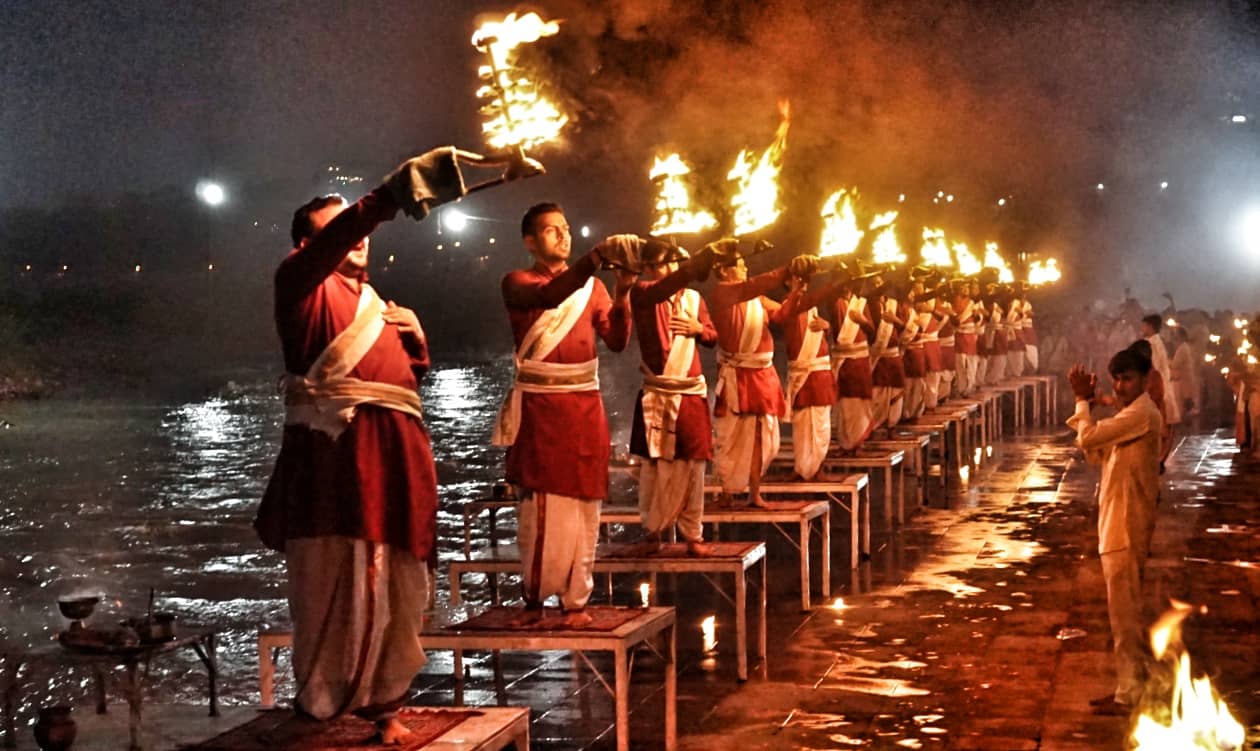
Rishikesh, widely celebrated as the “Yoga Capital of the World,” is a serene spiritual town nestled in the Himalayan foothills where the holy river Ganges emerges from the mountains into the plains. Located in the Dehradun district of Uttarakhand, it is a global epicenter for yoga, meditation, and spiritual learning, housing world-renowned ashrams such as Parmarth Niketan and the Beatles Ashram (Chaurasi Kutia), where the legendary band sought enlightenment in 1968. The town’s landscape is defined by iconic suspension bridges like Ram Jhula and Lakshman Jhula, which connect various temples and cafes across the jade-green waters of the Ganga. Beyond its spiritual allure, Rishikesh has evolved into the “Adventure Capital of India,” offering white-water rafting, bungee jumping, and trekking trails to sites like the Neelkanth Mahadev Temple. Every evening, the town is bathed in a divine glow during the Ganga Aarti at Triveni Ghat, where rhythmic chants and floating lamps create a mesmerizing atmosphere. As a gateway to the Char Dham Yatra, Rishikesh remains a unique destination that perfectly balances ancient Vedic traditions with modern-day adventure and nature tourism.
8. Mana Village

Mana Village, situated at an altitude of approximately 3,200 metres (10,500 feet) in the Chamoli district of Uttarakhand, is officially recognized as the “First Indian Village” on the Indo-Tibetan border. Located just 3–4 km ahead of the Badrinath Temple, this mythological hamlet is steeped in legends from the Mahabharata; it is believed to be the starting point of the Pandavas’ final journey to heaven, known as the Swargarohini yatra. The village is home to the Vyas Gufa, an ancient cave where Sage Ved Vyas is said to have composed the Mahabharata, and the nearby Ganesh Gufa, where Lord Ganesha acted as his scribe. Visitors can also witness the rare sight of the Saraswati River emerging with great force before disappearing underground near Bhim Pul, a massive natural rock bridge said to have been placed by Bhima for Draupadi to cross the river. Inhabited by the Bhotiya community, the village is famous for its hand-knotted woollen carpets, shawls, and the iconic “India’s First Tea Shop.” Due to heavy winter snow, the villagers migrate to lower altitudes from November to April, making the best time to visit between May and October.
9. Vasudhara Falls
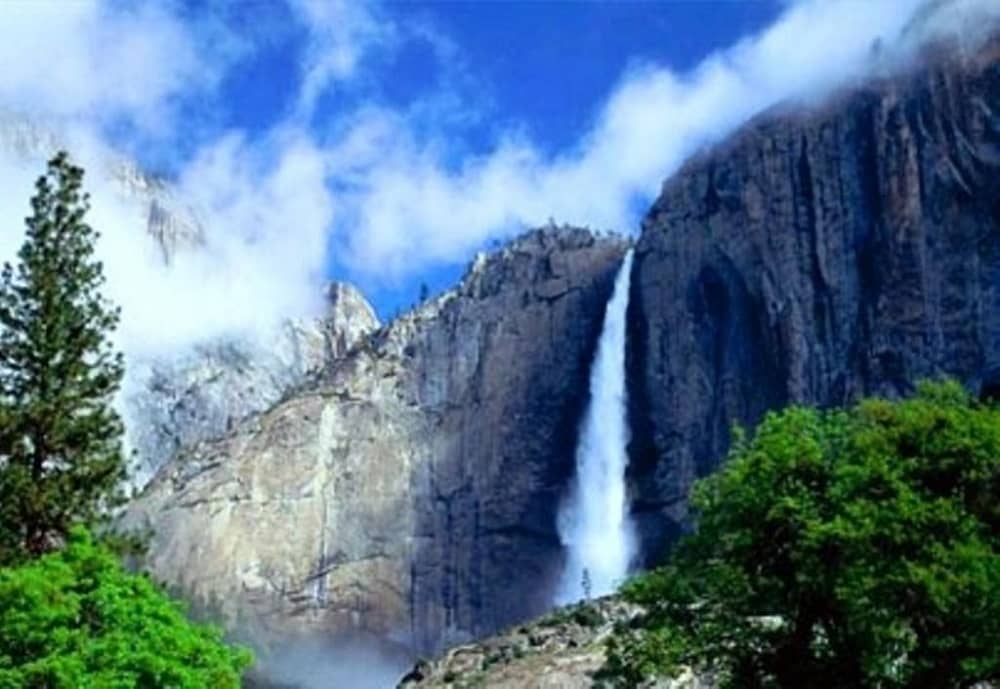
Vasudhara Falls is a majestic and spiritually significant waterfall situated at an altitude of approximately 3,700 metres (12,000 feet) in the Chamoli district of Uttarakhand. Plummeting from a height of about 400 feet (122 metres) against a backdrop of towering Himalayan peaks like Chaukhamba, Neelkanth, and Balakun, the falls eventually join the Alaknanda River. Reaching this natural wonder requires a moderate 6 km trek starting from Mana Village, which follows a rocky and steep trail through high-altitude terrain. In Hindu mythology, the site is deeply connected to the Pandavas, who are believed to have passed here during their final journey to heaven (Swargarohini), and it is famously said that the waterfall’s mist will not touch those who are impure at heart. The water itself is considered medicinal, as it flows through regions rich in Himalayan Ayurvedic herbs, and many pilgrims collect it as “holy nectar”. Due to its remote location and the lack of shops along the trail, visitors are advised to carry their own water and snacks and start the trek early to witness the falls in the best light.
10. Madhyamaheshwar Temple
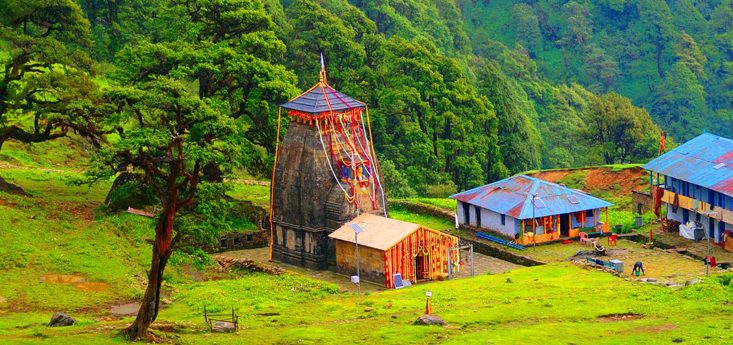
Madmaheshwar Temple, also known as Madmaheshwar, is a highly revered Hindu pilgrimage site dedicated to Lord Shiva and is considered the fourth temple to be visited in the sacred Panch Kedar pilgrimage circuit. Situated at an altitude of approximately 3,497 meters (11,473 feet) in the Rudraprayag district of Uttarakhand, the temple is nestled amidst the lush green meadows of the Kedarnath Wildlife Sanctuary. According to Hindu mythology, following the Kurukshetra War, the Pandavas sought out Lord Shiva to atone for their sins; when Shiva assumed the form of a bull to evade them and submerged himself into the earth, his navel (middle portion) emerged at this specific location, thereby giving the temple its name—meaning “The Great Lord of the Middle.” Reaching the temple requires undertaking a moderately difficult trek of 16–18 km (one way) starting from Ransi village, passing through picturesque hamlets such as Gondar and Bantoli, where the Madmaheshwar Ganga and Markandeya Ganga rivers converge. A short ascent further up from the main temple leads to ‘Budha Madmaheshwar’—a scenic mountain ridge offering some of the most breathtaking and unobstructed views of the majestic Chaukhamba and Neelkanth mountain peaks.
11. Kalimath
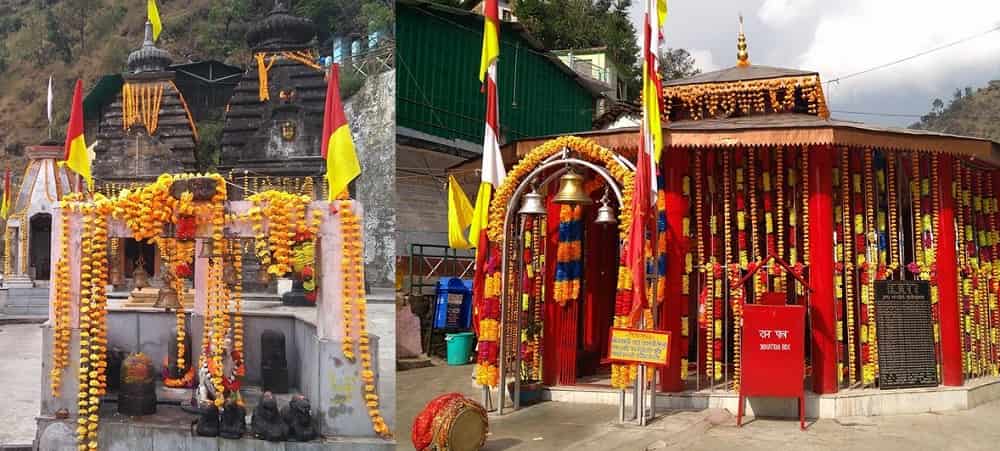
Kalimath is a highly revered Hindu Shakti Peeth located at an altitude of approximately 1,800 metres (5,905 feet) in the Rudraprayag district of Uttarakhand, situated on the banks of the sacred Saraswati River. It is unique among Indian temples because there is no idol of the deity; instead, devotees worship a silver plate (Shakti Yantra) that covers a sacred pit (kund) where Goddess Kali is believed to have vanished into the earth after slaying the demon Raktabija. According to the Skanda Purana, this is the only spot where the “Tridevi”—Mahakali, Mahalakshmi, and Mahasaraswati—are worshipped together in separate shrines within one complex. The silver plate is opened only once a year during the Ashtami of Sharad Navratri at midnight for a secret ritual performed by the chief priest. Another local legend connects it to the Dhari Devi Temple, believing Kalimath houses the lower half of the goddess while the upper half resides at Dhari Devi. Unlike the high-altitude shrines of the Char Dham, Kalimath remains open throughout the year and is a popular addition for pilgrims on the Kedarnath route, being just 13 km from Ukhimath.
12. Chandrashila
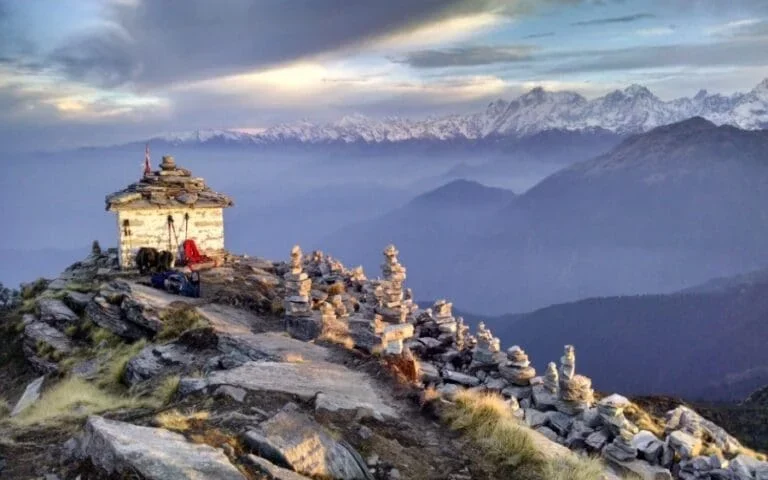
Chandrashila, which translates to “Moon Rock,” is a majestic Himalayan summit situated at an altitude of approximately 4,000 metres (13,123 feet) in the Rudraprayag district of Uttarakhand. It is the crowning jewel of the Tungnath range and is famously accessible via a scenic 5 km trek starting from the meadows of Chopta, often called the “Mini Switzerland of India”. The peak is steeped in mythology; one popular legend states that Lord Rama meditated here to seek penance after defeating Ravana, while another tells of Chandradev (the Moon God) performing years of penance at this spot to please Lord Shiva. The trek first leads to Tungnath Temple, the highest Shiva shrine in the world and part of the Panch Kedar circuit, before a steep 1.5 km final ascent to the summit. Upon reaching the top, trekkers are rewarded with an unparalleled 360-degree panoramic view of some of the highest peaks in India, including Nanda Devi, Trishul, Chaukhamba, and Kedar Dome. Known for its spectacular sunrises that turn the snow-clad mountains golden, Chandrashila remains a favorite for both spiritual seekers and adventure enthusiasts, offering a rare blend of ancient legend and breathtaking natural beauty.
13. Surya Kund

Surya Kund is a highly significant sacred site in the Char Dham Yatra, most famously known as the natural thermal spring located adjacent to the Yamunotri Temple in the Uttarkashi district of Uttarakhand. At an altitude of 3,293 metres (10,804 feet), this spring is named after the Sun God (Surya), who in Hindu mythology is considered the father of the Goddess Yamuna. The water in Surya Kund is exceptionally hot, reaching temperatures of approximately 88°C (190°F), which pilgrims believe is a manifestation of the Sun God’s divine energy and warmth for his daughter. A unique and essential ritual involves pilgrims tying rice and potatoes in a muslin cloth and dipping them into the steaming waters; the food is cooked within minutes and is later offered as prasad at the temple. While Yamunotri’s hot spring is the most prominent, another revered Surya Kund exists near the Gangotri Temple, where it manifests as a spectacular waterfall on the Bhagirathi River; legend states that Goddess Parvati used to bathe there to pay homage to the Sun God, and a natural Shivling can be seen submerged in its waters during the winter months. Whether at Yamunotri or Gangotri, Surya Kund remains a powerful symbol of the intersection between geothermal natural wonders and deep Vedic faith.
14. Saptrishi Kund

Saptrishi Kund is a high-altitude glacial lake located at an elevation of approximately 4,421 metres (14,500 feet) in the Uttarkashi district and is considered the true geological source of the Yamuna River. While the Yamunotri Temple is the primary site of worship, the river actually originates from the Champasar Glacier which feeds this pristine, dark-blue lake. According to Hindu mythology, the lake is named after the Saptarishis—the seven great sages (Kashyapa, Atri, Bharadwaj, Vishwamitra, Gautama, Jamadagni, and Vasistha)—who are believed to have performed intense penance and Vedic rituals here for thousands of years. Reaching the Kund is an arduous and challenging 7–10 km trek from the Yamunotri Temple, involving steep climbs over glaciers, rocky moraines, and ridges with no predefined paths. The surroundings are known for their raw natural beauty, featuring rare Brahma Kamal flowers and unique naturally formed slate stones along the banks. Due to the treacherous terrain and extreme weather, the trek is recommended only for experienced trekkers with a local guide, as night stays at the Kund are nearly impossible due to heavy winds and freezing temperatures.
15. Devprayag Sangam
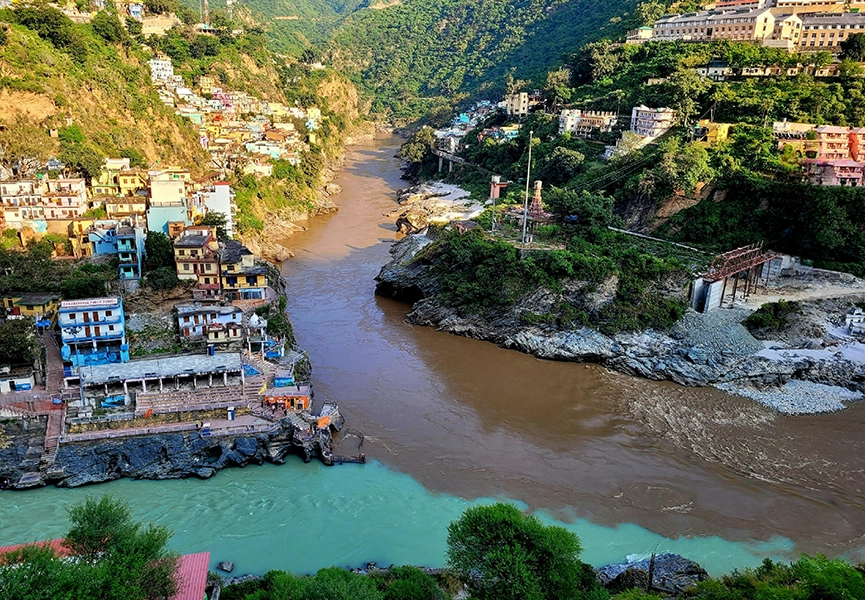
Devprayag Sangam is one of the most spiritually significant sites in India, marking the sacred confluence where the Alaknanda and Bhagirathi rivers merge to officially become the Holy Ganges. Located at an altitude of approximately 830 metres (2,723 feet) in the Tehri Garhwal district, it is the final and most famous of the Panch Prayags (five holy confluences). The meeting of the two rivers is a visually stunning spectacle: the Bhagirathi, known for its blue-green, turbulent waters, represents the “mother-in-law,” while the Alaknanda, which appears calmer and brownish, is termed the “daughter-in-law” in local folklore. Towering above the Sangam is the ancient Raghunathji Temple, believed to be over 1,000 years old and dedicated to Lord Rama, who is said to have performed intense penance here to atone for the sin of killing Ravana. This “Godly Confluence” is a vital stop for pilgrims on the Char Dham Yatra route and is the traditional winter seat of the priests of Badrinath Dham.