
Ahmedabad, also known as ‘Amdavad,’ is the largest city in Gujarat. It is a unique destination where a beautiful blend of 600-year-old history and rapid modern development can be witnessed. Founded in 1411 by Sultan Ahmed Shah on the banks of the Sabarmati River, the city was declared India’s first ‘UNESCO World Heritage City’ in 2017, recognized for its exquisite architecture and urban planning. The city is particularly renowned for its ‘Pols’ (traditional residential clusters).
Historically, Ahmedabad played a pivotal role in India’s freedom struggle, serving as the home of Mahatma Gandhi; it was here that he established the Sabarmati Ashram. From an economic perspective, the city came to be known as the ‘Manchester of India’ due to its massive textile industry; today, however, it has also emerged as a major hub for education, pharmaceuticals, and chemicals. Tourists visiting the city can explore a diverse range of historical monuments—such as the intricate stone carvings at the ‘Sidi Saiyyed Mosque,’ the modern ‘Sabarmati Riverfront,’ and the world’s largest cricket stadium, the ‘Narendra Modi Stadium.’ The city is nothing short of a paradise for food enthusiasts; its ‘Manek Chowk’ is famous for its spicy street food, while traditional Gujarati snacks like ‘Dhokla’ and ‘Fafda’ are also immensely popular here.
Ahmedabad’s economy is characterized by a diverse range of industrial activities, earning it the status of Gujarat’s ‘Economic Capital.’ According to 2023 estimates, the total GDP of this metropolitan city stood at approximately $136.1 billion. Historically referred to as the ‘Manchester of the East,’ the city remains a global leader in the textile industry to this day—specifically, driven by major companies like ‘Arvind Mills,’ it stands as the world’s largest producer of denim. Ahmedabad is generally regarded as one of India’s safest cities—whether for its local residents or for tourists visiting from outside. In 2025, it was declared the country’s safest major city across various global databases. The city is considered particularly safe for women traveling alone; they can unhesitatingly stroll the streets or take a cab even late at night, as the roads remain quite busy and well-lit during those hours.
Most Famous And Attractive Tourist Places In Ahmedabad :
1. Sabarmati Riverfront
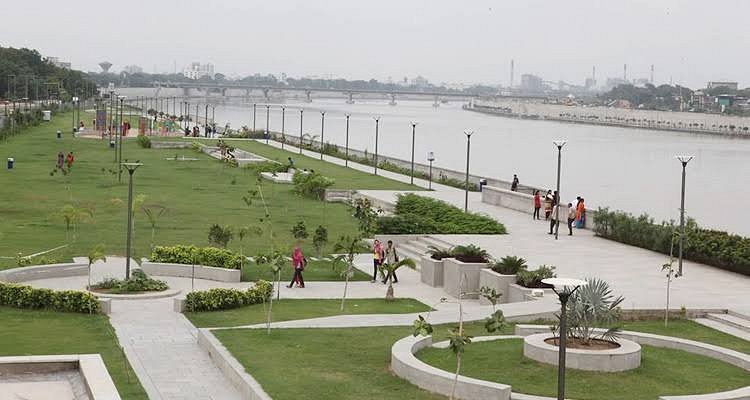
The Sabarmati Riverfront is a massive urban development project that has completely transformed the banks of the Sabarmati River into a vibrant public space in the heart of Ahmedabad. Spanning over 11 kilometres on each side, the area features a unique two-level promenade: the lower level is designed specifically for pedestrians and cyclists to enjoy the water’s edge, while the upper level houses lush parks, gardens, and cultural venues. It is a major recreational hub where you can go for morning walks, enjoy boat rides, or visit iconic attractions like the Atal Pedestrian Bridge and the Riverfront Flower Park. Beyond being a beautiful spot for locals and tourists, the project has improved the city’s environment by cleaning the river and providing better flood protection.
2. Rani ki Vav
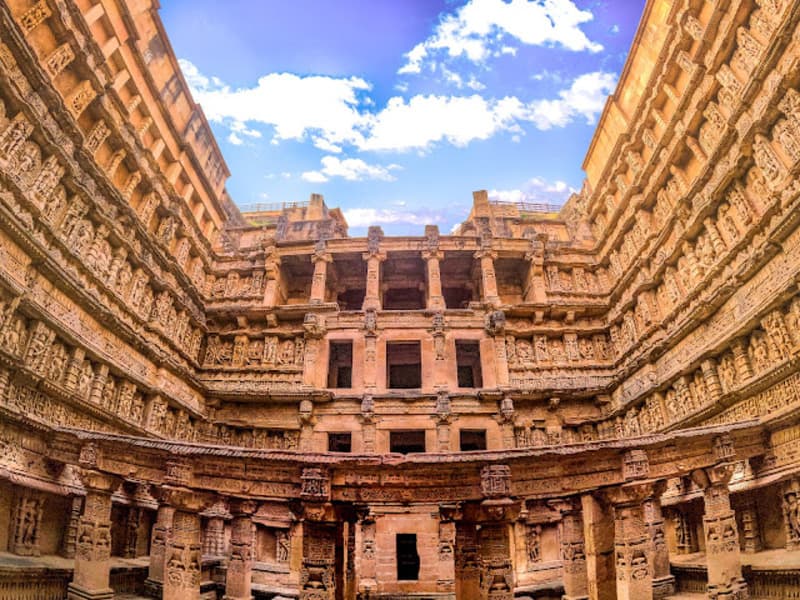
Rani ki Vav, or the “Queen’s Stepwell,” is a magnificent UNESCO World Heritage Site located in Patan, about 125 km from Ahmedabad. Built in the 11th century by Queen Udayamati in memory of her husband, King Bhimdev I, it is famous for its unique design as an “inverted temple”. Unlike traditional temples that rise upwards, this seven-storey structure descends deep into the ground, celebrating the sanctity of water. For centuries, it remained hidden and buried under the silt of the Saraswati River until it was excavated and restored by the Archaeological Survey of India in the 1980s. Today, it is so iconic that it is featured on the back of the Indian ₹100 note.
3. Kankaria Lake
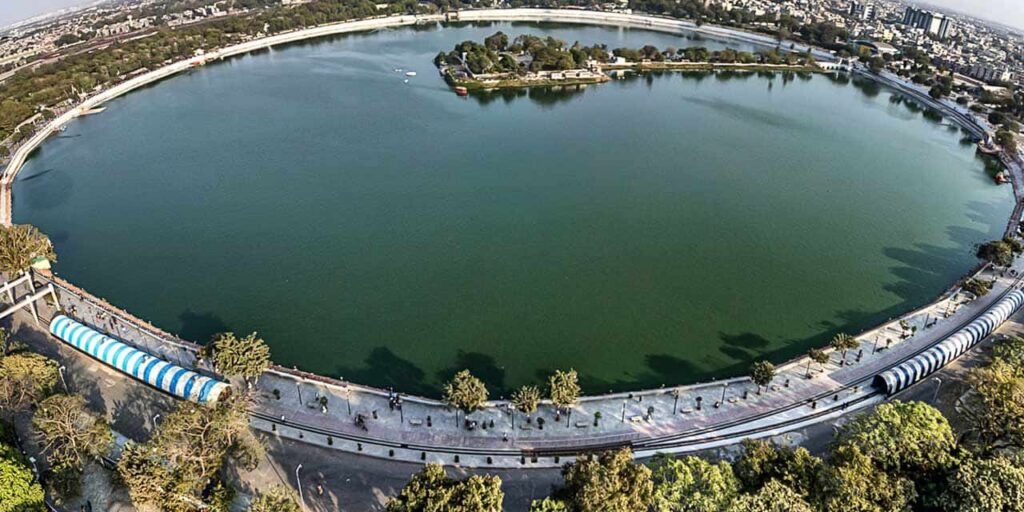
Kankaria Lake is the largest man-made lake in Ahmedabad and serves as the city’s most popular entertainment hub for families and tourists. Originally built in the 15th century by Sultan Qutb-ud-Din, it was once a royal bathing place for kings, but today it is a beautifully developed lakefront with a paved pedestrian promenade. The lake is a 34-sided polygon that features a stunning garden-themed island in its centre called Nagina Wadi, which is accessible by a tree-lined walkway. Visitors flock here to enjoy a wide variety of activities, including the Atal Express toy train that circles the lake, tethered hot-air balloon rides, a world-class zoo, and a musical fountain show.
4. Bhadra Fort
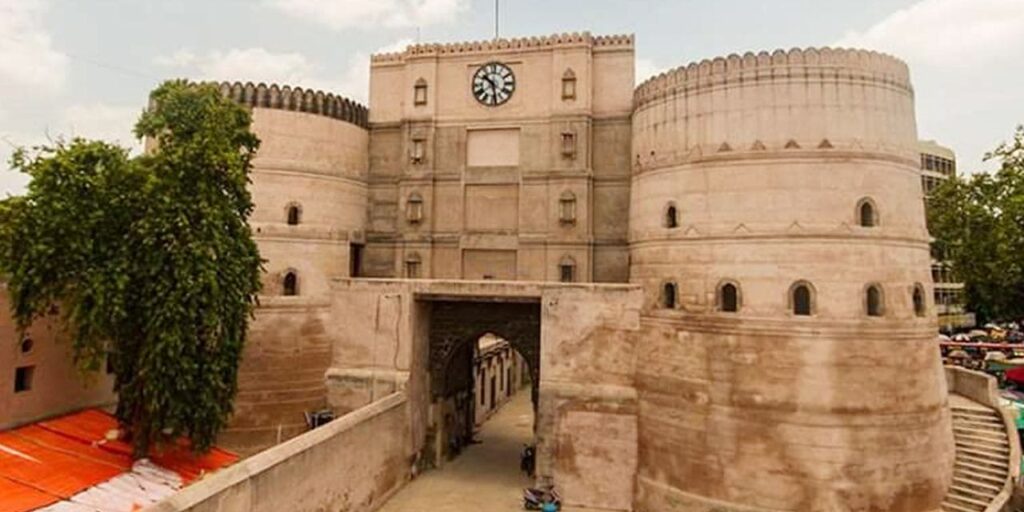
Built in 1411 by Sultan Ahmad Shah I, the Bhadra Fort stands as the historic foundation of Ahmedabad, Gujarat. Spanning roughly 43 acres, this massive citadel was designed as the royal headquarters of the Gujarat Sultanate, featuring classic Indo-Saracenic architecture with intricately carved arches, balconies, and sturdy red sandstone walls. Its name is believed to be derived from the Bhadrakali Temple, a shrine dedicated to the goddess Kali that was established within the premises during Maratha rule. The fort complex is famous for the Teen Darwaza (Triple Gateway), which once led to a grand royal square where processions and martial games were held. Other significant structures inside include the Azam Khan Sarai, a palace-turned-inn built during the Mughal era, and a prominent Clock Tower added by the British in 1849. Beyond its stone walls, the fort is tied to the legend of Goddess Lakshmi, who is said to have blessed the city with eternal prosperity at this very spot. Today, while it houses several government offices, it remains a bustling cultural landmark and a protected monument under the Archaeological Survey of India.
5. Auto World Vintage Car Museum
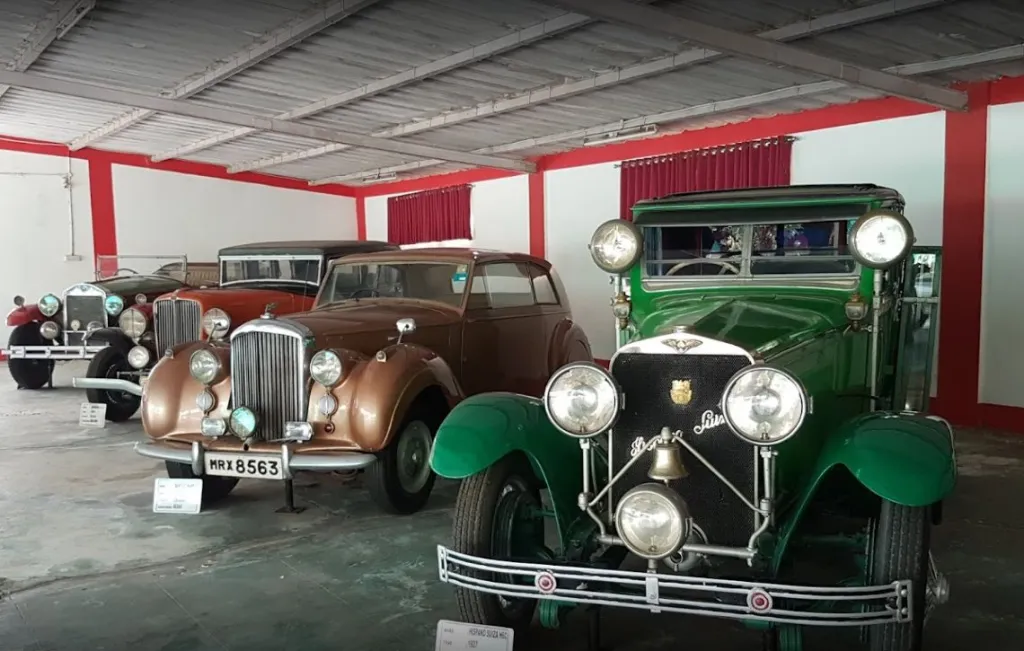
The Auto World Vintage Car Museum, located within the Dastan Estate in Ahmedabad, is home to one of the largest and most prestigious private collections of vintage cars in India. Established by the late Shri Pranlal Bhogilal, a Guinness World Record holder, the museum showcases over 100 meticulously maintained automobiles ranging from the early 1900s to the 1970s. The collection features rare gems such as Rolls-Royces, Bentleys, Mercedes-Benz, Maybachs, and Cadillacs, many of which were custom-built for Indian Maharajas and international royalty. Notable highlights include a 1923 Rolls-Royce Silver Ghost styled like a Victoria carriage and a 1927 Phantom I with a boat-tail roadster body. A unique feature of the museum is that most vehicles remain in drivable condition, and for a fee, visitors can even book a short 3.5 km ride in one of these classic beauties. The sprawling 2,200-acre estate also includes a section for antique horse-drawn carriages, a children’s play area, and an authentic Gujarati thali restaurant, making it a complete heritage experience.
6. Sardar Vallabhbhai Patel National Memorial
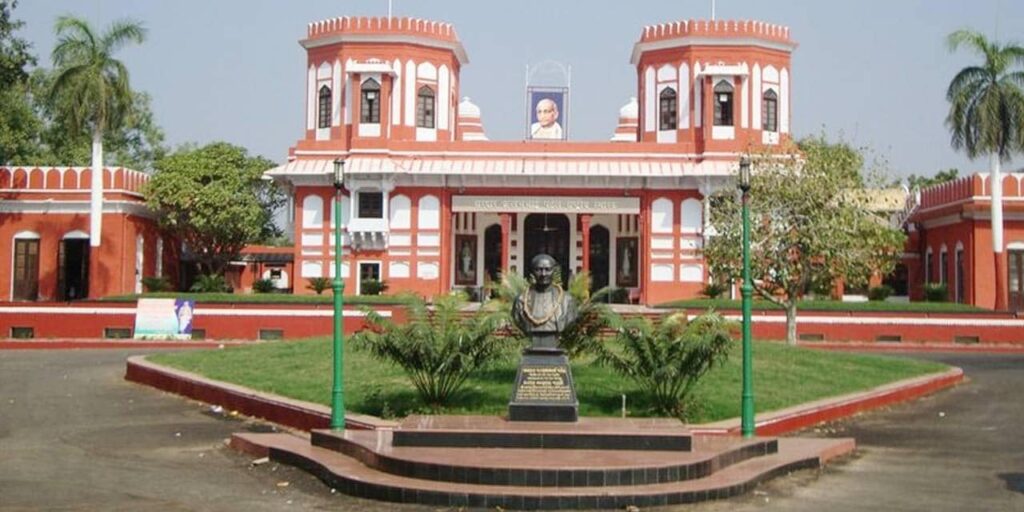
The Sardar Vallabhbhai Patel National Memorial in Ahmedabad, Gujarat, is a prominent museum and exhibition centre dedicated to India’s first Deputy Prime Minister and Home Minister, the “Iron Man of India.” Housed in the historic Moti Shahi Mahal, a 17th-century palace built by Mughal Emperor Shah Jahan between 1618 and 1622, the memorial blends imperial Mughal architecture with contemporary exhibits. The museum chronicles Patel’s life and his monumental role in the Indian independence movement and the subsequent unification of over 560 princely states through a rich collection of personal artifacts, including his clothes, footwear, and legal documents, alongside rare photographs and political cartoons. Notably, the palace also features a room dedicated to Rabindranath Tagore, who stayed there in 1878, and houses interactive multimedia galleries that utilize 3D sound, light, and laser mapping technology to narrate India’s history. Surrounded by the lush Shahibaug Gardens, the complex serves as a vital educational hub for visitors to reflect on the legacy of nation-building and Patel’s uncompromising commitment to national integration.
7. Jhulta Minar
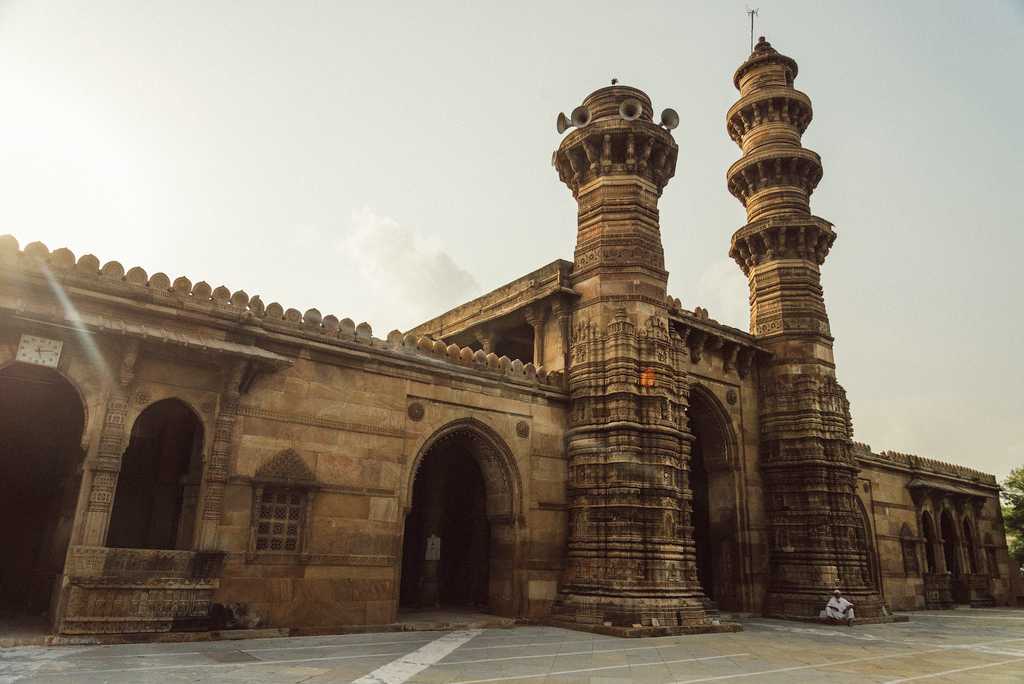
The Jhulta Minar, or the Shaking Minarets, is an extraordinary 15th-century architectural wonder located at the Sidi Bashir Mosque near Sarangpur Gate in Ahmedabad. The minarets are famous for a unique and unexplained engineering phenomenon: when one minaret is gently shaken, the other begins to vibrate within seconds, even though the connecting arched passage remains completely steady. Built around 1452 AD—either by Sidi Bashir, a slave of Sultan Ahmed Shah, or Malik Sarang, a noble in the court of Mahmud Begada—these three-storey towers stand roughly 70 feet tall and feature intricately carved stone balconies and internal spiral staircases. The structure is a masterclass in Indo-Saracenic design, blending Islamic and Rajputana styles, and is believed by some to have been built with earthquake-resistant foundations using flexible sandstone. While much of the original mosque was destroyed in 18th-century battles between the Marathas and the Gujarat Sultanate, the two surviving minarets remain a major attraction, though public entry to climb them was closed in 1981 for preservation.
8. Kamla Nehru Zoo
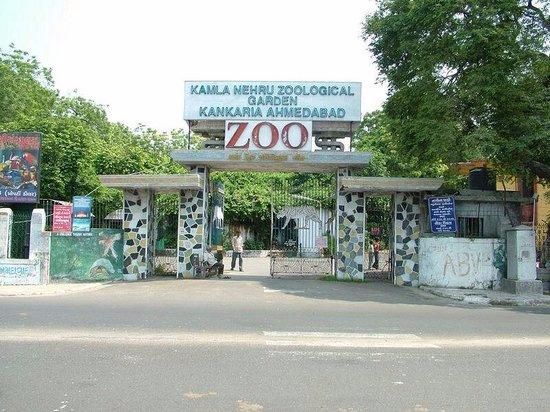
The Kamla Nehru Zoological Garden, popularly known as the Kankaria Zoo, is a premier wildlife destination situated on the outer periphery of the historic Kankaria Lake in Ahmedabad. Established in 1951 by the renowned self-taught veterinarian and Padma Shri recipient Reuben David, the zoo was once recognized as the “Best Zoo in Asia” in 1974. Spanning roughly 117 acres, it serves as a critical conservation and breeding centre for endangered species such as crocodiles, pythons, and Asiatic lions. The park houses a diverse collection of over 450 animals, 2,000 birds, and 140 reptiles, including rare highlights like the white blackbuck, spotted deer, and Nicobar pigeons. One of its most innovative features is the Nocturnal Animal House, which uses geothermal aeration to maintain a natural environment for species like bats and civets to remain active during visiting hours. Today, it is managed by the Ahmedabad Municipal Corporation and remains one of India’s most visited zoological gardens, attracting over 30 lakh visitors annually.
9. Law Garden
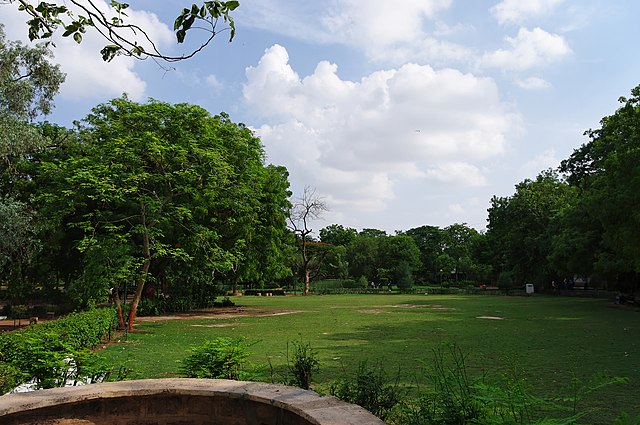
Law Garden, officially known as Sheth Motilal Hirabhai Park, is a vibrant urban oasis in the heart of Ahmedabad, famous for being a premier cultural and shopping hub. Established in an area bordering the city’s Law College (from which it takes its name), the 10-acre garden features lush green lawns, a jogging track, and a serene pond, serving as a peaceful retreat for morning walkers. However, the area truly comes alive in the evening as it transforms into a bustling Night Market. Artisans from Kutch and Saurashtra set up stalls along the garden walls, offering a colourful array of traditional Gujarati attire, including Chaniya Cholis with intricate mirror work, Bandhani sarees, and oxidized silver jewelry. Bargaining is a key part of the experience here, with shoppers often negotiating significantly to get the best deals on handicrafts and ethnic home decor. Complementing the shopping is the adjacent Happy Street (formerly Khau Gully), a famous food lane where visitors can enjoy authentic street food like Pav Bhaji, Dabeli, and Ashrafi’s Kulfi.
10. Gujarat Science City
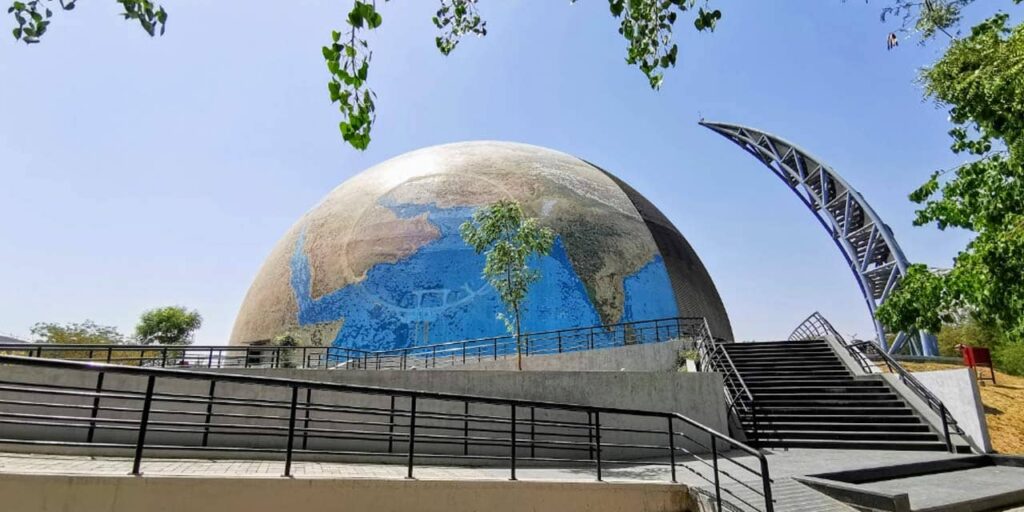
Gujarat Science City, located in the Hebatpur area of Ahmedabad, is India’s premier and largest science education and entertainment complex. Spread across more than 107 hectares of lush green land, it was established by the Government of Gujarat in 2001 to foster a scientific temperament among citizens. The sprawling campus features state-of-the-art facilities, including an IMAX 3D Theatre, a Robotics Gallery with interactive humanoid robots, and the Aquatic Gallery, which houses India’s largest public aquarium with a 28-metre-long shark tunnel. Visitors can explore specialized zones like the Planet Earth Pavilion, which mimics natural disasters, the Hall of Space, and an Energy Education Park. The complex is designed to be highly interactive, encouraging guests to “touch and learn” through working models, virtual reality stations, and live science demonstrations. Beyond the galleries, the city offers immersive experiences like Mission to Mars simulator rides and a stunning Musical Fountain show in the evening.
11. Parimal Garden
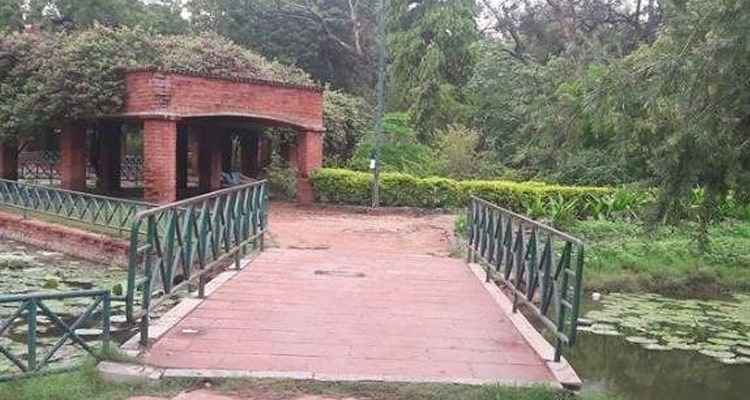
Parimal Garden is one of Ahmedabad’s most beloved and well-maintained public parks, located in the bustling Ambawadi area. Originally established in 1960, the garden underwent a massive, award-winning renovation in 2022 that transformed it into a world-class urban space while preserving its iconic heritage. Spanning over 8.5 acres, the garden is famous for its picturesque lotus pond, traditional red-brick arches, and a diverse collection of trees that provide a lush canopy for visitors. It is designed to be inclusive, featuring a dedicated senior citizen area with swinging benches, a large children’s play zone, and a world-class gymnasium. The park’s layout seamlessly blends modern landscape design with historical elements, such as its old stone pavilions and a beautifully lit fountain that serves as a centerpiece in the evenings. For fitness enthusiasts, it offers one of the best walking and jogging tracks in the city, making it a popular hub for both quiet morning yoga sessions and lively evening strolls.
12. Vastrapur Lake
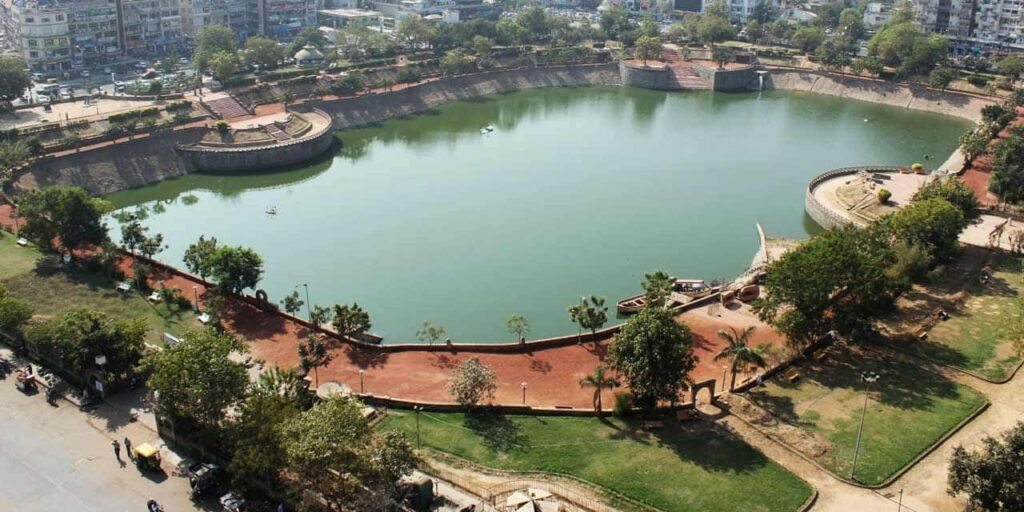
Vastrapur Lake, officially renamed Bhakt Kavi Narsinh Mehta Sarovar in 2013, is a popular man-made lake and urban recreational hub in western Ahmedabad. Originally beautified by the Ahmedabad Municipal Corporation (AMC) in 2002, the lake serves as a “green lung” for the city, featuring a 600-metre paved pathway that is a favorite for local walkers and joggers. The complex is renowned for its open-air amphitheatre, which frequently hosts major cultural events and musical performances, and a large central statue of the 15th-century poet-saint Narsinh Mehta. In addition to its scenic stone-walled gardens and lush lawns, the lakefront offers a children’s play park, boating facilities, and an evening musical fountain show. After a major ₹10 crore renovation, the lake reopened in late 2025 with a refreshed look, featuring new fitness equipment and improved landscaping.
13. One Tree Hill Garden
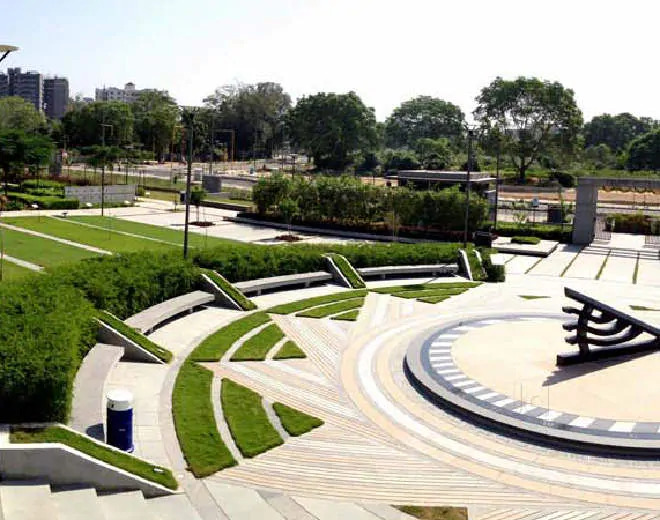
One Tree Hill Garden, located on the southern banks of Kankaria Lake in Ahmedabad, is a serene botanical and historical park known for its unique blend of natural beauty and colonial heritage. The garden gets its name from a legendary lone tree that once stood on its embankment before the area was fully developed. It is most famous for housing the Dutch and Armenian tombs, which date back to the 17th century (1641–1699) and feature distinctive Saracenic architecture with domes, pillars, and pyramid-shaped structures. These monuments serve as a reminder of the Dutch East India Company’s strong trade presence in Ahmedabad for textiles and indigo. Beyond its history, the park offers a peaceful escape from the bustling lakefront with well-maintained lawns, vibrant flower beds, and panoramic views of the water, making it a popular spot for morning yoga, photography, and nature lovers.
14. Dada Bhagwan Temple
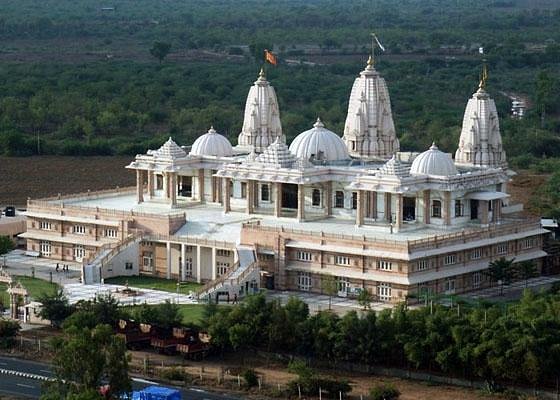
The Dada Bhagwan Temple, famously known as the Adalaj Trimandir, is a unique non-sectarian temple located on the Ahmedabad-Kalol Highway. Established by the Dada Bhagwan Foundation, the temple follows the visionary concept of Param Pujya Dada Bhagwan, who sought to unite different religions on a single platform to eliminate sectarian differences. The magnificent two-storey structure is built from pink sandstone and features a central 108-foot-high shikhar. On the first floor, the main sanctum houses a 13-foot marble idol of Lord Simandhar Swami, flanked by deities from Jainism, Shaivism, and Vaishnavism—including Lord Shiva and Lord Krishna—all receiving equal reverence. The ground floor contains a massive, 10,000-square-foot Satsang Hall with a seating capacity of 6,000, where spiritual discourses are held. The peaceful complex also includes an informative museum, a mini-theatre showcasing the life of Dada Bhagwan, beautifully manicured gardens, and a dedicated “Store of Happiness” for children.
15. Sarkhej Roza, Ahmedabad
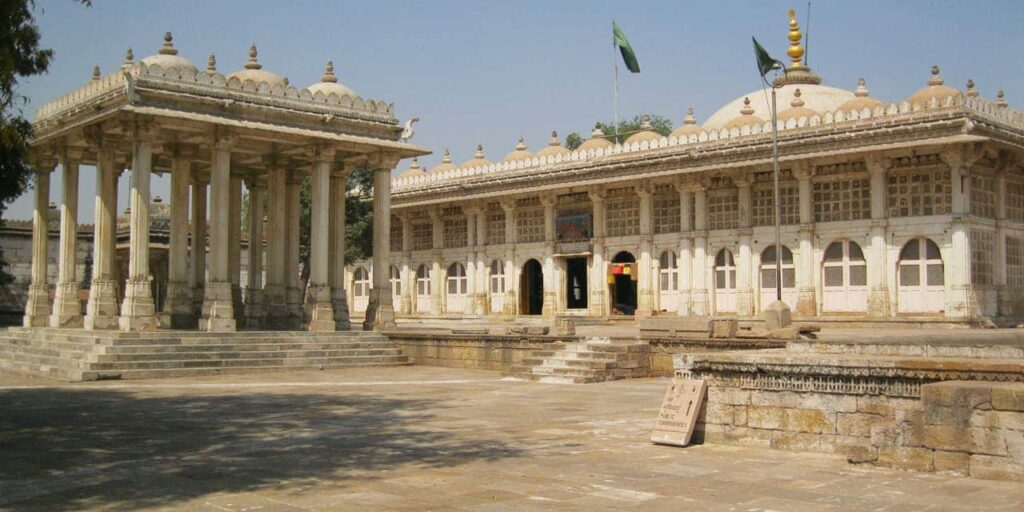
Sarkhej Roza, famously described by modernist architect Le Corbusier as the “Acropolis of Ahmedabad,” is an exquisite 15th-century mosque and tomb complex located in the Makarba village area. It was originally built as a tribute to the revered Sufi saint Shaikh Ahmed Khattu Ganj Baksh, the spiritual advisor to Sultan Ahmed Shah I, who is credited with suggesting the location for the city of Ahmedabad. The complex is a masterpiece of early Indo-Saracenic architecture, unique for its flat-roofed structures and 120 stone pillars that blend Islamic, Persian, and Hindu design elements without the typical minarets or arches found in later Mughal buildings. Over the decades, it was expanded by Sultan Mahmud Begada to include a massive rectangular water tank known as Ahmed-Sar, surrounded by summer palaces for kings and queens, a harem (Zenana), and the royal tombs of Mahmud Begada and his queen Rajabai. Today, it remains a thriving spiritual hub, especially vibrant during Ramzan and annual Sufi festivals, offering a tranquil historical escape on the city’s outskirts.
16. Hutheesing Jain Temple, Ahmedabad
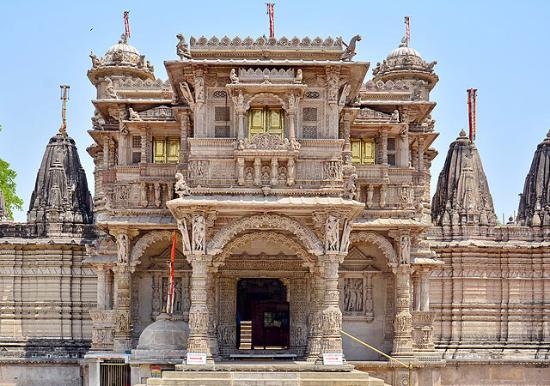
The Hutheesing Jain Temple, located outside Delhi Gate in Ahmedabad, is a 19th-century architectural masterpiece renowned for its intricate marble work and serene ambiance. Constructed in 1848 by the wealthy merchant Sheth Hutheesing Kesarisinh and completed by his wife Shethani Harkunwar during a severe famine, the project famously provided livelihoods for hundreds of skilled artisans for over two years. Dedicated to Lord Dharmanatha, the 15th Jain Tirthankara, the temple blends the traditional Maru-Gurjara style with elements of a traditional Gujarati haveli, featuring carved balustrades, overarching balconies, and stone screens with floral lattis work. The main two-storey structure houses a central sanctum with 11 idols and is surrounded by a sprawling courtyard containing 52 secondary shrines, each enshrining a Tirthankara idol. A prominent feature in the outer courtyard is the 78-foot-high Manastambha (Tower of Victory), inspired by the Kirti Stambha of Chittorgarh, which was added in 2003 to mark the 2500th birth anniversary of Lord Mahavira.
17. Akshardham Temple, Ahmedabad
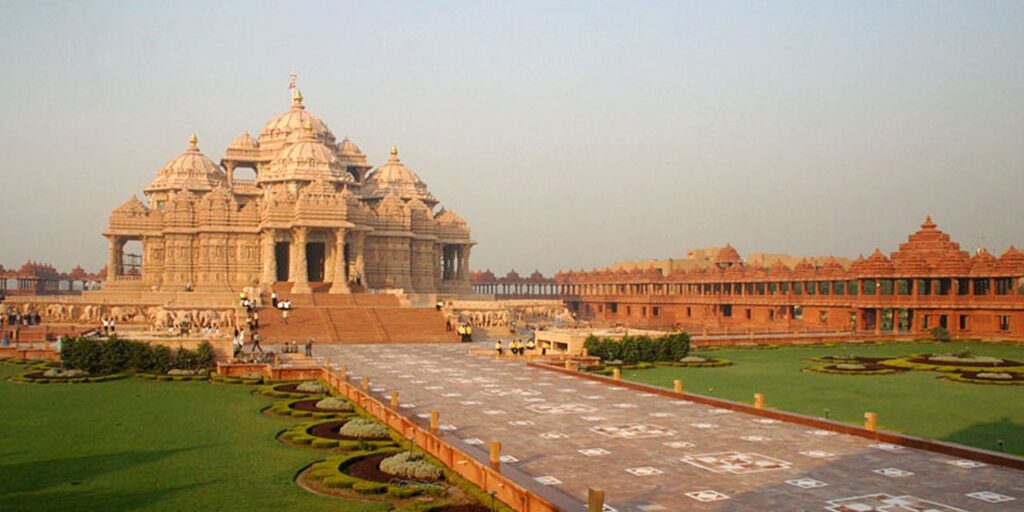
The Swaminarayan Akshardham Temple, located in Gandhinagar (just 30 km from Ahmedabad), is a monumental cultural and spiritual complex dedicated to Bhagwan Swaminarayan. Inaugurated in 1992 by the BAPS Sanstha, the temple is an architectural marvel built entirely from 6,000 tonnes of pink sandstone without the use of any structural steel or iron. The central monument stands 108 feet high and features a 7-foot gold-leafed idol of Lord Swaminarayan, surrounded by intricately carved pillars and 210 single-piece stone beams. The sprawling 23-acre campus is famous for its Exhibition Halls, which use immersive audio-visuals and dioramas to showcase Indian heritage, and the Sat-Chit-Anand Water Show, a spectacular evening performance using lasers, fire, and water screens to tell spiritual stories. Beyond its religious significance, the temple serves as a hub for peace and education, housing the Sahajanand Van gardens and a dedicated research centre.
18. Nalsarovar Bird Sanctuary, Ahmedabad
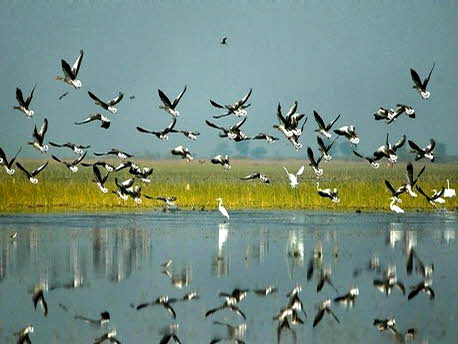
Nalsarovar Bird Sanctuary, located roughly 64 km from Ahmedabad, is the largest wetland bird sanctuary in Gujarat and a designated Ramsar site of international importance. Spanning 120 square km of shallow freshwater lake and marshy islands, it serves as a critical wintering ground for over 250 species of birds. Between November and February, thousands of migratory guests—including flamingos, pelicans, rosy starlings, and brahminy ducks—travel from as far as Siberia and Europe to the lake’s 360 islets. The primary attraction is a peaceful ride in a hand-rowed country boat at sunrise or sunset, which allows visitors to get close to the avian life in the shallow 4-foot waters. The area is also home to the Padhar community, known for their unique folk culture and skills as boatmen, and features an Abhiruchi Kendra interpretation centre that provides multimedia exhibits on migratory routes and local biodiversity.
19. Manek Chowk
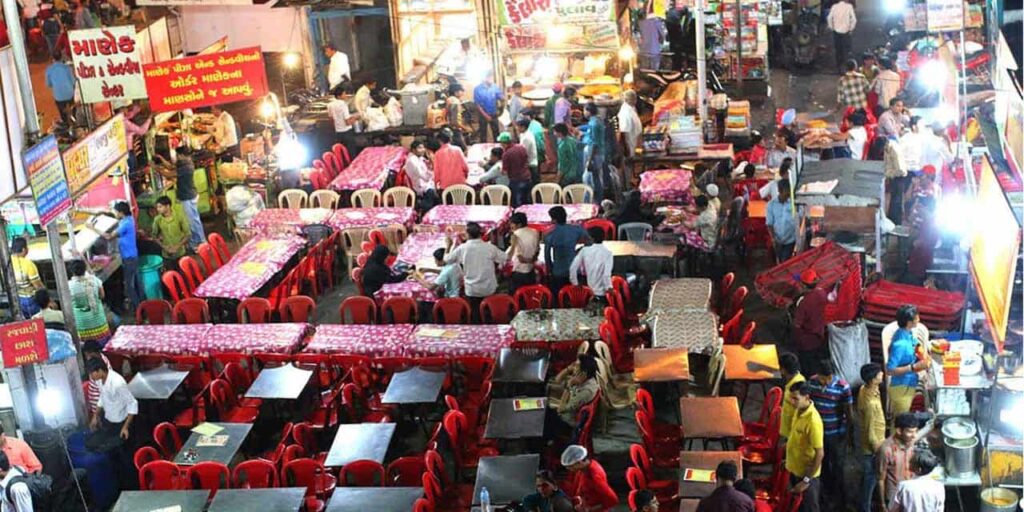
Manek Chowk is a prominent city square in the Old City of Ahmedabad that is famous for its unique three-way transformation throughout the day. Named after the legendary 15th-century saint Baba Maneknath, who assisted Sultan Ahmed Shah I in building the city, the square starts its day as a bustling vegetable and fruit market in the early morning hours. By afternoon, it shifts into one of India’s most important jewelry hubs, reportedly the second largest in the country, with transactions worth crores of rupees occurring in its narrow lanes. However, its most famous avatar begins after 9:00 PM, when the jewelry shops close and the area transforms into a legendary night food market. Foodies flock here until late at night to enjoy iconic street delicacies such as the Gwalior Dosa, the massive Chocolate Sandwich, Pineapple Sandwiches, and traditional Kulfi, making it the vibrant culinary soul of Ahmedabad’s heritage area.
20. Vechaar Utensils Musuem
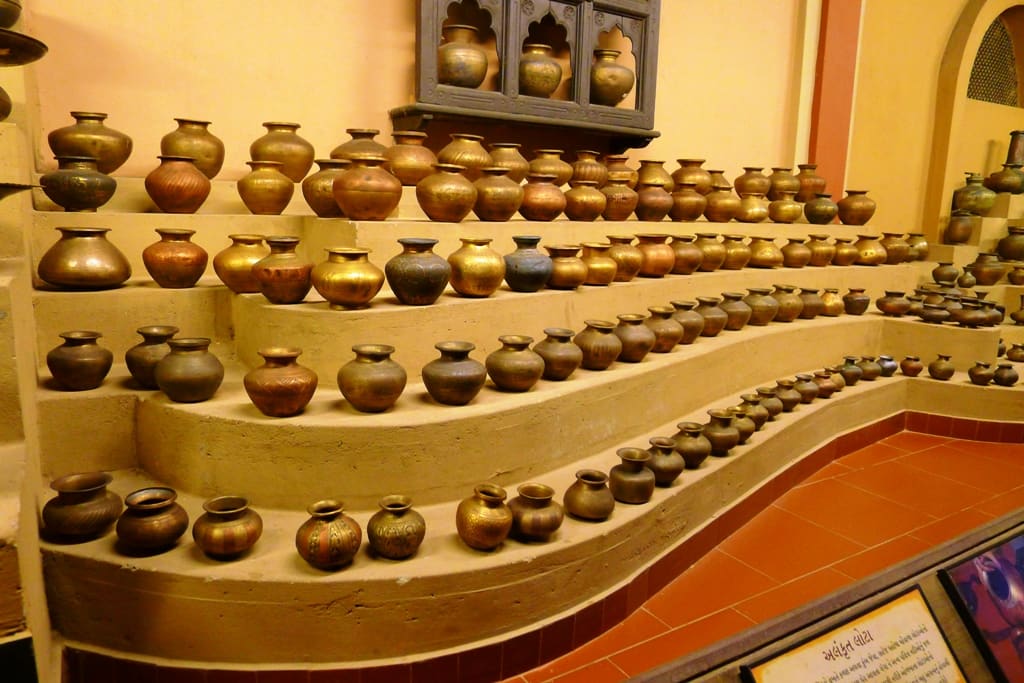
The Vechaar Utensils Museum (Vishalla Environmental Centre for Heritage of Art, Architecture and Research) in Ahmedabad is a unique cultural landmark dedicated to preserving India’s rich history of domestic tools. Established in 1981 by architect Surendra Patel with the guidance of anthropologist Dr. Jyotindra Jain, the museum was born out of a desire to save traditional metalware from being melted down for scrap. Housed in a rustic, hut-like structure made of mud, bamboo, and straw, the museum creates a traditional village atmosphere that complements its collection. It features over 4,500 exhibits spanning nearly a thousand years, ranging from everyday clay pots and brass water pitchers to intricate royal silverware, nutcrackers, and ritual accessories. Visitors can explore galleries dedicated to metal utensils and specialty items like sudis (nut cutters), all displayed freely without glass cases to allow for a more immersive experience. The museum is located within the premises of the famous Vishalla Restaurant, where the theme of traditional heritage continues through authentic Gujarati meals served on leaf plates in a floor-seated setting.