
The Kathmandu-Chitwan Tour offers the “best of both worlds” experience in Nepal, seamlessly blending the country’s deep spiritual heritage with its wild, subtropical natural beauty. This journey begins in the historic capital, Kathmandu—a city that feels like a living museum—where you spend your days exploring ancient UNESCO World Heritage Sites. You will witness sacred Hindu cremation rituals at Pashupatinath Temple, join hundreds of pilgrims in a meditative “Kora” (circumambulation) around the colossal Boudhanath Stupa, and climb the steps of Swayambhunath (the Monkey Temple) for panoramic views of the entire valley. After soaking up the intricate wood carvings and medieval history of Durbar Square, the tour takes you southward to the lush lowlands of the Terai region, where you visit Chitwan National Park.
This world-renowned sanctuary stands in stark contrast to the mountains; the adventure continues with a tranquil canoe ride along the Rapti River—where you can spot crocodiles basking on the riverbanks—followed by a visit to a traditional Tharu village, where you can learn about the indigenous culture and witness their vibrant ‘Stick Dance’ performances. It is a comprehensive journey that fully encapsulates both Nepal’s spiritual soul and its wild heart, all without the need for strenuous trekking. The Kathmandu-Chitwan Tour is generally considered a low-risk and safe vacation option, equally popular among solo travelers, families, and groups alike. Since this tour avoids high altitudes and arduous treks, it is physically more accessible and safer for children and elderly travelers compared to many of Nepal’s mountain-based itineraries.
Most Famous And Attractive Tourist Places In Kathmandu Chitwan Tour :
1. UNESCO Heritage Sites in Kathmandu

The Kathmandu Valley is home to seven UNESCO World Heritage monument zones that collectively illustrate the region’s rich cultural and artistic achievements. These seven sites are clustered across the three ancient cities of Kathmandu, Patan, and Bhaktapur. The list includes three historic royal courtyards—Kathmandu Durbar Square, Patan Durbar Square, and Bhaktapur Durbar Square—which showcase intricate Newari wood and stone carvings once built for Malla kings. Complementing these are two sacred Hindu temple complexes: Pashupatinath, a sprawling site dedicated to Lord Shiva, and Changu Narayan, considered the oldest temple in the valley with inscriptions dating back to the 5th century. The valley is also defined by two massive Buddhist stupas: Swayambhunath (the Monkey Temple), which offers panoramic city views from its hilltop perch, and Boudhanath, one of the largest stupas in the world and a central hub for Tibetan Buddhism. Together, these sites form a “living museum” where ancient religious traditions and medieval architecture continue to thrive in the modern day.
2. Spiritual Views at the “Monkey Temple”
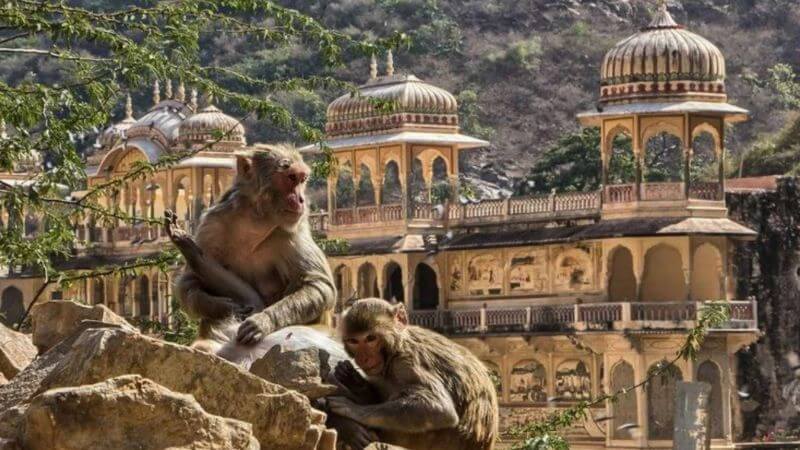
The Swayambhunath Stupa, famously known as the Monkey Temple, is one of Nepal’s most iconic spiritual landmarks, perched atop a lush hill overlooking the Kathmandu Valley. This ancient religious complex is a profound symbol of harmony, as it is sacred to both Buddhists and Hindus, who frequently visit to offer prayers and perform rituals. The main white dome is crowned by a shimmering gold spire painted with the “all-seeing eyes” of the Buddha, representing wisdom and compassion looking out over the four cardinal directions. Reaching the top requires a climb up a steep stone staircase of 365 steps, where visitors are often greeted by the large population of rhesus macaque monkeys that live within the temple grounds and are considered holy. Once at the summit, the atmosphere is a blend of spinning prayer wheels, the scent of burning incense, and the chanting of monks, all set against a 360-degree panoramic view of the sprawling city below and the majestic Himalayan peaks in the distance.
3. Scenic Transition to the Terai
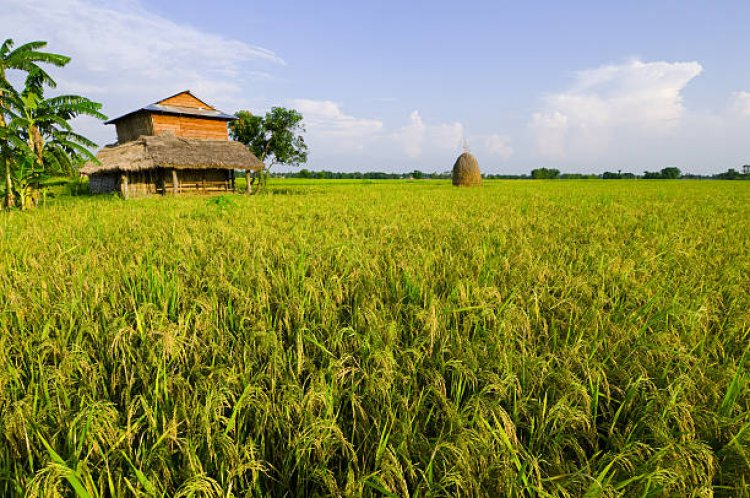
The journey from the high-altitude hills of Kathmandu to the flat, subtropical plains of the Terai is a dramatic and scenic transition that showcases Nepal’s diverse geography. Most travelers take the Prithvi Highway, a winding road that snakes alongside the emerald-green Trishuli River, famous for its white-water rafting. As you descend from the valley, the cool mountain air gradually turns warmer and more humid, and the landscape shifts from steep, terraced hillsides to wide, fertile basins. A major highlight of this transit is the stop at Kurintar, where a 10-minute cable car ride whisks visitors up to the sacred Manakamana Temple; this vantage point offers breathtaking views of the river deep below and the towering peaks of the Annapurna and Manaslu ranges on a clear day. By the time you reach the plains of Chitwan, the narrow gorges open up into vast forests and grasslands, marking your arrival in the lush heart of Nepal’s lowland wilderness.
4. Jeep and Elephant Safaris in Chitwan

The wildlife safari in Chitwan National Park is the heart of the tour, offering two distinct ways to explore one of Asia’s finest wildlife reserves. A jeep safari is the most popular choice for covering vast distances, allowing you to venture deep into the dense sal forests and sprawling grasslands to increase your chances of spotting the elusive Royal Bengal Tiger or a sloth bear. These open-top 4×4 vehicles provide a comfortable vantage point and typically offer both half-day and full-day options led by expert naturalists. Alternatively, an elephant safari provides a more traditional and stealthy experience; because wild animals do not perceive humans on the back of an elephant as a threat, you can often get within just a few meters of the Greater One-horned Rhinoceros and various species of deer. While jeep safaris are restricted during the monsoon season due to muddy tracks, the park remains a year-round haven for birdwatchers and nature enthusiasts who come to witness Nepal’s successful conservation of these endangered species.
5. Canoeing on the Rapti River
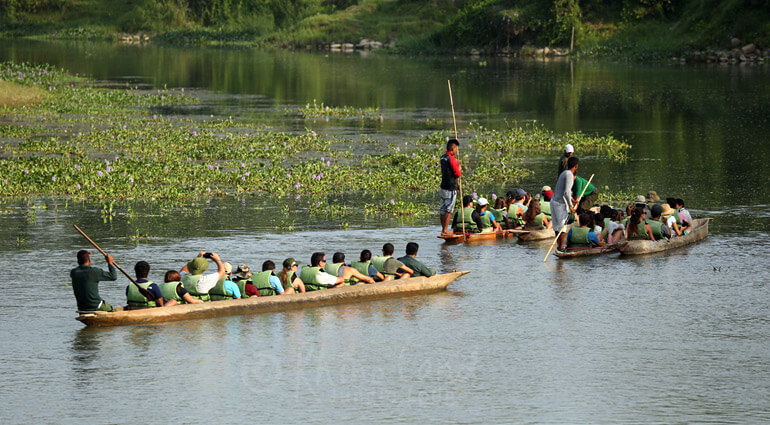
A canoeing trip on the Rapti River is one of the most serene and captivating experiences in Chitwan, typically taking place in the early morning or late afternoon when wildlife is most active. You will board a traditional dugout canoe, hand-carved from a single tree trunk, and glide silently down the calm waters that border the national park. This silent approach is perfect for spotting two rare species of crocodiles: the fish-eating Gharial, known for its long, thin snout, and the broader Marsh Mugger, both of which can often be seen sunbathing on the sandy riverbanks. Beyond the reptiles, the river is a paradise for birdwatchers, as you are likely to see vibrant kingfishers, egrets, storks, and migrating water birds. The gentle drift provides a unique perspective of the jungle’s edge, offering a peaceful contrast to the high-energy jeep safaris and a chance to soak in the golden light reflecting off the water.
Overview
Travel is the movement of people between relatively distant geographical locations, and can involve travel by foot, bicycle, automobile, train, boat, bus, airplane, or other means, with or without luggage, and can be one way or round trip. Travel can also include relatively short stays between successive movements.
The origin of the word “travel” is most likely lost to history. The term “travel” may originate from the Old French word travail, which means ‘work’. According to the Merriam Webster dictionary, the first known use of the word travel was in the 14th century.
It also states that the word comes from Middle English travailen, travelen (which means to torment, labor, strive, journey) and earlier from Old French travailler (which means to work strenuously, toil). In English we still occasionally use the words “travail”, which means struggle. According to Simon Winchester in his book The Best Travelers’ Tales (2004), the words “travel” and “travail” both share an even more ancient root: a Roman instrument of torture called the tripalium (in Latin it means “three stakes”, as in to impale).