
Spain is a transcontinental country situated primarily on the Iberian Peninsula in southwestern Europe. It is renowned for its diverse geography, rich history, and vibrant culture. As the fourth-largest country in Europe, it features a central plateau flanked by mountain ranges, as well as an extensive coastline bordering the Mediterranean Sea and the Atlantic Ocean. Historically, Spain has been shaped by Roman rule, a long-lasting Islamic Moorish influence, and the role it played as a global empire following Christopher Columbus’s voyages in 1492. Today, it is a parliamentary constitutional monarchy and a prominent member of the European Union. Its cultural identity is defined by a deep passion for food—particularly tapas and paella—the world-renowned art of great masters like Picasso and Dalí, and a lifestyle that prioritizes social interaction and regional traditions such as flamenco. From the lush, rain-swept landscapes of the north to the sun-drenched beaches of the south, and to the architectural marvels of cities like Madrid and Barcelona, Spain remains one of the world’s most visited and culturally influential nations. It is the home of tapas—small plates of food shared among friends—as well as paella, a famous rice dish originating in Valencia. People love Spain for its beautiful coastal beaches and vibrant festivals, such as the ‘Running of the Bulls’ or the massive ‘Tomatina’ tomato fight.
Spain’s economy is one of the largest in the world, supported by several key industries that provide employment and wealth to the nation. Its greatest support comes from the service sector, particularly tourism. Because Spain boasts beautiful beaches and renowned cities, it is the second most-visited country in the world; indeed, this industry alone accounts for approximately 12% of its total wealth. Spain is considered one of the safest countries in Europe for tourists and consistently receives a “Normal Safety Precautions” rating from major travel advisories.
Most Famous And Attractive Tourist Places In Spain :
1. Sagrada Familia Barcelona
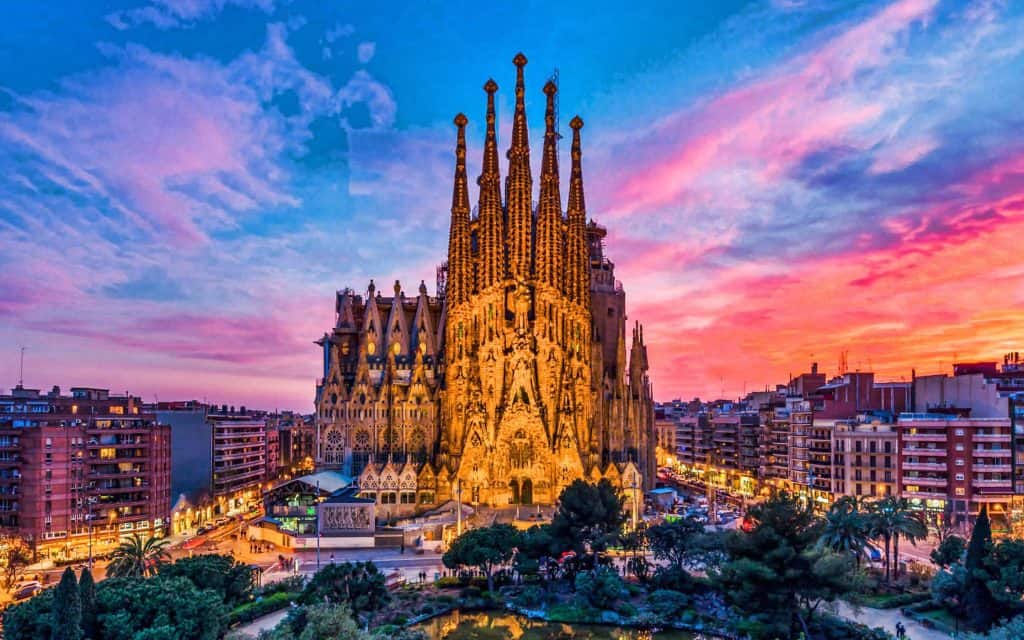
The Basílica i Temple Expiatori de la Sagrada Família, located in the Eixample district of Barcelona, is the world’s largest unfinished Catholic church and a definitive icon of Catalan Modernism. Designed by the legendary architect Antoni Gaudí, who took over the project in 1883, the basilica has been under continuous construction for over 140 years. Gaudí’s vision was a radical departure from traditional Gothic styles, blending organic, nature-inspired forms with intricate Christian symbolism to create a “Bible in stone”. The structure features three grand façades: the Nativity façade, which celebrates the birth of Jesus with lush, floral details; the Passion façade, characterized by stark, skeletal sculptures representing his death; and the yet-to-be-finished Glory façade. Inside, the soaring nave is supported by columns that branch out like trees, creating a forest-like atmosphere bathed in shifting light from vibrant stained-glass windows. In February 2026, the central Tower of Jesus Christ reached its full height of 172.5 metres, making the Sagrada Família the tallest church in the world—though it remains exactly one metre shorter than Barcelona’s Montjuïc Hill, as Gaudí believed human work should never exceed God’s creation. Funded solely by private donations and visitor ticket sales, the main architectural elements are aimed for completion in 2026 to mark the centenary of Gaudí’s death.
2. Alhambra

The Alhambra, situated atop Sabika Hill in Granada, Spain, is a breathtaking palace and fortress complex that stands as the most significant remnant of Islamic rule in the Iberian Peninsula. Originally established as a small fortress in the 9th century, it was transformed into a majestic “palatine city” by the Nasrid Dynasty starting in 1238, serving as the royal residence for the last Muslim emirs of Al-Andalus. Its name, derived from the Arabic Al-Qal’ah al-Hamrā (“The Red Fortress”), reflects the distinct reddish hue of its rammed-earth walls. The complex is celebrated for its exquisite Moorish architecture, featuring the world-renowned Nasrid Palaces with their intricate “honeycomb” muqarnas ceilings, delicate stucco carvings, and vibrant geometric tilework known as azulejos. Beyond the fortifications of the Alcazaba, the site includes the Generalife, a summer estate famous for its lush terraced gardens and tranquil water channels that represent the Islamic vision of paradise. Following the Christian Reconquista in 1492, the Alhambra became the Royal Court for Ferdinand and Isabella—the very site where Christopher Columbus received endorsement for his voyage—and later saw the addition of the Renaissance-style Palace of Charles V. Today, it is a protected UNESCO World Heritage Site, recognized as one of the most beautiful and well-preserved examples of medieval Islamic art in the world.
3. Pub Crawl

A pub crawl, also known as a bar crawl or bar-hopping, is a social activity where a group of people visits multiple pubs or bars in a single evening, typically having at least one drink at each venue. While the term “crawl” likely refers to the physical state of participants after several stops, the tradition has its roots in British pub culture of the late 19th century and has evolved into a global phenomenon for exploring local nightlife. Modern pub crawls are often organized by hostels or tour companies, providing a structured way for solo travellers and tourists to meet new people while discovering a city’s best hidden spots safely. These events usually follow a set route—often within a walkable neighborhood to keep energy high—and frequently include perks like free welcome shots, discounted drinks, and VIP entry to top nightclubs. Whether spontaneous or professional, the primary goal of a pub crawl is to experience the diverse atmospheres of various local establishments in one “marathon” night of social connection.
4. Palma Aquarium
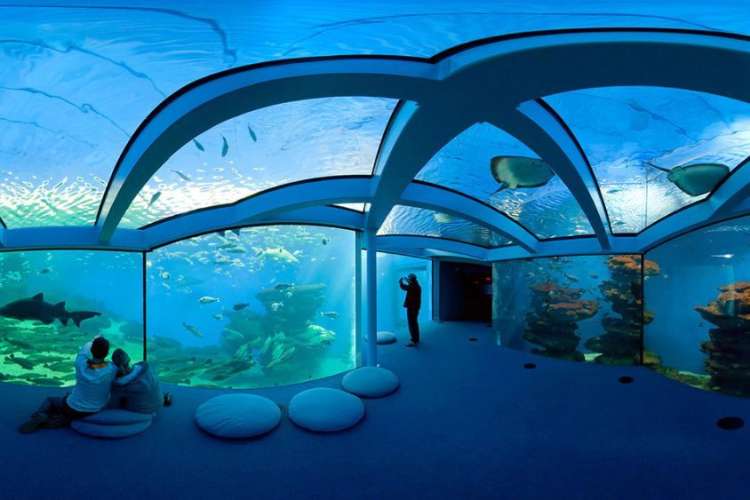
Palma Aquarium, located in the Playa de Palma area of Mallorca, is one of Europe’s most advanced marine parks, designed as an immersive journey through the world’s oceans. Opened in 2007, the facility houses over 8,000 specimens from roughly 700 different species across 55 tanks. Its crowning jewel is the “Big Blue,” which holds the title of the deepest shark tank in Europe at 8.5 metres deep, allowing visitors to walk through a transparent tunnel as sharks and rays glide overhead. The park is uniquely divided into thematic zones, including the Mediterranean Sea, Tropical Seas (boasting the largest collection of live coral in Europe), and The Jungle, which is the largest rooftop garden in Spain, recreating a humid Amazonian rainforest with a seven-metre waterfall. Beyond traditional viewing, the aquarium offers high-tech experiences like the Aquadome, a 3D cinema focused on humpback whales, and interactive activities such as the Shark Vision Boat or even “Shark Sleepovers” for children. Heavily committed to conservation, the park also manages the Palma Aquarium Foundation, which works on the rescue and rehabilitation of local marine species like sea turtles and dolphins.
5. Costa Brava
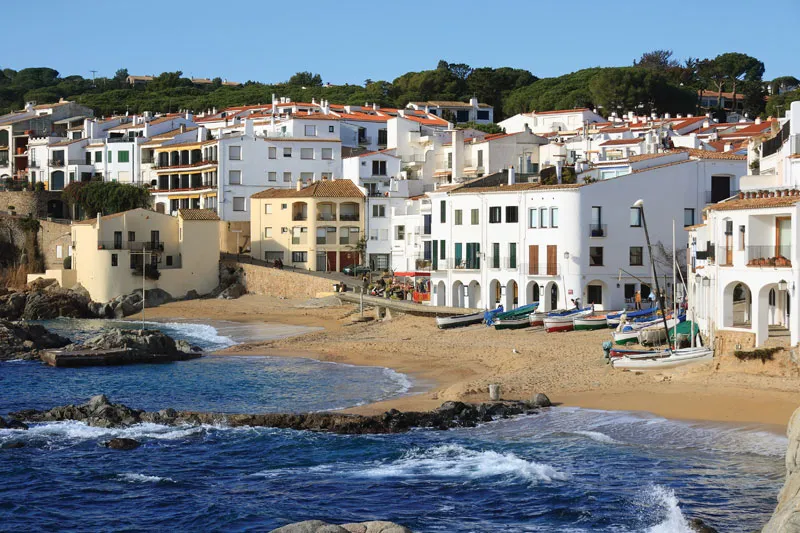
The Costa Brava, meaning “Wild Coast,” is a stunning 214-kilometre stretch of coastline in northeastern Catalonia, Spain, extending from the town of Blanes to the French border. Defined by its rugged cliffs, hidden turquoise coves (calas), and fragrant pine forests that grow right down to the shoreline, it has long been a source of inspiration for artists like Salvador Dalí. The region offers a diverse mix of experiences, from the vibrant, bustling beaches of Lloret de Mar to the preserved, whitewashed beauty of Cadaqués, where Dalí once lived. Beyond its natural beauty, the Costa Brava is steeped in history, featuring the ancient Greco-Roman ruins of Empúries, well-preserved medieval villages like Pals and Peratallada, and the world-famous “Dalí Triangle” of museums. The area is also a global culinary powerhouse, home to a high concentration of Michelin-starred restaurants and the renowned Empordà wine region. Whether hiking the Camí de Ronda coastal paths or diving in the protected Medes Islands marine reserve, the Costa Brava remains one of the most picturesque and culturally rich Mediterranean destinations.
6. Toledo
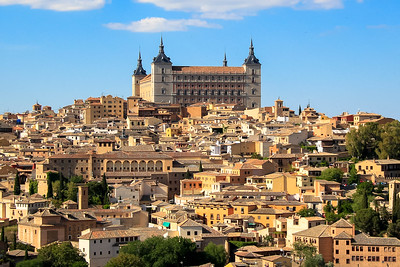
Toledo, known as the “City of the Three Cultures,” is a breathtaking hilltop city in central Spain and the former capital of the Spanish Empire. Located just south of Madrid, this UNESCO World Heritage Site is famous for its unique historical legacy, where Christian, Muslim, and Jewish communities lived together for centuries, leaving behind a rich tapestry of architecture and art. The city is a living museum, characterized by a labyrinth of narrow, winding medieval streets, ancient stone gates, and the massive Alcázar fortress that dominates the skyline. Visitors flock to see the Primate Cathedral of Saint Mary, a masterpiece of Gothic architecture, and the works of the famous Renaissance painter El Greco, who lived and worked in the city. Beyond its monuments, Toledo is world-renowned for its traditional Damascene metalwork (inlaying gold or silver into steel) and its historic production of high-quality swords and blades, which have supplied armies since Roman times.
7. The Santiago de Compostela Cathedral
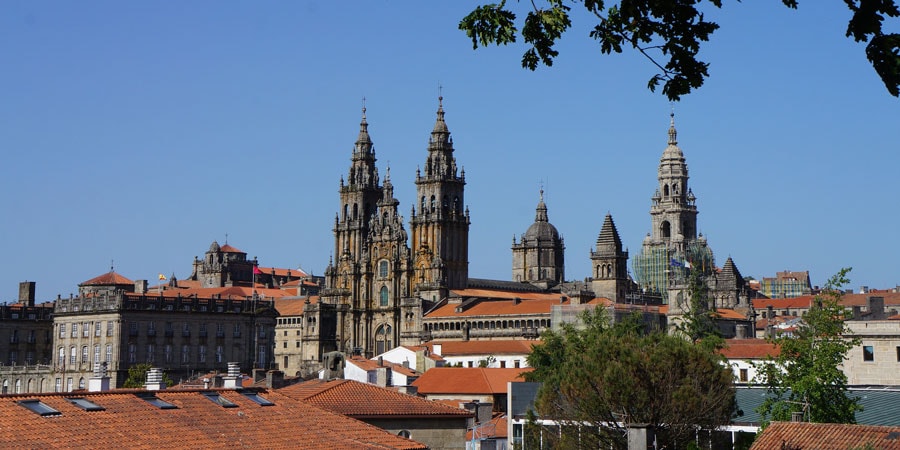
The Santiago de Compostela Cathedral, located in the Galicia region of northwestern Spain, is one of the world’s most significant Catholic shrines and the legendary burial place of Saint James the Great. As the final destination of the Camino de Santiago pilgrimage network, the cathedral has drawn millions of “peregrinos” across Europe since the 9th century. While the building’s heart is a pure Romanesque structure from the 11th and 12th centuries, its exterior was dramatically transformed during the Baroque era, most notably with the ornate Obradoiro façade that towers over the city’s main square. Inside, the basilica’s high altar sits directly above a silver urn containing the apostle’s relics, which pilgrims traditionally visit to offer a “hug” to a 13th-century statue of the saint. The cathedral is also famous for the Botafumeiro, the world’s largest incense burner, which is swung through the transept by eight men at speeds of up to 68 km/h during special liturgical services to purify the air and bless the faithful.
8. The Gothic Quarter
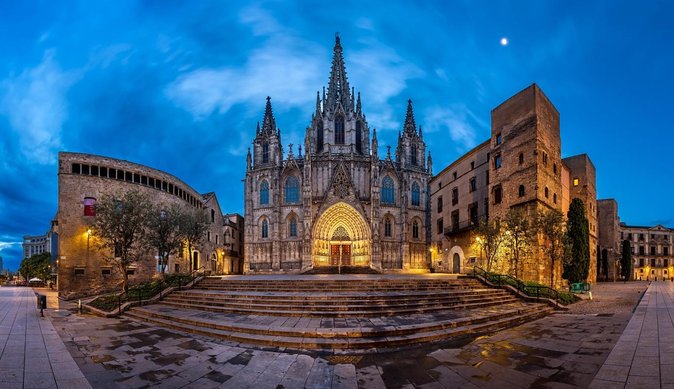
The Gothic Quarter (Barri Gòtic) is the historic and spiritual heart of Barcelona, forming the oldest part of the city with roots dating back over 2,000 years to the Roman colony of Barcino. Situated between La Rambla and Via Laietana, it is a captivating maze of narrow, winding medieval streets and hidden squares that open up to reveal grand stone palaces and ancient churches. The district’s centerpiece is the Barcelona Cathedral, a magnificent Gothic structure famous for its cloister inhabited by thirteen white geese. As you wander, you’ll encounter remnants of the Roman walls, the historic Jewish Quarter (El Call), and the Plaça del Rei, where the Catholic Monarchs reportedly received Christopher Columbus after his first voyage to the Americas. Today, the Gothic Quarter blends its solemn history with a vibrant modern energy, housing artisan boutiques, centuries-old tapas bars, and lively plazas like Plaça Reial, known for its palm trees and streetlamps designed by a young Antoni Gaudí.
9. Aqueduct of Segovia

The Aqueduct of Segovia, located in the heart of Segovia, Spain, is one of the most significant and best-preserved monuments bequeathed by the Roman Empire on the Iberian Peninsula. Built around the 1st century AD—likely under the reign of Emperor Trajan—this engineering marvel was designed to transport water from the Fuenfría spring in the nearby mountains over a distance of approximately 17 kilometres to the city. What makes the structure truly remarkable is its construction: it consists of roughly 24,000 granite blocks stacked meticulously without a single drop of mortar or cement, held together purely by the precision of the stone cutting and the force of gravity. Its most iconic section towers over the Plaza del Azoguejo, featuring a double tier of 167 arches that reaches a maximum height of 28.5 metres. A proud symbol of the city and a UNESCO World Heritage Site since 1985, the aqueduct served as Segovia’s primary water source for nearly two millennia, remaining functional until as recently as 1973.
10. Tibidabo Amusement Park
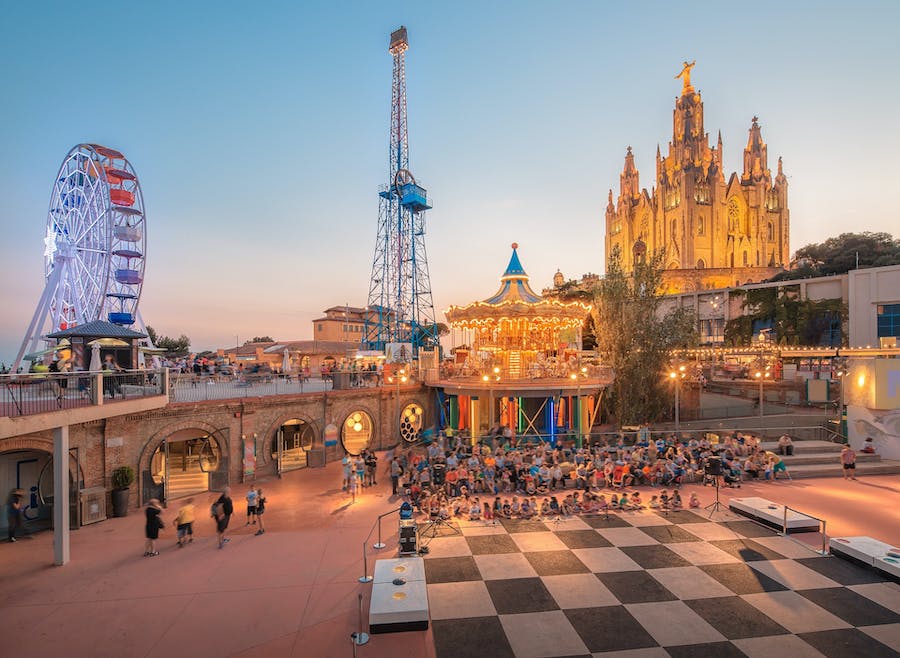
Tibidabo Amusement Park, perched on the highest peak of the Collserola Ridge, is the oldest functioning amusement park in Spain and the third oldest in Europe. Opened in 1901, it offers a nostalgic and “old-world” charm, featuring several original vintage rides that have been meticulously preserved, such as the iconic Avió airplane, a 1928 flight simulator that remains one of the world’s oldest. Beyond its historical appeal, the park provides the most spectacular panoramic views of Barcelona and the Mediterranean Sea due to its elevation of 512 metres. The park is divided into two areas: the Panoramic Area, which is free to enter and houses the most famous vantage points and the colourful Talaia basket ride, and the full Amusement Park, which requires a ticket to access the modern rollercoasters, the spooky Hotel Krüeger, and the interactive Museum of Automata. Overlooking the entire site is the magnificent Temple Expiatori del Sagrat Cor, a neo-Gothic church topped with a massive statue of the Sacred Heart of Jesus, making Tibidabo a unique destination where history, thrills, and spirituality meet.
11. The Madrid Rio
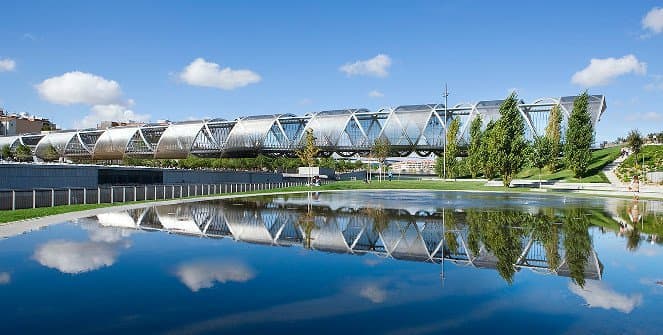
Madrid Río is a massive urban park and recreational corridor that stretches over 10 kilometres along the banks of the Manzanares River. This transformative project, completed in 2011, reclaimed the riverfront for the city by burying a significant section of the M-30 ring road (a major highway) underground. This monumental engineering feat “stitched” together long-separated neighbourhoods, creating roughly 120 hectares of green space that seamlessly blends nature with modern architecture. The park features a stunning array of landmarks, including the futuristic, helical Arganzuela Bridge designed by Dominique Perrault, and historical structures like the 18th-century Puente de Toledo. Beyond its architectural appeal, Madrid Río is a vibrant social hub, home to 17 unique children’s play areas, an urban beach with water jets, a world-class skatepark, and the Matadero Madrid, a former slaughterhouse turned into a cutting-edge contemporary arts centre. The renaturalization of the river has also led to a resurgence of local biodiversity, with herons, kingfishers, and a variety of fish returning to its waters.
12. San Lorenzo of El Escorial
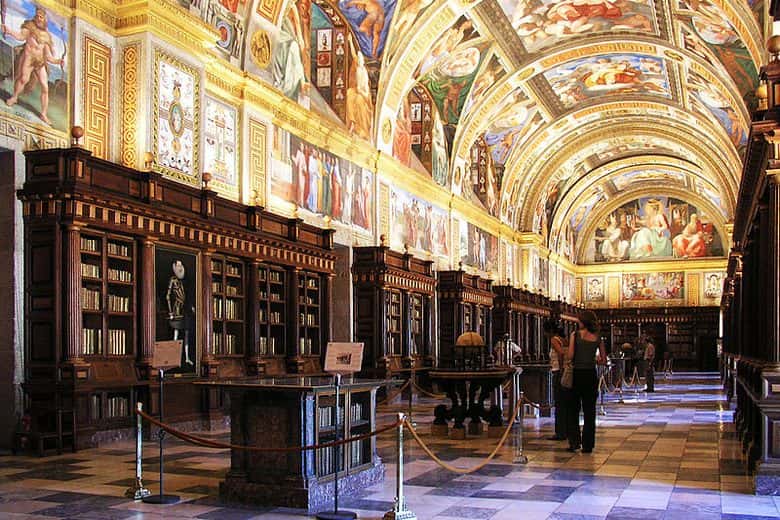
San Lorenzo de El Escorial, located roughly 45 kilometres northwest of Madrid, is a monumental complex that served as the ideological and cultural heart of the Spanish Empire during its “Golden Age”. Commissioned by King Philip II and built between 1563 and 1584, the site was designed to fulfill multiple roles: a royal palace, a Hieronymite monastery, a prestigious library, and a dynastic mausoleum for the Spanish monarchs. The architecture, primarily the work of Juan de Herrera, introduced a sober, unornamented style known as Herrerian, which broke from the highly decorative trends of the time to reflect the King’s religious austerity. Legend says the building’s grid-like floor plan pays homage to the grill used in the martyrdom of Saint Lawrence, in whose honour the site was named following the Spanish victory at the Battle of Saint Quentin. Today, as a UNESCO World Heritage Site, it remains one of Europe’s most impressive Renaissance monuments, housing a vast collection of masterworks by artists like El Greco, Titian, and Velázquez.
13. The Great Mosque of Cordoba
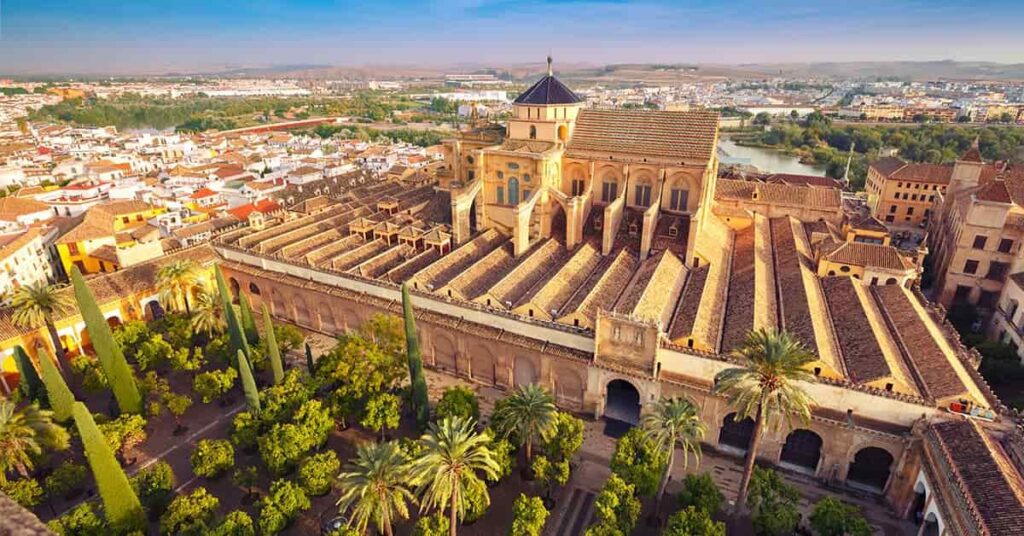
The Great Mosque of Córdoba, known as the Mezquita, is an unparalleled architectural masterpiece in Andalusia, Spain, that famously houses a 16th-century Renaissance cathedral within its original Islamic structure. Originally established by Abd al-Rahman I in 785 AD on the site of a Visigothic church, the mosque was expanded over two centuries to become one of the largest and most magnificent in the Islamic world. Its most iconic feature is the “forest of columns”—a vast prayer hall containing approximately 850 pillars made of jasper, onyx, and marble, supporting distinctive red-and-white striped double arches that create a mesmerizing sense of infinite space. The complex also features a breathtakingly ornate Mihrab (prayer niche) decorated with 1,600 kilograms of gold mosaics sent by the Byzantine Emperor, and the tranquil Patio de los Naranjos (Courtyard of the Orange Trees) at its entrance. Following the Christian Reconquista in 1236, the mosque was consecrated as a cathedral, and today it remains a UNESCO World Heritage Site celebrated as a unique symbol of the complex religious and cultural layering of Spanish history.
14. Alcazar of Segovia
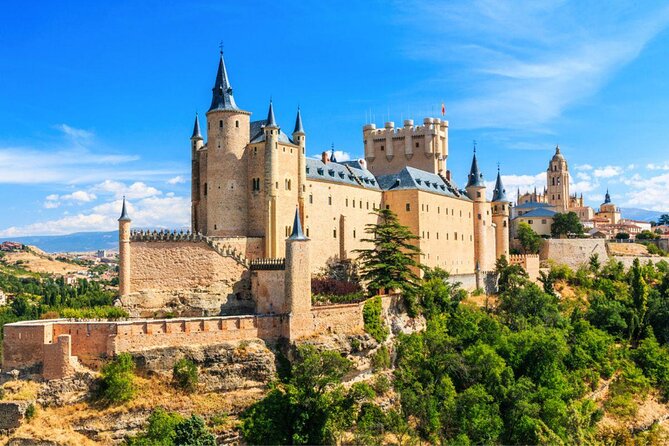
The Alcázar of Segovia is one of Spain’s most distinctive medieval fortresses, famously perched on a rocky crag between two rivers to resemble the prow of a ship. Originally built as a Roman fort and later a Moorish citadel, the current stone structure dates back to the 12th century and has served as a royal palace for twenty-two monarchs, a state prison, and a military academy. Its unique silhouette—featuring deep blue slate spires and a massive dry moat—is widely cited as the primary inspiration for Walt Disney’s Cinderella Castle. Inside, the palace is a masterpiece of Mudéjar and Gothic art, boasting the grand Hall of Kings with its golden frieze of Spanish royalty and a legendary Armoury. Historically, it is most significant as the site where Isabella I was proclaimed Queen of Castile in 1474, a pivotal moment in the unification of Spain.
15. Park Guell
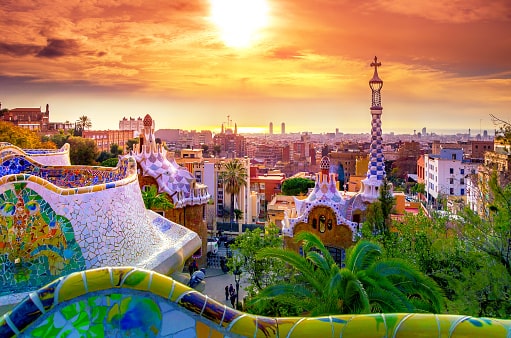
Park Güell is a fantastical public park system in Barcelona, Spain, designed by the legendary architect Antoni Gaudí between 1900 and 1914. Originally commissioned by Eusebi Güell as a luxury residential estate inspired by the English “garden city” movement, the project failed commercially, with only two of sixty planned houses completed. Today, it is a UNESCO World Heritage Site and a masterpiece of Catalan Modernism, where architecture and nature blend seamlessly. The park is renowned for its organic stone structures, winding pathways that mimic tree trunks, and vibrant mosaics created using the trencadís technique (using broken ceramic shards). Its highest point, the Three Crosses Hill, offers sweeping panoramic views of the city, the Sagrada Família, and the Mediterranean Sea.
16. Reina Sofia National Art Museum
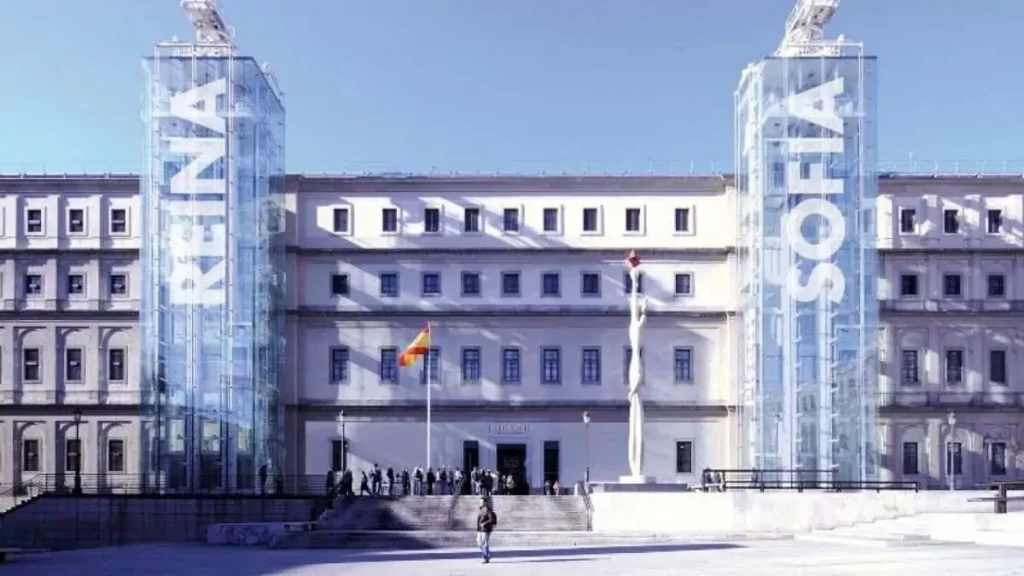
The Reina Sofía National Art Museum (Museo Nacional Centro de Arte Reina Sofía) is Spain’s premier museum for 20th-century and contemporary art, located in the heart of Madrid. Housed primarily in a massive 18th-century former hospital, the museum was expanded in 2005 with a striking red-roofed wing designed by architect Jean Nouvel. It serves as the modern counterpart to the nearby Prado Museum, completing Madrid’s famous “Golden Triangle of Art.” The collection is world-renowned for its focus on Spanish masters like Salvador Dalí, Joan Miró, and Pablo Picasso, providing a deep dive into movements like Surrealism, Cubism, and the political art of the Spanish Civil War era.
17. The Ses Salines Natural Park

The Ses Salines Natural Park (Parc Natural de ses Salines) is a breathtaking UNESCO World Heritage site spanning the southern tip of Ibiza, the north of Formentera, and the marine channel between them. Established in 2001, the park protects over 15,000 hectares of diverse ecosystems, including ancient salt flats, shifting sand dunes, centuries-old juniper forests, and rocky cliffs. It is most famous for its Posidonia oceanica seagrass meadows, which oxygenate the Mediterranean waters and create the region’s signature crystalline, turquoise clarity. Historically, the park has been a vital economic hub since 600 BC, when the Phoenicians first began salt extraction; today, these same salt pans create a vibrant landscape of pink and emerald pools as the water evaporates.
18. Girona
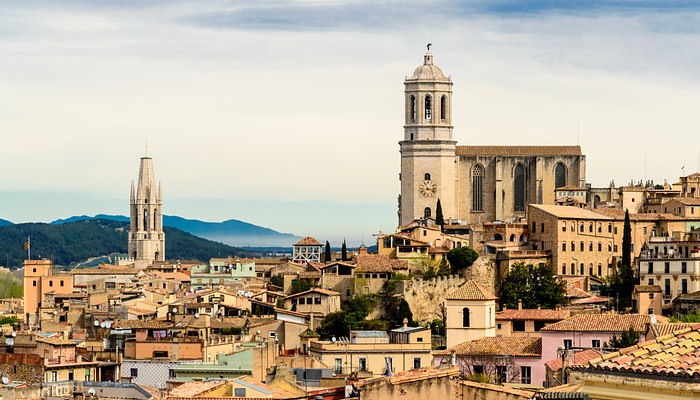
Girona is a historic city in northeastern Catalonia, Spain, sitting at the confluence of four rivers and boasting over 2,000 years of history. Often visited as a day trip from Barcelona, it is famous for its remarkably preserved medieval Old Town (Barri Vell), which is enclosed by ancient Roman and Carolingian walls known as the Passeig de la Muralla. The city’s visual hallmark is the “Cases de l’Onyar”—a row of brightly painted houses reflecting in the Onyar River—and the iconic red iron Eiffel Bridge, designed by Gustave Eiffel just before he built his famous tower in Paris.
19. Rioja

La Rioja is Spain’s most famous wine-producing region, located in the north of the country along the Ebro River valley. Protected by the Sierra de Cantabria mountains, it possesses a unique microclimate perfect for grape cultivation, specifically the Tempranillo grape which forms the backbone of its world-class reds. The region is divided into three zones—Rioja Alta, Rioja Alavesa, and Rioja Oriental—each offering distinct soil types and wine profiles ranging from elegant and acidic to bold and fruity. Beyond its vineyards, Rioja is steeped in history, featuring medieval hilltop villages like Laguardia, the ancient Way of St. James (Camino de Santiago) pilgrimage route, and the “Cradle of the Spanish Language” at the San Millán de Suso and Yuso monasteries.
20. Bilbao

Bilbao is the largest city in the Basque Country and a global symbol of urban transformation, having evolved from a gritty industrial port into a sleek hub of art and design. The city’s rebirth was sparked by the 1997 opening of the Guggenheim Museum Bilbao, a titanium-clad masterpiece designed by Frank Gehry that put the city on the international map. Despite its modern makeover, Bilbao remains deeply rooted in its traditions, centered around the Casco Viejo (Old Town) and its “Seven Streets,” where medieval architecture meets lively social squares. The city is bisected by the Nervión River, which is lined with impressive pedestrian walkways, avant-garde bridges like the Zubizuri, and the historic Ribera Market, one of Europe’s largest indoor food markets.
21. The Bulls Pamplona

The Running of the Bulls (Encierro) is the heart of the San Fermín Festival held annually in Pamplona, Spain, from July 6th to 14th. The event involves hundreds of people running in front of six fighting bulls and six steers through a narrow, half-mile stretch of cobbled streets leading to the city’s bullring. Each run begins at 8:00 AM and typically lasts between two and three minutes. While the tradition dates back to the 13th century as a practical way to transport cattle from the city gates to the arena, it has evolved into a global phenomenon made famous by Ernest Hemingway’s novel The Sun Also Rises.
22. Top Theme Parks
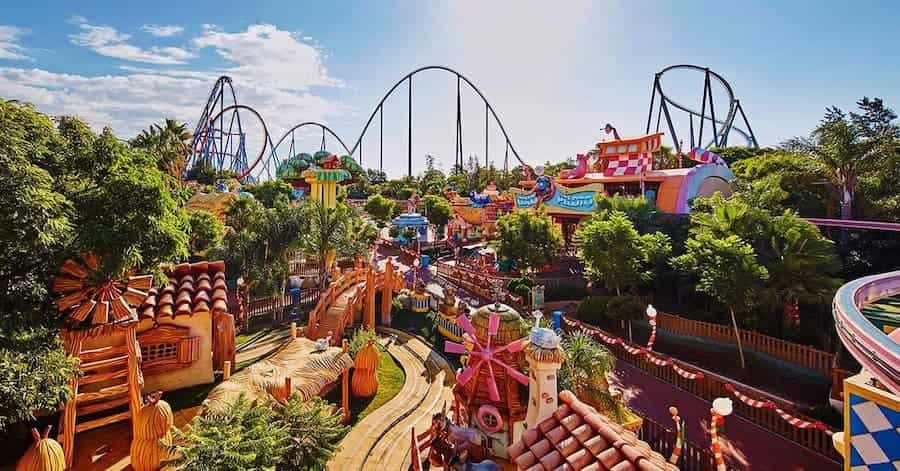
Spain’s theme park scene is headlined by PortAventura World, Parque Warner Madrid, and Terra Mítica, offering a diverse mix of world-record-breaking thrills and immersive storytelling. PortAventura World, located near Barcelona, is the crown jewel; it features six themed lands ranging from Imperial China to the Far West and is home to Red Force at Ferrari Land, the tallest and fastest vertical accelerator in Europe. In the capital, Parque Warner Madrid brings Hollywood to life with intense coasters themed after DC Superheroes and Looney Tunes characters, making it a favorite for cinema buffs. Meanwhile, Isla Mágica in Seville focuses on the “Age of Discovery” with water-heavy attractions ideal for the southern heat, and Terra Mítica in Benidorm transports visitors to the ancient civilizations of Greece, Rome, and Egypt.
23. The Jerez Horse Fair Andalucia

The Jerez Horse Fair (Feria del Caballo) is one of Spain’s most elegant and traditional festivals, held every May in Jerez de la Frontera, Andalusia. Unlike the private casitas of Seville’s April Fair, the marquees (casetas) in Jerez are open to the public, making it a welcoming celebration of Andalusian culture. The event is a spectacular showcase of the city’s three great passions: purebred horses, flamenco, and sherry wine. Throughout the week, the Gonzalez Hontoria park is transformed into a golden-sand arena where riders in traditional “traje corto” and women in vibrant flamenco dresses parade on horseback and in ornate carriages.
24. The April Fair Seville
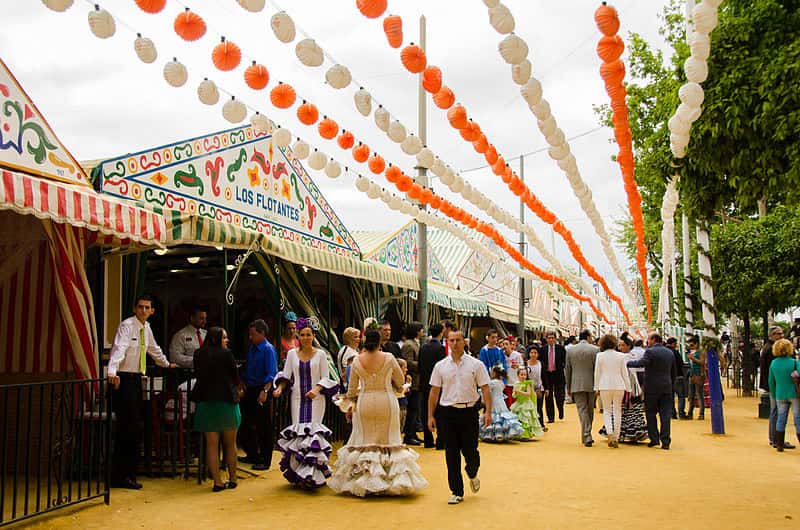
The April Fair (Feria de Abril) is Seville’s most iconic and vibrant festival, beginning two weeks after Easter Sunday and transforming the city into a spectacular display of Andalusian tradition. The fair takes place on a massive dedicated fairground (the Real de la Feria) packed with over 1,000 casetas—striped tents owned by prominent families, clubs, or associations. The week kicks off with the “Alumbrado,” the ceremonial lighting of the fairground’s monumental entrance gate and thousands of light bulbs. For seven days, the air is filled with the scent of fried fish, the rhythm of Sevillanas (traditional folk dance), and the sight of locals dressed in stunning trajes de flamenca (ruffled The April Fair (Feria de Abril) is Seville’s most iconic and vibrant festival, beginning two weeks after Easter Sunday and transforming the city into a spectacular display of Andalusian tradition. The fair takes place on a massive dedicated fairground (the Real de la Feria) packed with over 1,000 casetas—striped tents owned by prominent families, clubs, or associations. The week kicks off with the “Alumbrado,” the ceremonial lighting of the fairground’s monumental entrance gate and thousands of light bulbs. For seven days, the air is filled with the scent of fried fish, the rhythm of Sevillanas (traditional folk dance), and the sight of locals dressed in stunning trajes de flamenca (ruffled dresses) and “traje corto” (traditional short jackets for men).dresses) and “traje corto” (traditional short jackets for men).
25. Royal Palace of Madrid
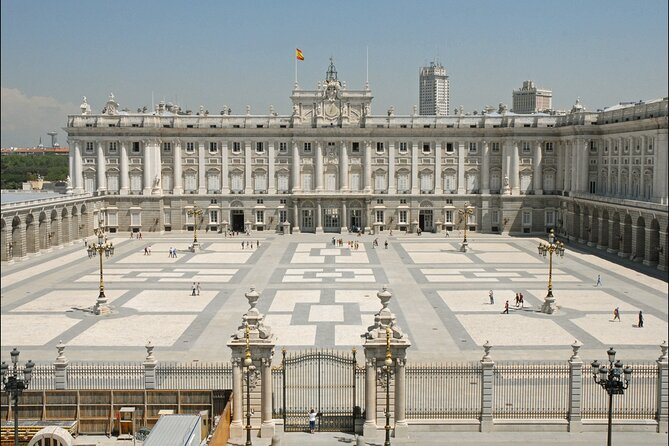
The Royal Palace of Madrid (Palacio Real) is the largest functioning royal palace in Western Europe, featuring over 3,400 rooms and a floor area of 135,000 square metres. Built on the site of a 9th-century Moorish fortress that was destroyed by fire in 1734, the current limestone and granite structure was designed in a grand Baroque-Neoclassical style by architects Sachetti and Sabatini. Although it is the official residence of the Spanish King, the royal family lives in the smaller Zarzuela Palace, meaning this landmark is primarily used for state ceremonies and public tours. The interior is a massive treasury of art, including frescoes by Tiepolo, the world’s only complete Stradivarius string quintet, and the Royal Armoury, which is considered one of the finest collections of medieval weaponry in existence.