

About Us
Greece is a beautiful country in Southern Europe, renowned for its ancient history and thousands of sun-drenched islands. It is often referred to as the “birthplace of Western culture,” as it was here that democracy (voting), the Olympic Games, and many famous myths about gods and heroes first originated. The country boasts an extensive coastline featuring sparkling blue waters, and many of its buildings are painted white with blue roofs to harmonize with the surrounding sea.
Its capital is Athens, where you can still see massive stone temples built by people thousands of years ago. Today, Greece is known for its friendly people, delicious food—such as feta cheese and olives—and magnificent weather. Most of the country is covered in mountains, yet people from all over the world flock to the beaches of islands like Santorini and Crete.
Whether you are exploring ancient ruins or swimming in the sea, Greece is a place where the past and the present coexist. Greece’s economy rests primarily on three major “pillars”: tourism, shipping, and agriculture. Given Greece’s thousands of beautiful islands and long history, tourism is a massive industry here—generating approximately 18% of the country’s total income—as millions of people visit each year to see sites like the Acropolis or to relax on the beaches.
Greece is also a global leader in maritime shipping; it possesses the world’s largest fleet of merchant vessels, which transport goods across the globe. Finally, Greece produces and exports numerous renowned agricultural products—such as olive oil, feta cheese, and fruits—that are popular worldwide. Greece is a very safe country for tourists and is often considered one of the most peaceful places to visit in Europe. Violent crime is extremely rare here, and the locals are known for being very friendly and helpful toward visitors. Whether you are exploring a major city like Athens or touring a quiet island, you can feel comfortable and safe—both during the day and even at night.
Most Famous And Attractive Tourist Places In Greece Tour :
1. The Acropolis & Parthenon (Athens)
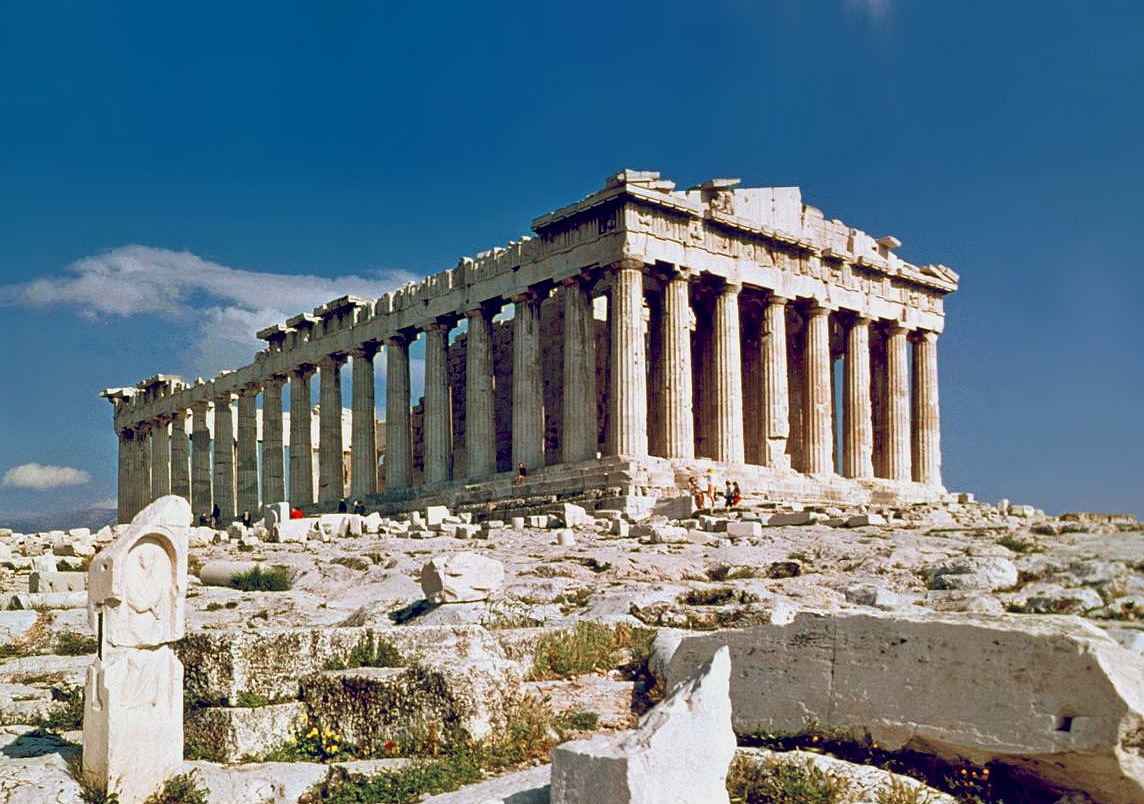
The Acropolis is a famous flat-topped hill in Athens, Greece, that sits high above the city. Think of it as an ancient “fortress in the sky” where the most important buildings were located. The most famous of these buildings is the Parthenon, a massive marble temple built over 2,400 years ago. It was built to honor Athena, the goddess of wisdom, who the people of Athens believed protected their city. The Parthenon is world-famous because of its beautiful tall columns and the way it was designed to look perfectly straight and balanced to the human eye. In ancient times, it was decorated with colorful statues and held a giant statue of Athena made of gold and ivory. Even though it has been damaged by wars and time, the Acropolis and the Parthenon still stand today as symbols of Ancient Greece and the beginning of democracy.
2. Meteora Monasteries (Kalabaka)
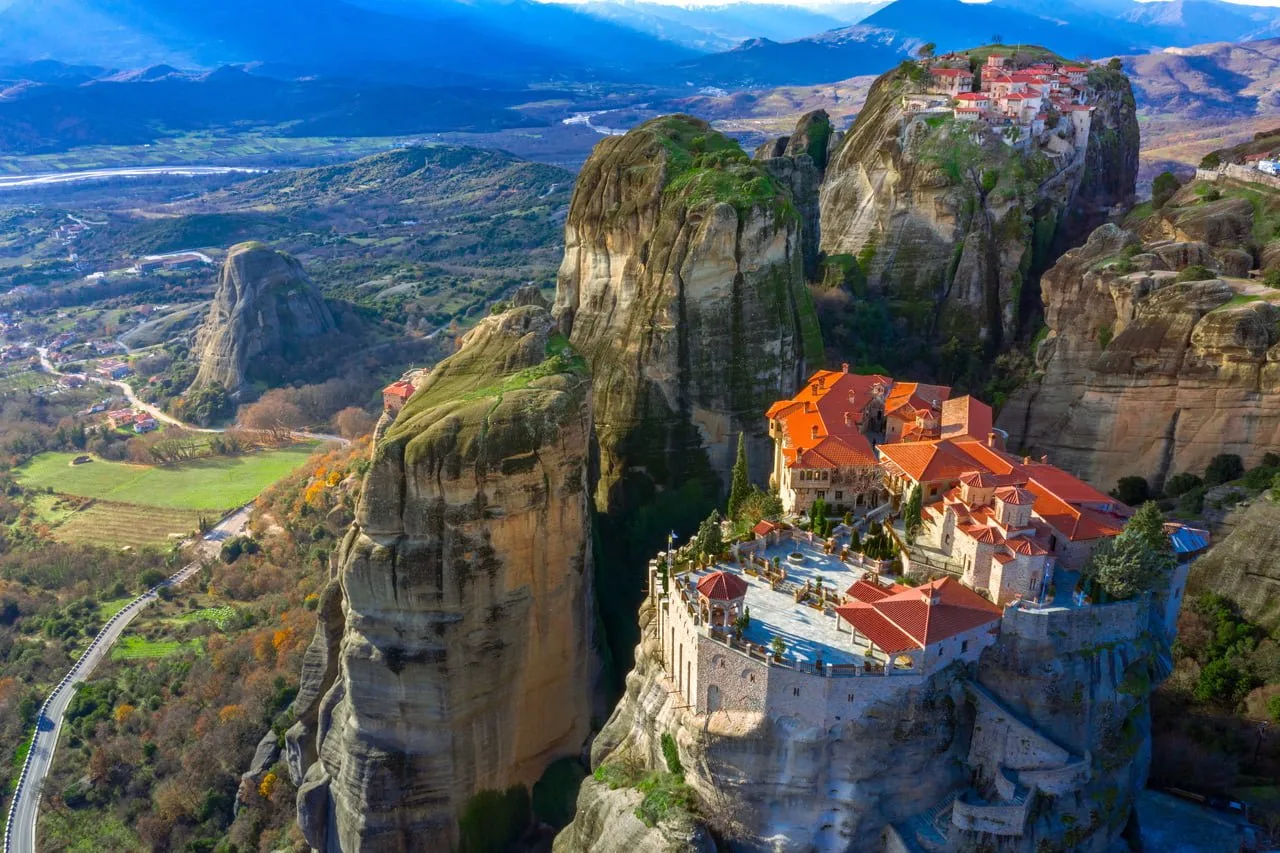
The Meteora Monasteries are a stunning group of Greek Orthodox monasteries situated near the town of Kalabaka in central Greece. Perched atop towering sandstone rock pillars that rise over 400 metres high, their name literally translates to “suspended in the air”. While hermits began living in the area’s caves as early as the 11th century, the first formal monasteries were established in the 14th century to provide a safe haven from political instability and invaders. Out of the original 24 monasteries, only six remain active today and are open to the public: the Great Meteoron, Varlaam, Rousanou, St. Nicholas Anapausas, St. Stephen, and Holy Trinity.
Today, people from all over the world visit Meteora to see the amazing views and the beautiful old churches. There are only six monasteries left that people still live in. Now, instead of using nets, visitors can walk up steps that have been carved right into the stone. It is such a special and beautiful place that it is protected as a World Heritage Site, meaning it is important to the history of the whole world.
3. Santorini Caldera & Oia (Cyclades)

The Santorini Caldera is a massive, mostly submerged volcanic crater in the Cyclades islands of Greece, formed by one of the largest volcanic eruptions in history roughly 3,600 years ago. This geological wonder consists of several islands arranged in a circle, with the main island of Santorini (Thira) featuring sheer cliffs that drop 300 metres into the deep blue Aegean Sea. Perched at the northern tip of these cliffs is the iconic village of Oia, famous worldwide for its whitewashed “cubist” houses, blue-domed churches, and narrow cobblestone paths. Oia is the most celebrated spot for viewing the caldera’s sunsets, where the golden light reflects off the cliff-side buildings and the shimmering Mediterranean waters. Today, the area is a UNESCO-recognized hub for tourism and geology, offering a unique mix of volcanic history and classic Greek beauty.
4. Delphi Archaeological Site (Phocis)

The Delphi Archaeological Site is a very special place in the mountains of Greece that people long ago called the “center of the world.” It was built high up on a mountainside with amazing views of the valleys below. In ancient times, it was a holy place dedicated to the god Apollo, the god of light and truth. People from all over Greece would travel for many days to reach Delphi because they wanted to ask the Oracle (a famous priestess) for advice or to tell them their future. Today, when you visit Delphi, you can see the ruins of the giant Temple of Apollo, where the Oracle lived, and a large theater where people watched plays. There is even a stadium at the very top of the hill where athletes used to race. One of the most beautiful parts is a round building called the Tholos, which you might recognize from many postcards. It is a World Heritage Site because it shows us how the ancient Greeks lived, prayed, and competed in sports thousands of years ago.
5. Mykonos Town & Little Venice (Cyclades)
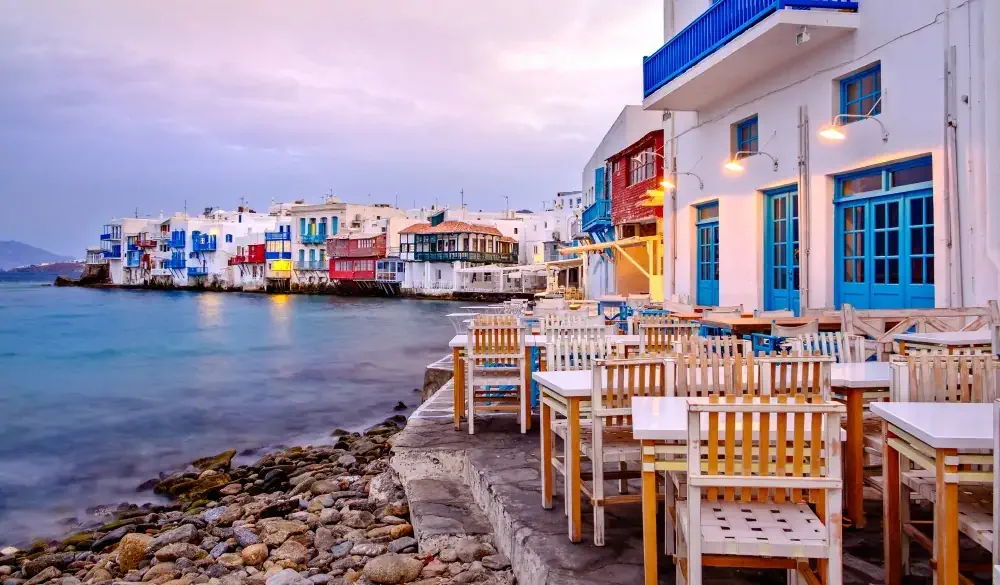
Mykonos Town (also known as Chora) and its famous Little Venice district are the vibrant heart of Mykonos, one of Greece’s most popular Cyclades islands. The town is a labyrinth of narrow, whitewashed cobblestone streets designed in a maze-like fashion to confuse invading pirates in the 18th century. Little Venice is a particularly romantic quarter where elegant medieval houses with colorful wooden balconies are built directly over the water’s edge, with waves literally splashing against their foundations. Originally home to wealthy sea merchants and captains—some of whom were rumored to be pirates—these historic buildings have mostly been converted into trendy waterfront bars and cafes. Just steps away from Little Venice are the iconic Kato Mili Windmills, which stand on a hill overlooking the harbor and were once used to grind grain for the island’s residents. Today, this entire area is a world-class destination for photography and sunset views, where visitors from Tripadvisor praise the “magical” atmosphere as the sun dips into the Aegean Sea. Whether you are wandering through the boutique-filled alleys or sipping a cocktail while watching the waves, Mykonos Town offers a perfect blend of historic charm and modern cosmopolitan life.
6. Knossos Palace (Crete)

The Knossos Palace is an amazing ancient site on the island of Crete that was built thousands of years ago. It is special because it was the home of the Minoans, who are known as Europe’s first great civilization. The palace was huge and had over 1,000 rooms, including a throne room for the king and big storage areas for food and oil. This palace is also famous because of the legend of the Minotaur—a monster that was half-man and half-bull. Stories say the king built a giant maze called a Labyrinth under the palace to keep the monster hidden. Today, when you visit, you can see bright red columns and beautiful paintings of dolphins and bulls on the walls. It is a wonderful place to visit if you want to feel like you’ve stepped back into a world of kings, myths, and ancient mysteries.
7. Navagio Beach / Shipwreck Cove (Zakynthos)

Navagio Beach, also known as Shipwreck Cove, is an exposed sandy inlet on the coast of Zakynthos in the Ionian Islands of Greece. It is one of the most photographed beaches in the world, famous for its dramatic limestone cliffs, electric-blue turquoise waters, and the rusted remains of the MV Panagiotis. This freight ship ran aground in 1980, allegedly while fleeing from the Greek Navy during a storm, giving the beach its “Shipwreck” name and a sense of maritime mystery. The beach is unique because it is only accessible by boat, as it is surrounded by sheer white cliffs that drop hundreds of feet into the sea. Most visitors either take a boat tour to walk on the white pebbles and swim in the neon-blue water or travel to the viewing platform high above the cliffs for the iconic postcard perspective. Because of its incredible beauty, it has become a bucket-list destination for travellers on Tripadvisor. While it is currently sometimes restricted to visitors for safety reasons due to falling rocks, it remains a powerful symbol of Greece’s natural wonder and rugged coastline.
8. Rhodes Old Town (Dodecanese)

Rhodes Old Town, located on the island of Rhodes in the Dodecanese, is one of the best-preserved medieval settlements in Europe and a designated UNESCO World Heritage Site. Surrounded by massive stone walls and a deep dry moat, the town was the stronghold of the Order of the Knights of St. John from 1309 until 1522. Walking through its gates feels like stepping back in time, especially as you stroll down the Street of the Knights, a perfectly preserved medieval road lined with “inns” that once housed the various nationalities of the crusading knights. At the highest point of the town stands the imposing Palace of the Grand Master, a fortress-palace featuring spherical towers and beautiful mosaic floors. Beyond its medieval architecture, the Old Town is a fascinating layer-cake of history, featuring Byzantine churches, Ottoman mosques, and traditional Greek fountains. Today, it remains a “living” city where people still reside and work amidst the historical monuments, offering a vibrant atmosphere filled with shops, cafes, and narrow winding alleys.
9. Thessaloniki Waterfront & White Tower (Central Macedonia)

The Thessaloniki Waterfront, also known as the Nea Paralia, is a vibrant six-kilometre promenade that serves as the social heart of Greece’s second-largest city in Central Macedonia. Its most iconic landmark is the White Tower, a 15th-century Ottoman fortification that stands at the edge of the Thermaic Gulf. Originally part of the city’s seawalls and once used as a notorious prison, the tower was whitewashed in the late 19th century to “purify” it of its dark past; today, it houses a fascinating museum dedicated to the city’s diverse history. The waterfront area underwent a major transformation in recent years, turning into a series of themed gardens, fountains, and wide walking paths perfect for cycling or strolling. One of the most photographed spots along the walk is the modern “Umbrellas” art installation by George Zongolopoulos, which looks particularly magical when lit up at night. As the sun sets over the water, the promenade comes alive with locals and tourists alike, offering a perfect blend of historic architecture and contemporary urban life.
10. Samaria Gorge (Crete)
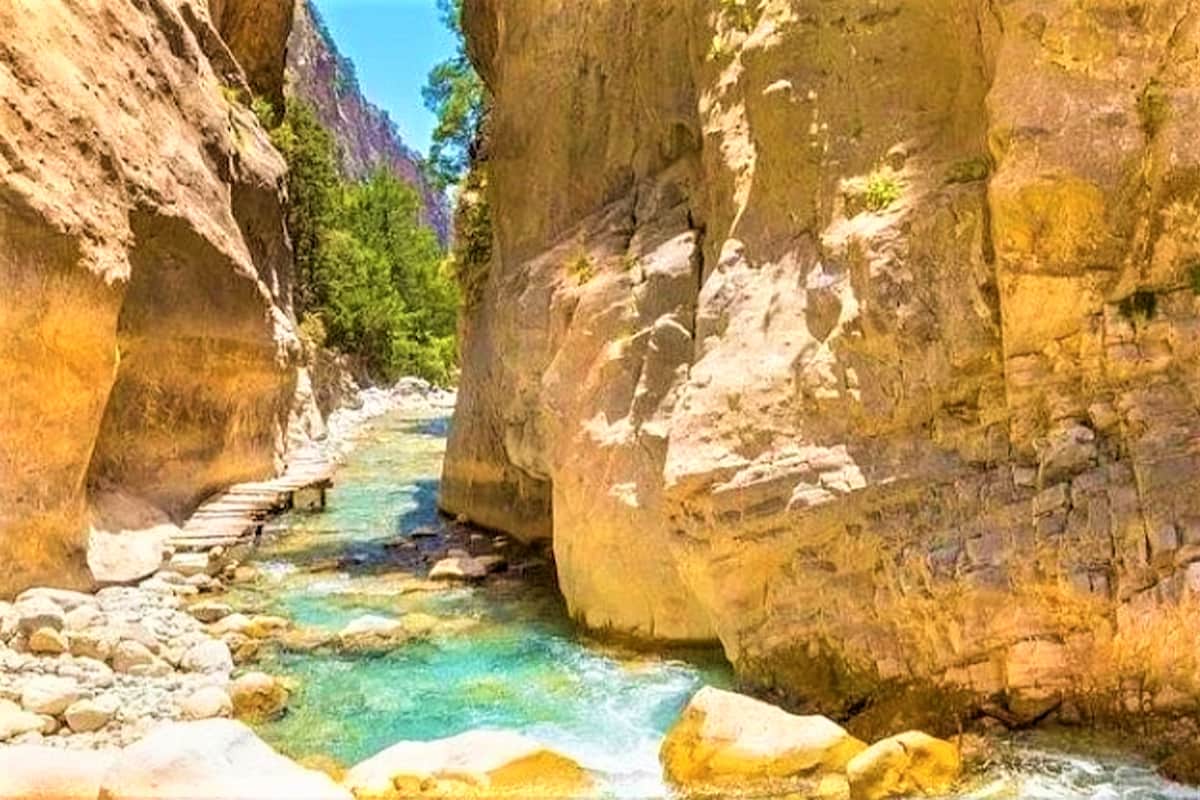
The Samaria Gorge, located in the White Mountains of western Crete, is one of the longest and most spectacular canyons in Europe. Stretching approximately 16 kilometres, it is a designated National Park and a UNESCO Biosphere Reserve known for its rugged natural beauty. The hike begins at an altitude of 1,250 metres at Xyloskalo and winds its way down through ancient forests of cypress and pine, past abandoned stone settlements like the village of Samaria. The most famous part of the trek is the “Iron Gates”, a dramatic pass where the limestone walls narrow to just four metres wide while towering nearly 300 metres high. This protected area is the primary sanctuary for the Kri-Kri, a rare species of Cretan wild goat often seen by lucky hikers. The trail concludes at the seaside village of Agia Roumeli, where visitors typically take a ferry to reach the nearest road, as the village itself is inaccessible by car. Due to its steep terrain and the risk of flash floods, the gorge is generally open only from May to October. It remains a bucket-list destination for hikers worldwide, offering a challenging but rewarding journey through one of the most pristine landscapes in the Mediterranean.
11. Mount Olympus (Pieria/Larissa)

Mount Olympus, located on the border between Pieria and Larissa, is the highest mountain in Greece and one of the most famous peaks in the world due to its role in Greek mythology. To the ancient Greeks, its highest peak, Mytikas (rising to 2,918 metres), was the mythical home of the Twelve Olympian Gods, led by Zeus. Because of its incredible height and frequent cloud cover, it was seen as the perfect “throne” for the gods to watch over humanity. Beyond its legends, it was the first area in Greece to be declared a National Park in 1938 and is a UNESCO Biosphere Reserve, recognized for its immense biodiversity, including over 1,700 species of plants and rare birds. Today, Mount Olympus is a premier destination for hikers and climbers from around the globe. Most treks begin in the picturesque town of Litochoro, following the Enipeas Canyon up toward the various mountain refuges. While the climb to the very top is challenging and requires good physical condition, the mountain offers many trails for all levels, featuring lush forests, deep gorges, and stunning views of the Aegean Sea. Whether you visit for its spiritual history or its rugged natural beauty, it remains a powerful symbol of Greek heritage and the majesty of nature.
12. Nafplio Old Town (Peloponnese)

Nafplio Old Town is one of the most beautiful and romantic places in all of Greece. It is located by the sea in a part of the country called the Peloponnese. A long time ago, right after Greece became an independent country, Nafplio was actually its very first capital city! Because of this history, the town is filled with grand old buildings, marble-paved squares, and narrow streets with pretty pink flowers hanging over the walls.The town is famous for its three castles. The biggest one, called Palamidi, sits high on a hill and has a famous staircase with nearly 1,000 steps! There is also a tiny castle called Bourtzi that sits on a little island right in the middle of the water. Today, people love to visit Nafplio to walk along the seaside, eat delicious gelato, and explore the old shops. It feels like a town from a fairy tale because it has been kept exactly how it looked hundreds of years ago.
13. Elafonissi Pink Sand Beach (Crete)
:max_bytes(150000):strip_icc()/TAL-elafonissi-beach-crete-greece-BESTBEACH0225-e99d9a95e17541ea924c074db879efd9.jpg)
Elafonissi Beach, located on the remote southwestern tip of Crete, is world-renowned for its extraordinary pink sand and crystal-clear turquoise waters. This natural phenomenon is caused by thousands of crushed shells and coral fragments that wash ashore, creating a shimmering rose-coloured fringe along the water’s edge. The area is technically a peninsula, but at high tide, it becomes an island separated from the mainland by a shallow lagoon. This lagoon is so still and shallow that visitors can easily wade through the knee-deep water to reach the protected Elafonissi Island, which is a designated Natura 2000 site. Because it is a protected nature reserve, you won’t find large hotels or heavy construction here; instead, the beach is home to rare plants like sea daffodils and endangered species like the Loggerhead sea turtle (Caretta caretta). Despite its remote location—about a 90-minute drive through winding mountain roads from Chania—it is one of Greece’s most popular destinations. Visitors are encouraged to arrive early to enjoy the surreal landscape before the crowds, as the combination of white dunes, black volcanic rocks, and pink-tinted shoreline makes it one of the most beautiful beaches in the Mediterranean.
14. Corfu Old Town (Ionian Islands)
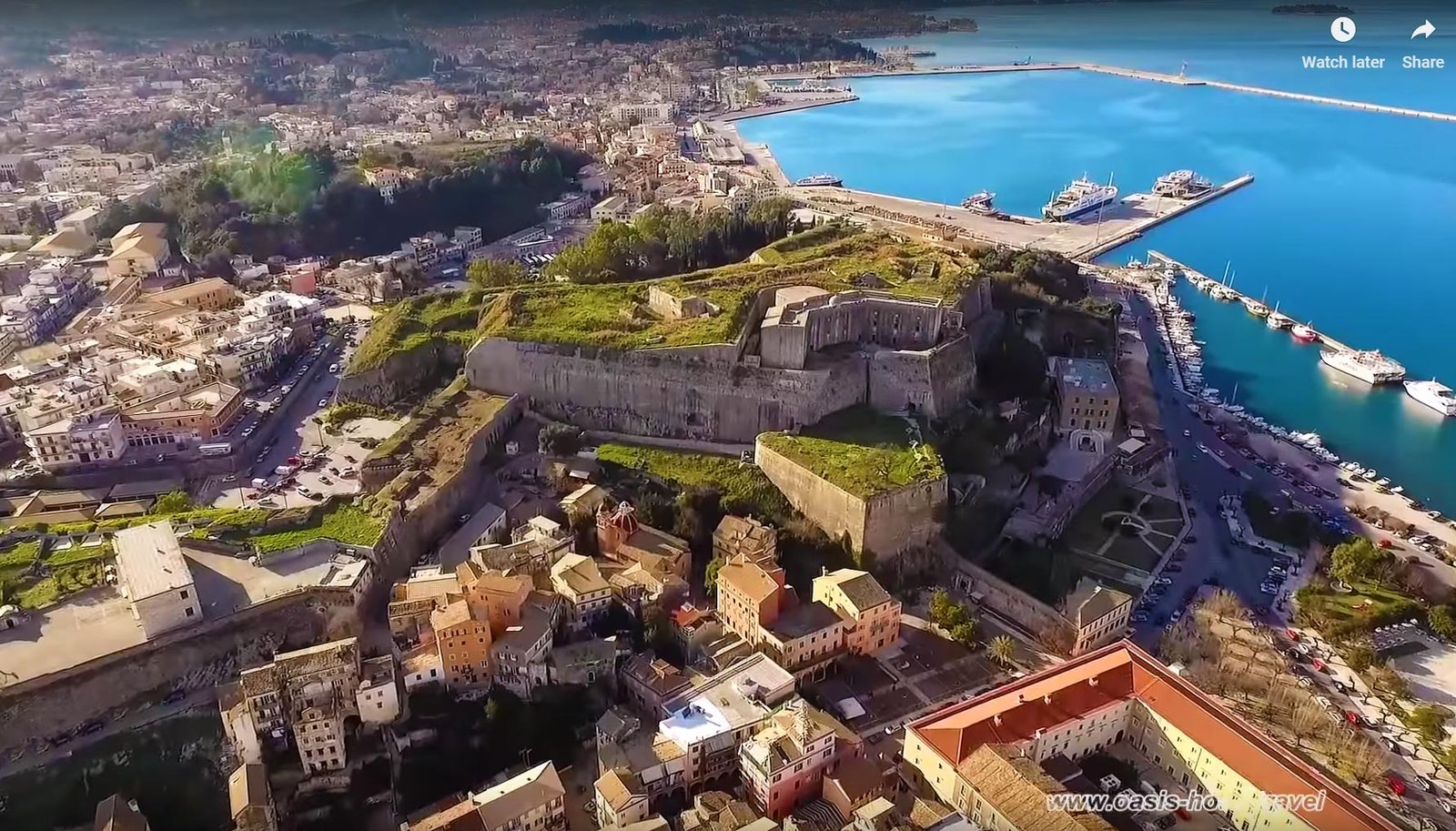
Corfu Old Town is a beautiful and historic place on a Greek island that feels very different from the rest of Greece. For hundreds of years, it was ruled by people from Venice, Italy, which is why the town looks like a mini-version of an Italian city! Instead of the usual white and blue houses, you will see tall buildings painted in pretty pastel colours like peach, yellow, and pink, with laundry hanging between the windows over narrow, winding cobblestone streets. The town is very safe because it sits between two giant stone fortresses that were built long ago to protect the people from enemies. In the middle of the town is a huge grassy park called the Spianada, where you can actually see people playing cricket—a game they learned from the British! It is a wonderful place to walk around, eat a meal under the arched walkways of the Liston, and visit the famous church with the bright red tower. It is so special that it is protected as a World Heritage Site.
15. Sarakiniko Beach (Milos)

Sarakiniko Beach on the island of Milos is one of the most unique-looking places in the world. Instead of yellow sand or pebbles, this beach is made of bright white volcanic rock that has been worn down by the wind and waves into smooth, wavy shapes. Because the rocks are so white and the landscape is so bare, it looks exactly like the surface of the moon, which is why people often call it “Moon Beach.” There are no trees or umbrellas here, just the white stone meeting the deep blue Aegean Sea. You can jump off the white cliffs into the clear water or explore small caves carved into the rock by pirates a long time ago. It is a favorite spot for photographers because the white rocks glow beautifully during the day and look magical under the moonlight.
16. Epidaurus Ancient Theatre (Argolis)
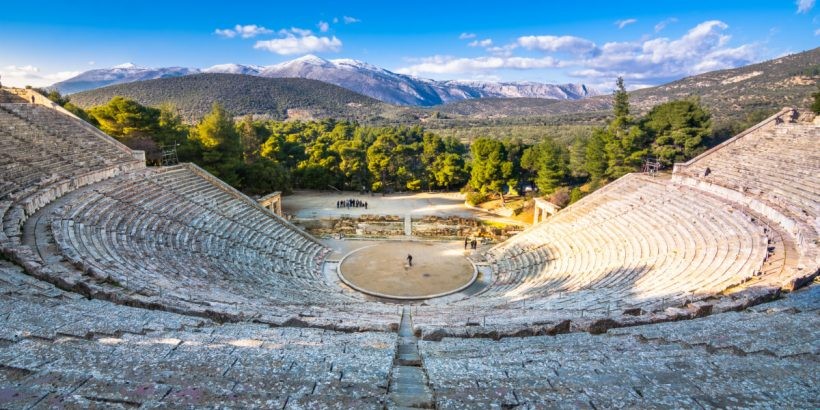
The Ancient Theatre of Epidaurus, located in the Argolis region of the Peloponnese, is world-renowned as the most beautiful and best-preserved theatre of the ancient world. Built in the 4th century BCE by the architect Polykleitos the Younger, it was originally part of a religious sanctuary dedicated to Asklepios, the god of healing. The Greeks believed that watching plays was not just entertainment but part of a patient’s medical treatment to calm the mind. The theatre is built entirely of limestone and could hold up to 14,000 spectators in its massive semi-circle of 55 rows of seats. The most incredible feature of the site is its perfect acoustics. The design is so precise that if you drop a coin or strike a match in the centre of the circular stage (the orchestra), the sound can be heard perfectly by someone sitting in the very last row, nearly 60 metres away. Scientists believe the limestone seats act as a natural sound filter, blocking out low-frequency background noise while carrying voices upward. Today, it is a UNESCO World Heritage Site and still hosts live performances of ancient Greek tragedies and comedies every summer, allowing modern audiences to experience the same magic as the ancients did over 2,000 years ago.
17. Cape Sounion & Temple of Poseidon (Attica)
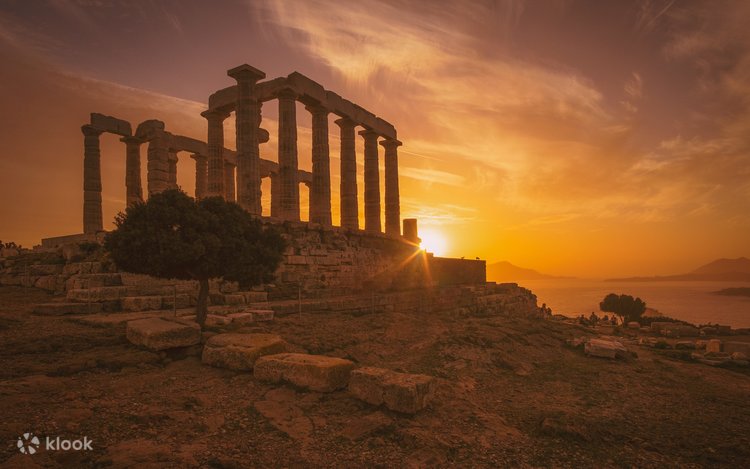
The Temple of Poseidon at Cape Sounion is a majestic ancient site perched on a sheer cliff 60 metres above the Aegean Sea, marking the southernmost tip of the Attica peninsula. Built between 444 and 440 BCE during the Golden Age of Athens, the temple was dedicated to Poseidon, the god of the sea, serving as a sacred landmark for ancient sailors returning to the port of Piraeus. Its gleaming white Doric columns were designed to withstand the harsh salt air, and they still stand as a powerful symbol of Greece’s maritime history. The site is also famously linked to the myth of King Aegeus, who supposedly leapt from these cliffs into the sea after mistakenly believing his son Theseus had died, which is how the Aegean Sea got its name. Today, Cape Sounion is one of the most popular day trips from Athens, celebrated for offering one of the most spectacular sunsets in the world. Visitors can walk among the ruins and even look for the signature of the famous poet Lord Byron, who carved his name into one of the marble pillars in 1810. Because the temple is surrounded by water on three sides, it provides a 270-degree view of the sea and the distant Cycladic islands. Whether you are interested in the architectural precision of the 5th century or the romantic views of the coastline, it remains a breathtaking example of how ancient Greeks harmonised their monuments with the natural landscape.
18. Hydra Island Harbour (Saronic Islands)
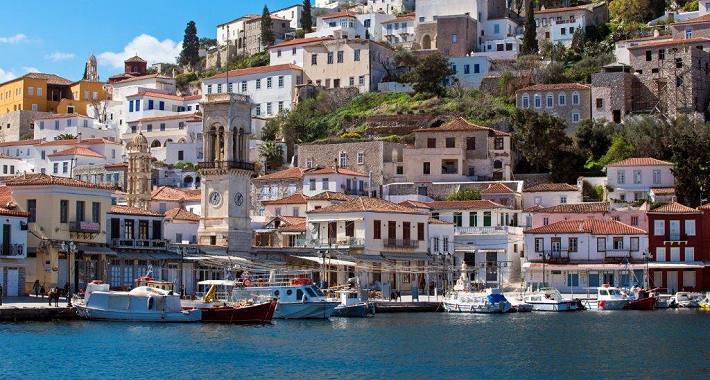
Hydra Island Harbour is the picturesque heart of one of Greece’s most unique islands in the Saronic Gulf, famous for its preserved 18th-century stone mansions and its strict ban on motor vehicles. Since cars, motorbikes, and even bicycles are not allowed, the crescent-shaped harbour serves as a lively hub where traditional donkeys and mules are the primary mode of transport for everything from luggage to construction materials. The harbour is lined with elegant “captain’s houses” built by wealthy maritime merchants during the Napoleonic Wars, giving the town an aristocratic and timeless atmosphere that has long attracted famous artists, musicians, and writers like Leonard Cohen. Walking along the waterfront, you will see marble-paved quays filled with colorful fishing boats, water taxis, and luxury yachts, all framed by the grey stone hills of the island. The harbour is guarded by historic bastions with cannons that once protected the town from naval attacks, serving as a reminder of Hydra’s powerful role in the Greek War of Independence. Today, the area is a protected national monument, offering a peaceful escape where the only sounds are the church bells, the clatter of donkey hooves, and the splashing of the sea.
19. Vikos Gorge (Epirus)

The Vikos Gorge, located in the Pindus Mountains of Epirus in northwestern Greece, is officially recognized by the Guinness World Records as the deepest gorge in the world relative to its width. Carved over millions of years by the Voidomatis River, the gorge stretches for about 20 kilometres, with cliffs that soar vertically to heights of over 1,000 metres. It is the centerpiece of the Vikos-Aoos National Park, a region celebrated for its extreme biodiversity, containing rare flowers, bears, wolves, and golden eagles. Unlike many other famous canyons, Vikos remains remarkably pristine and untouched, offering a raw and powerful look at Greece’s rugged mountainous interior. For hikers, the most popular route through the gorge takes about 5 to 7 hours, starting from the traditional stone village of Monodendri and ending in Vikos or Papigo. Along the way, the trail passes through lush forests and by the springs of the Voidomatis, which is known as one of the cleanest and coldest rivers in Europe. For those who prefer not to hike, spectacular aerial views can be found at the Oxya and Beloi viewpoints, where the sheer drop into the canyon is truly dizzying. Today, the gorge is a major destination for eco-tourism and is a key part of the UNESCO Global Geopark network.
20. Portara (Apollo Temple Gate) (Naxos)
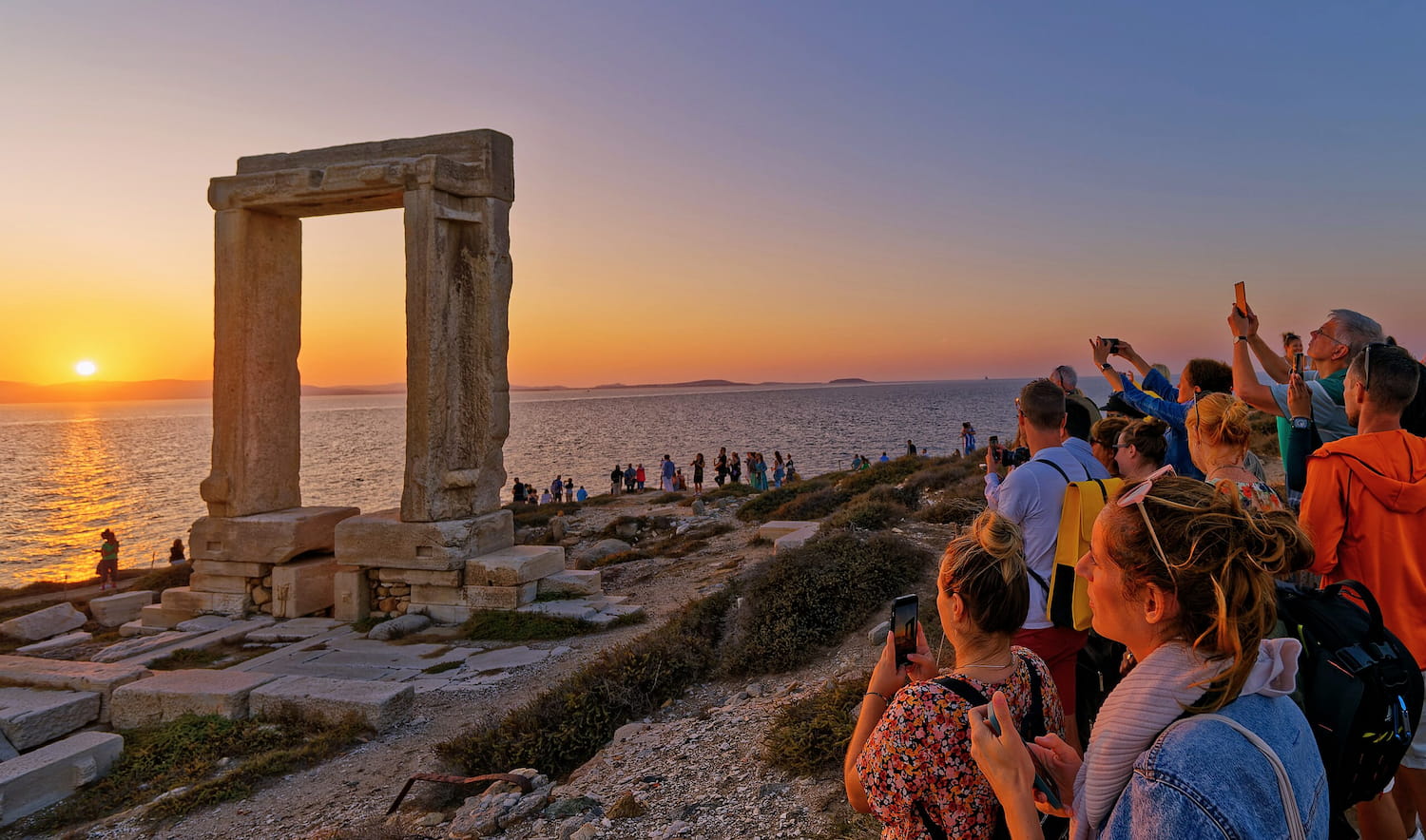
The Portara is a giant stone doorway that stands on a small island right next to the main town of Naxos. It looks like a massive empty picture frame made of marble. Built over 2,500 years ago, it was supposed to be the entrance to a huge temple for the god Apollo, but the temple was never finished. The gate is so heavy and strong that it is still standing today, even though the rest of the temple is gone!Because it sits on a hill overlooking the ocean, it is the most famous place on the island to watch the sunset. When the sun goes down, it looks like it is sitting right inside the giant doorway. To get there, you just walk across a short paved path over the water. It is a great place to take photos and imagine what the giant temple would have looked like if it had been completed.
Overview
Travel is the movement of people between relatively distant geographical locations, and can involve travel by foot, bicycle, automobile, train, boat, bus, airplane, or other means, with or without luggage, and can be one way or round trip. Travel can also include relatively short stays between successive movements.
The origin of the word “travel” is most likely lost to history. The term “travel” may originate from the Old French word travail, which means ‘work’. According to the Merriam Webster dictionary, the first known use of the word travel was in the 14th century.
It also states that the word comes from Middle English travailen, travelen (which means to torment, labor, strive, journey) and earlier from Old French travailler (which means to work strenuously, toil). In English we still occasionally use the words “travail”, which means struggle. According to Simon Winchester in his book The Best Travelers’ Tales (2004), the words “travel” and “travail” both share an even more ancient root: a Roman instrument of torture called the tripalium (in Latin it means “three stakes”, as in to impale).