

Gir National Park and Wildlife Sanctuary, commonly known as Sasan Gir, is a world-renowned wildlife tourism destination located in the state of Gujarat, India. It holds the unique distinction of being the only natural habitat for Asiatic lions outside of Africa. Spanning approximately 1,412 square kilometers, the region constitutes a complex ecosystem comprising dry deciduous forests, rocky hills, and grasslands, watered by seven perennial rivers such as the Hiran and Shingoda. Historically, due to excessive hunting, these lions had reached the brink of extinction; by 1913, their numbers had dwindled to fewer than 20 individuals. However—thanks to early protection provided by the Nawab of Junagadh, followed by sustained conservation efforts undertaken by the Government of India since the sanctuary’s official establishment in 1965—the lion population has successfully rebounded to over 600 individuals.
For nature lovers, the most beautiful places to visit in Gir Gujarat include the Kamleshwar Dam and Nalsarovar Lake. These sites are famed for offering an excellent bird-watching opportunity along with their tranquil vibes. For those who are curious about learning the culture of the region, a visit to Durbar Hall Museum and Uparkot Fort will turn out to be an intriguing getaway with family and friends.
Beyond its famous big cats, Gir is also a major hub of biodiversity, home to approximately 38 mammal species, over 300 bird species, and 37 types of reptiles. Visitors to the park can spot rare Indian leopards, striped hyenas, and the Chousingha (the world’s only four-horned antelope), alongside various other unique herbivores. The Kamleshwar Dam—often referred to as the “lifeline of Gir”—is another prominent attraction within the park, renowned as a habitat for a large population of crocodiles. Tourism within the park is strictly regulated through a permit system. While the main ‘Gir Jungle Trail’ remains closed during the monsoon season (mid-June to mid-October), the ‘Devalia Safari Park’ remains open throughout the year, offering tourists a guaranteed opportunity to view lions within a secure, enclosed area. Gir National Park serves as a vital economic engine for the Saurashtra region, contributing significantly to the state’s Gross Domestic Product (GDP) through wildlife-based tourism and unique ecosystem services. Tourism alone accounts for approximately 30% of the Gir region’s GDP, generating an annual revenue of nearly ₹10 crore through safari permits and entry fees. This industry provides employment to over 1,000 local residents, including safari drivers, forest guides, and staff members working at the numerous luxury resorts and budget hotels situated around the park. Consequently, agricultural profits in the neighboring villages consistently remain higher compared to those in more remote areas.
Gir National Park is considered an exceptionally safe destination for tourists. This can be attributed to the stringent safety regulations implemented by the Gujarat Forest Department, as well as the unique—and relatively less aggressive—temperament of the Asiatic lions. Safaris here are conducted in government-authorized, open-roofed jeeps. These vehicles are operated by certified guides and experienced drivers who have undergone specialized training to understand animal behavior. They also ensure that the vehicles maintain a respectful and safe distance from the wild animals.
ATTRACTIVE PLACES IN GIR :
1. Gir National Park
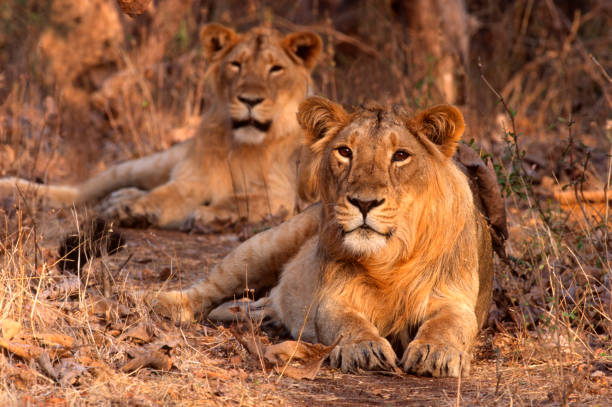
Gir National Park, also known as Sasan Gir, is a world-renowned wildlife sanctuary in Gujarat that serves as the sole natural habitat for the majestic Asiatic lion (Panthera leo persica). Established in 1965 in the former private hunting grounds of the Nawab of Junagarh, the park spans over 1,412 square kilometres, featuring a rugged landscape of dry deciduous forests, acacia scrub, and rocky hills. This critical ecosystem was instrumental in bringing the Asiatic lion back from the brink of extinction; the population has grown from fewer than 20 individuals in 1913 to an estimated 891 lions in the wild as of 2025. Beyond its famous lions, the park is a biodiversity hotspot home to over 40 species of mammals—including leopards, honey badgers, and the world’s only four-horned antelope (Chowsingha)—as well as more than 400 species of birds and 40 types of reptiles.
2. Kamleshwar Dam
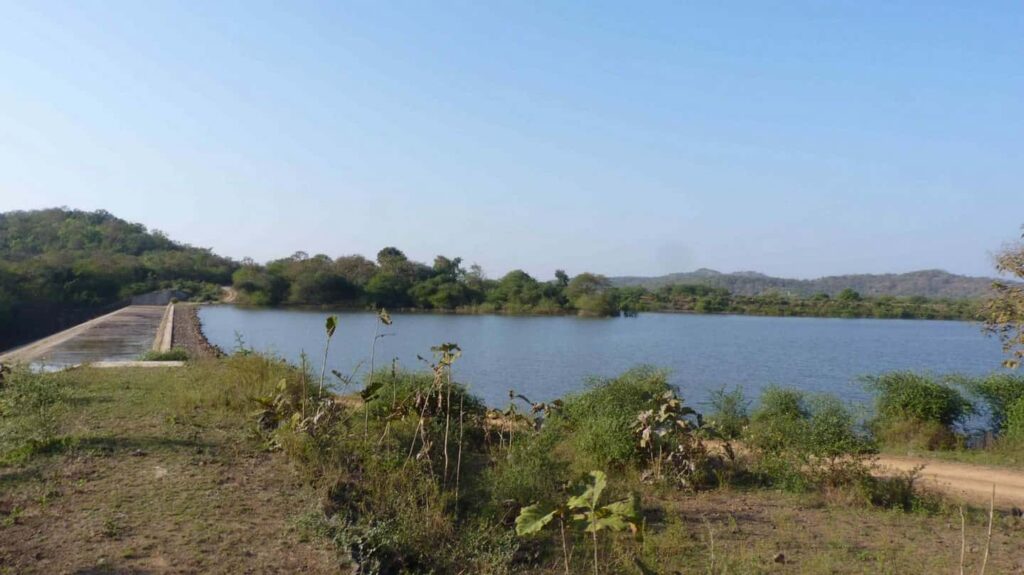
The Kamleshwar Dam, officially known as the Hiran-I Dam, is a critical water reservoir located at the heart of Gir National Park in Gujarat. Completed in 1959 on the Hiran River, it is widely regarded as the “Lifeline of Gir” because it serves as the primary permanent water source for the park’s diverse inhabitants, including the famous Asiatic lions, leopards, and various deer species. The dam creates a vast 8-square-kilometre reservoir that is globally renowned for hosting a prolific population of marsh crocodiles (muggers); visitors often spot these prehistoric reptiles basking on the banks or floating in the shimmering waters. Beyond its reptilian residents, the dam is a premier destination for birdwatching, attracting both resident and migratory species like pelicans and Indian skimmers, while an onsite watchtower provides tourists with a panoramic view of the surrounding forest canopy and distant settlements.
3. Durbar Hall Museum

The Durbar Hall Museum, also known as the Junagadh Museum, is a magnificent repository of royal history housed within the Taj Manzil Building, once the palace and courthouse of the Nawabs of Junagadh. Located in the heart of Junagadh, the museum showcases a lavish collection of approximately 2,900 artefacts from the 19th century, offering a vivid glimpse into the opulent lifestyle of the Babi dynasty. Its diverse galleries include a Picture Gallery featuring portraits and photographs of the last Nawab with his beloved dogs, as well as rooms dedicated to royal weapons, armour, and intricately designed textiles. The central attraction is the Darbar Hall itself, which has been preserved in its original setting as a royal assembly hall, complete with sparkling Bohemian chandeliers, silver-plated thrones, and a legendary hand-woven carpet created by inmates of the local jail. Among its rarest treasures is a silver-plated howdah (elephant saddle) adorned with mermaids and protected by a silver tiger, standing as a testament to the artistic grandeur of Gujarat’s princely past.
4. Nalsarovar Lake
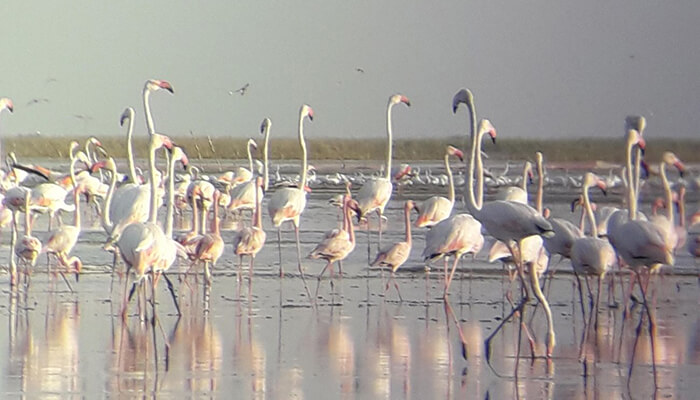
Nalsarovar Lake, situated approximately 64 km from Ahmedabad, is the largest wetland bird sanctuary in Gujarat and a designated Ramsar site of international importance. Spanning an area of 120 sq. km, this shallow freshwater lake and its surrounding marshes serve as a vital wintering ground for over 250 species of birds, many of which migrate thousands of kilometres from Siberia, Europe, and Central Asia. Visitors can witness spectacular congregations of flamingos, pelicans, rosy starlings, herons, and brahminy ducks particularly during the peak winter months. The sanctuary is also home to 360 small islets and is inhabited by the Padhar community, traditional boatmen and folk dancers who ferry tourists in hand-rowed country boats to observe the avian life up close. Beyond birdwatching, the area offers a unique cultural experience where you can enjoy local Kathiawari cuisine—such as Bajra no Rotlo and garlic chutney—on the islands, or explore the Abhiruchi Kendra interpretation centre to learn about migratory patterns.
5. Girnar Hills
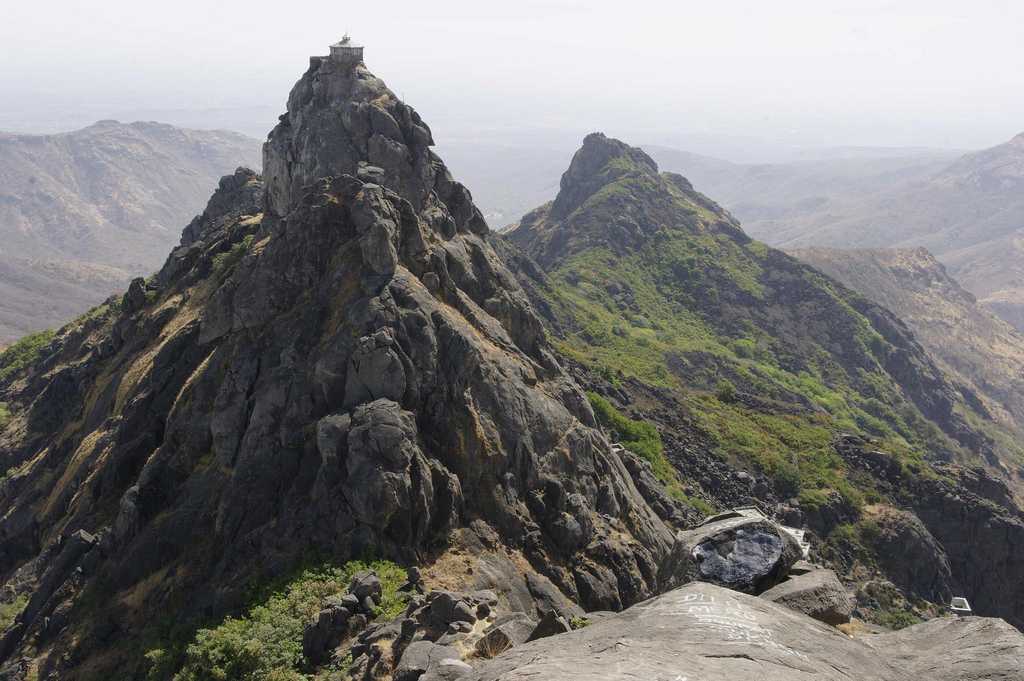
The Girnar Hills, located near Junagadh in Gujarat, are an ancient volcanic mountain range that predates the Himalayas and serves as one of India’s most significant pilgrimage sites for both Hindus and Jains. Standing as the highest point in Gujarat at 1,117 metres (3,672 ft), the hills are composed of five principal peaks: Ambaji, Gorakhnath, Guru Dattatreya, Oghad Ansuya, and Kalika. For Jains, the mountain is the sacred Nirvana Bhumi where the 22nd Tirthankara, Lord Neminatha, attained spiritual liberation; a massive 12th-century Jain temple complex is perched 4,000 steps up the mountain. Hindus revere the peaks as the abode of Guru Dattatreya, whose footprints are enshrined at the final summit, a feat traditionally reached by climbing a staggering 9,999 stone steps. The hills are also the site of the annual Girnar Parikrama and the Bhavnath Fair, where thousands of Naga Sadhus gather for a mystical celebration during Maha Shivaratri.
6. Kankai Mata Temple

The Kankai Mata Temple is a highly revered shrine located in the absolute heart of Gir National Park, approximately 25 km from Sasan Gir. Dedicated to Kankeshwari Mataji, the patron deity of many local communities, the temple offers a unique spiritual experience as it is one of the few places where humans can stay amidst the dense wilderness inhabited by Asiatic lions. The temple is situated on the banks of the Shingavada River, and it is a common, awe-inspiring sight for pilgrims to see lions and leopards coming to the riverbank to drink water near the temple premises. Because it is located deep within a protected forest zone, the journey to the temple itself serves as an unofficial jungle safari, requiring special permits from the forest department. To maintain the safety of both visitors and wildlife, private vehicles are only allowed during the day, and strict forest rules—such as no loud music and no wandering outside the temple walls after sunset—are enforced.
7. Devalia Safari Park
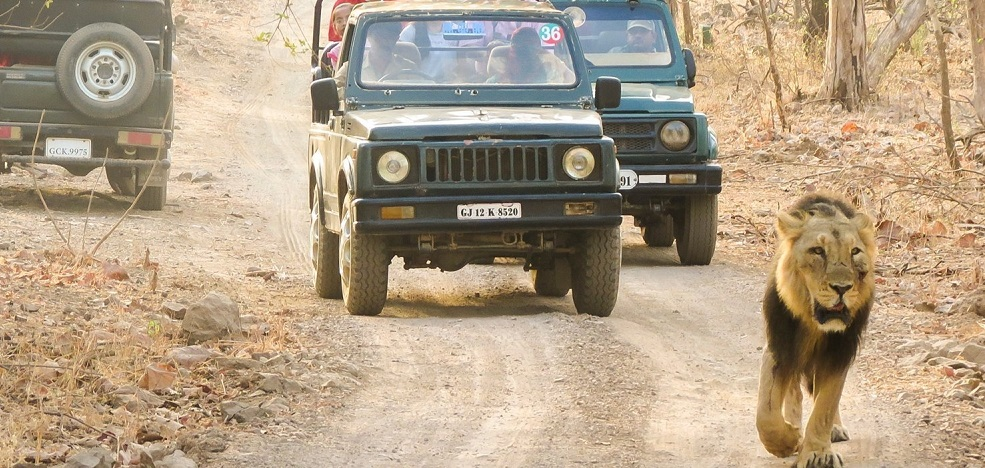
The Devalia Safari Park, also known as the Gir Interpretation Zone, is a 412-hectare fenced eco-tourism area designed to offer a “mini version” of the Gir forest. Established to reduce tourist pressure on the core sanctuary, it provides a structured environment where sightings of Asiatic lions and Indian leopards are highly probable, if not guaranteed. The park replicates the diverse habitats of Gir—including grasslands and woodlands—and is home to a variety of wildlife such as spotted deer, sambar, blue bulls, blackbucks, wild boars, and various bird species like vultures. Unlike the main Gir National Park, Devalia remains open during the monsoon season, making it the primary alternative for visitors when the core jungle trails are closed.
8. Uparkot Fort
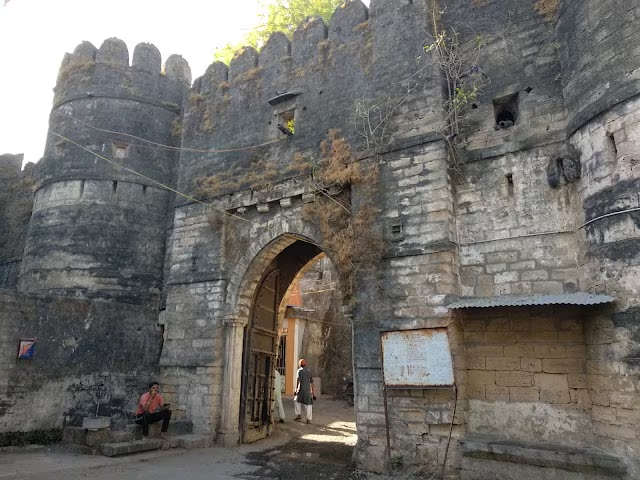
The Uparkot Fort is an ancient citadel perched on a plateau in the heart of Junagadh, Gujarat, believed to have been originally built by Chandragupta Maurya around 319 BCE. Over its 2,300-year history, the fort has survived 16 sieges, including one legendary unsuccessful siege that lasted for 12 years, earning it a reputation for matched resilience. Its formidable architecture features ramparts that reach up to 20 metres high and a complex entrance consisting of three distinct gateways. Inside the expansive complex, visitors can explore diverse historical treasures, such as the Uparkot Caves, which are 2nd–3rd century Buddhist monastic quarters carved into the rock, and the Jama Masjid, originally a palace that was converted into a mosque in the 15th century. The fort is also famous for two unique rock-cut stepwells: the circular, 41-metre-deep Adi Kadi Vav and the spiral-staircased Navghan Kuvo, both of which were essential for sustaining life during long sieges.
9. Somnath Temple
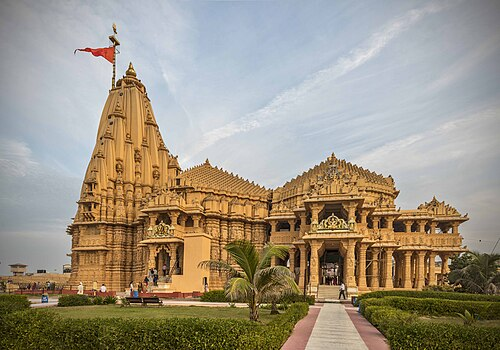
The Somnath Temple, located in Prabhas Patan near Veraval, Gujarat, is revered as the first of the twelve holy Jyotirlinga shrines of Lord Shiva and is known as the “Shrine Eternal” for its incredible history of destruction and resurrection. Situated at the holy Triveni Sangam (confluence of the Kapila, Hiran, and Saraswati rivers) on the Arabian Sea coast, the temple’s origins are rooted in mythology; legend says the Moon God (Soma) originally built it in gold to seek forgiveness and regain his lustre after a curse. Historically, the temple has been targeted, plundered, and demolished multiple times by various invaders, most notably by Mahmud of Ghazni in 1026 CE and later by the Delhi Sultanate and Mughal Emperor Aurangzeb. The current magnificent structure, built in the Māru-Gurjara (Chaulukya) style, was reconstructed following India’s independence under the vision of Sardar Vallabhbhai Patel and inaugurated in 1951 by President Dr. Rajendra Prasad. Its stunning architecture features a 155-foot-high spire (shikhara) and the unique Baan Stambh (Arrow Pillar), which famously indicates a straight, unobstructed sea route from the temple all the way to the South Pole (Antarctica).
10. Mahabat Maqbara Complex
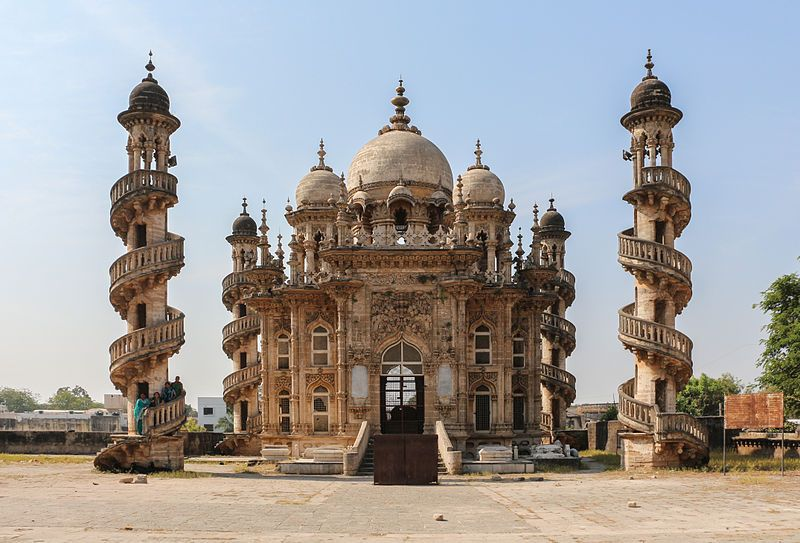
The Mahabat Maqbara Complex, located in the heart of Junagadh, Gujarat, is a breathtaking architectural marvel that showcases a unique “Indo-Euro-Islamic” fusion style. Built between 1878 and 1892, the complex houses the mausoleums of Mahabat Khan II, the Nawab of Junagadh, and his chief minister, Bahauddin Bhar. The site is world-famous for its stunning blend of Islamic domes, Gothic columns, and French-style windows, reflecting the diverse influences of the 19th-century princely state. Its most iconic feature is the Bahauddin Maqbara, which boasts four minarets surrounded by external spiral staircases that wrap around the towers like ribbons. Adorned with intricate stone carvings, silver-embossed doors, and grand onion-shaped domes, the complex stands as a testament to the opulent artistic vision of the Babi dynasty and remains one of the most photographed heritage sites in Gujarat.